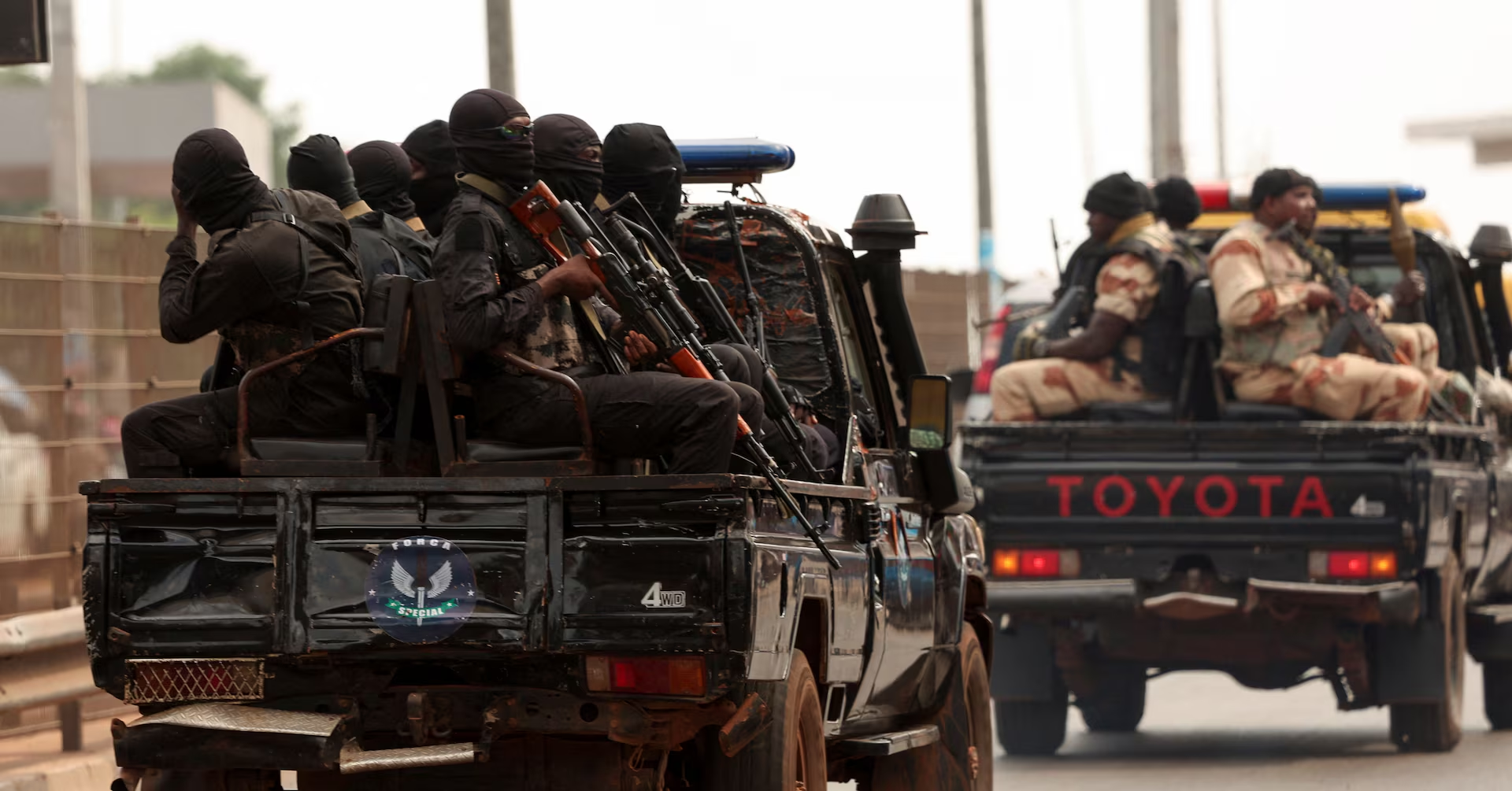
On 23 November 2025, the people of Guinea-Bissau queued for hours under the sun to choose their next president and parliament. Three days later, on 26 November, before the National Electoral Commission could publish the results, armed actors moved: soldiers surrounded key institutions, claimed “total control” of the country and halted the electoral process at gunpoint. On 27 November, the military high command installed Major-General Horta Inta-a Na Man as “transitional president” for a one-year period, while the deposed president, Umaro Sissoco Embaló, was escorted into exile. Call it a “staged coup”, a “self-coup” or a “corrective operation”, the label is irrelevant. What matters is the result: in the decisive hours after a national vote, the people’s verdict was hijacked at gunpoint.
By 29 November 2025, the African Union’s Peace and Security Council had suspended Guinea-Bissau from all AU activities, and ECOWAS had likewise condemned the takeover, suspended the country and demanded that the armed forces return to barracks and allow the announcement of the 23 November election results. This is not a minor constitutional hiccup. It is a direct attack on the fundamental right of citizens to choose and change their leaders, and a warning shot to every fragile democracy on the continent. If Guinea-Bissau’s coup, staged or “real”, is allowed to stand, it will become the new manual for incumbents and generals who want to cling to power while pretending to respect elections.
Africa simply cannot afford that. Not today, when we urgently need to focus on debt, jobs, climate, education and health, not on endless elite games in fatigues and suits. The African Union, ECOWAS and international partners must therefore draw a clear red line: this coup is illegal, illegitimate and intolerable. The 23 November election results must be published in full, an international investigation must expose the authors and sponsors, and sanctions must be so sweeping and personal that every potential putschist across the continent thinks twice before touching a ballot box or a constitution.

Here is my suggested roadmap in 7 points, that regional, continental and global institutions could act on urgently:
1. Staged or “real”, a coup is a coup, and it must not stand
Whether the events in Guinea-Bissau are labelled a “staged coup”, a “self-coup”, or a classic military takeover is a distraction. The bottom line is simple: armed actors intervened in the middle of an electoral process, blocked the announcement of results, dismantled constitutional institutions and installed a new authority by force. That is the textbook definition of an Unconstitutional Change of Government.
Africa, regional organizations and international partners must treat it as such: no recognition, no normalization, no excuses. Any government produced by this operation is born outside the constitution and should be treated accordingly.
Any attempt to “renegotiate” or massage the outcome in back rooms is not mediation; it is a continuation of the coup by other means. Democracy is not a menu you edit after seeing the numbers.
At most, there can be a very short, one-off exit window for the Guinean putschists: if, within a few days, they restore the elected authorities, allow the full publication of results, release detainees and return to their barracks, they can be considered for exemption from sanctions and prosecution. Beyond that narrow window, however, there should be no deals, no soft landing and no second chances.
2. We need an international investigation and real accountability
Guinea-Bissau cannot move forward on denial and amnesia. A time-bound, independent international commission of inquiry is essential to identify all those responsible:
- the uniformed officers who appeared on camera;
- the civilians who planned, financed or blessed the operation;
- and any foreign actors who enabled it.
This commission should be mandated jointly by the AU, ECOWAS and the UN, with:
- strong investigative powers and access to financial records;
- protection for witnesses and whistle-blowers;
- a clear path to justice, at national, regional or, if necessary, international level.
Impunity is the oxygen of every new putsch. That oxygen must be cut off.
3. Africa has anti-coup norms, let us enforce them
Africa is not starting from zero. The AU Constitutive Act, the Lomé Declaration and the African Charter on Democracy, Elections and Governance (ACDEG) are crystal clear: unconstitutional changes of government will not be tolerated.
The problem is not the law; it is the double standards. In some crises, suspension and sanctions are immediate and robust. In others, political convenience and geopolitical interests dilute the response. That inconsistency is one of today’s biggest coup enablers.
When putschists see that some regimes manage to negotiate their way to recognition, they learn the lesson. Guinea-Bissau must be the case where Africa finally proves that the rules apply to everyone, no matter the rank, the rhetoric or the foreign friends.
4. Sanctions: Travel bans, asset freezes and no safe havens
If Africa wants to stop coups, sanctions must hurt the right people, not the population. That means:
- Continent-wide travel bans on all coup leaders, their immediate families and key civilian sponsors – covering every AU and REC member state, with coordinated lists shared in real time. No shopping in Johannesburg, no medical trips in Tunis, no quiet conferences in Nairobi or Addis while citizens sit under military rule.
- Global travel bans aligned with the AU position, extending to Europe, the Americas, the Middle East and Asia. Putschists must know that any airport can become a point of arrest, not a transit lounge.
- Comprehensive asset freezes, targeting:
- bank accounts, companies and properties held by coup leaders and their associates;
- front companies and proxies used to hide wealth, including assets registered in the name of spouses, relatives, business partners or shell firms. Where necessary, beneficial-ownership investigations should be launched to expose these networks.
- A business blacklist: firms, lobbyists and political consultants who knowingly facilitate or profit from coup-born regimes should also face sanctions and exclusion from public contracts and international financing.
These measures must be automatic and coordinated: once the AU and ECOWAS determine that an Unconstitutional Change of Government has occurred, a standard sanctions package should be triggered within days, not debated for months. No more ad hoc bargaining, no more selective outrage.

5. Declare coups a serious crime with no prescription
Africa must also send a clear legal message: a coup is not just a political event; it is a crime, and one that should carry no statute of limitations.
- National laws, the AU legal framework and REC protocols should recognize the orchestration or support of an Unconstitutional Change of Government as a serious offense, comparable to high-level corruption or grave violations of constitutional order.
- Those responsible should remain permanently liable to prosecution, even after they leave office or flee abroad. Time should not wash away the crime.
- Amnesty deals that shield coup leaders from accountability should be strictly limited and subject to continental scrutiny; they must not become the default escape route.
By declaring coups a crime with no prescription, Africa would send a simple signal: even if you outlast this sanctions cycle, the knock on the door can still come in five, ten or twenty years. There will be no safe retirement for those who gain power by breaking the constitutional order.
6. This is about Africa’s economic and social future
Every coup, whether dressed up as “correction”, “transition” or “staged drama”, is a tax on Africa’s future. It scares away investment, deepens debt distress, fuels capital flight, weakens institutions and diverts energy from the real work such as creating jobs and decent livelihoods, reforming economies and fixing broken tax and debt systems, investing in health, education and climate resilience.
Guinea-Bissau is a fragile country that cannot afford yet another cycle of elite games between politicians, generals and traffickers. But the same is true across the continent.
The path forward is clear:
- ECOWAS and the AU must maintain suspension of Guinea-Bissau and refuse to recognize coup-born authorities.
- The election results must be published in full, with international support.
- An independent international investigation must establish the truth and trigger tough, personal sanctions travel bans, asset freezes and legal proceedings.
- The AU and RECs must update the definition of coups, make sanctions automatic, and treat coups as crimes with no statute of limitations.
At this moment, Africa can no longer tolerate coups, in khaki or in suits, while a whole generation waits for economic opportunity and social justice. Guinea-Bissau is not only a national crisis; it is a continental test.
If Africa stands firm here, together with its regional economic communities and global partners, it will send a powerful message: the age of playing games with the people’s will is over, and those who try will pay a permanent price.
7. Constitutional term-limit manipulation is also a coup
One of the most urgent debates Africa must stop dodging is this: when a leader changes the constitution to stay in power indefinitely, is that not also a coup? The African Charter on Democracy, Elections and Governance already gives us the answer. Article 23 is explicit that an Unconstitutional Change of Government includes any amendment or revision of the constitution or legal instruments that undermines the principles of democratic change of government.
In plain language, when incumbents abolish or reset term limits, rewrite electoral rules just before a vote, or redesign institutions so that alternation becomes impossible in practice, they are not “reforming” the system, they are seizing by legal means what generals seize by force of arms.
If we want citizens to take continental norms seriously, the African Union and Regional Economic Communities must say, clearly and publicly: unlimited term obtained by dismantling term limits is not more legitimate than a coup d’état, it is a constitutional coup. The same sanctions we demand for military putschists, suspension, travel bans, asset freezes and long-term political ineligibility, should also apply to leaders and coalitions that mutilate constitutions to rule for life. Otherwise, we send a disastrous message to African citizens: that the soldier who breaks the door with a gun is condemned, but the politician who quietly locks it from the inside is rewarded.
If you’d like to receive my articles automatically as soon as they’re published, simply follow this blog using the “Follow” button at the bottom left of this page or send me an email at: Desire.Assogbavi@Assodesire.com
 Assodesire