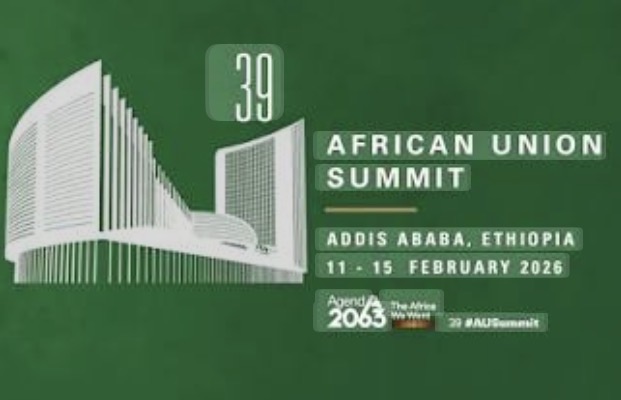
When African Heads of State and Government convene in Addis Ababa on 14-15 February 2026 for the 39th Ordinary Session of the Assembly of the African Union, they will do so at a moment of exceptional political gravity for the continent and the international system.
The Summit comes against a backdrop of intensifying global fragmentation, shrinking multilateralism, escalating conflicts, deepening debt distress, and growing climate stress. Despite the official Theme of the Year on water, peace and security is likely to sit at the center of gravity of this gathering, as escalating conflicts, regional instability, and fragile political transitions continue to dominate Africa’s political reality.
Across Africa, democratic and Human Rights regression, contested elections, repression of dissent, and prolonged states of emergency are testing the credibility of governance institutions.
At the same time, Africa’s strategic importance, driven by critical minerals, demographic weight, and geopolitical competition has never been higher, increasing both external pressure and internal fragmentation.
In this context, the 2026 Summit is not just a routine gathering. It is a test of Africa’s collective political agency, its capacity to act with unity, and the relevance of the African Union as a forum for continental leadership.
Water as Power: Climate, Development, and Political Stability
The AU Theme of the Year 2026, “Water as a Vital Resource for Life, Development and Sustainability”, reflects a deliberate political choice. Water is no longer treated as a technical or sectoral issue; it is increasingly understood as a strategic economic, social, and security asset.
Across Africa, climate change is manifesting through prolonged droughts, catastrophic floods, declining agricultural productivity, urban water stress, food price volatility, and heightened public health risks. Water scarcity and mismanagement are already contributing to local conflicts, forced displacement, and cross-border tensions, while water abundance, when poorly governed, can also fuel inequality and elite capture.
The AU Commission has framed the 2026 theme as delivery-oriented, anchored in Agenda 2063, with a focus on water security, climate adaptation, WASH and sanitation as questions of dignity, public health, and state legitimacy.
Reparations: From Moral Claim to Institutionalized Political Project
Alongside the 2026 water theme, the Summit will decisively advance the AU’s 2025 Theme on “Justice for Africans and People of African Descent through Reparations.”
Crucially, Heads of State will consider a landmark legal and political study examining the implications of defining colonization as a crime against humanity and characterizing certain acts of slavery, deportation, and colonial violence as genocide against African peoples.
This marks a historic shift from symbolic recognition to legal framing, norm-setting, and institutional responsibility under international law.
The AU has already taken some steps to operationalize this agenda. Dedicated expert and legal reference mechanisms have been established and are now functional, coordinated by the AU Commission through system-wide structures. Partnerships with CARICOM, the United Nations, and civil society have deepened, while reparations language has, for the first time, entered formal intercontinental declarations.
By extending the reparations agenda into a 2026-2035 Decade, Africa is signaling that reparatory justice is not an episodic diplomacy, but a long-term political project linking debt justice and illicit financial flows, climate loss and damage, cultural restitution and narrative justice, reform of global governance and financial systems.
The credibility test now lies in follow-through: whether the AU can translate moral authority into coordinated diplomacy, concrete mandates, and measurable outcomes.
Africa, the G20, and the Politics of Conditional Multilateralism
Africa’s growing role in global governance will also be under close scrutiny. The Assembly will receive a formal briefing on the outcomes of South Africa’s 2025 G20 Presidency, a milestone that symbolized Africa’s leadership into the world’s most powerful economic forum, the G20.
Yet this progress now faces controversy around President Trump’s decision not to invite South Africa to the 2026 G20 Leaders’ Summit., raising concerns about selective multilateralism and political conditionality.
This episode is bigger than South Africa. It is a test of African solidarity and a warning signal: if African participation in global governance is contingent on political alignment with powerful states, then Africa’s seat at the table remains precarious.
How the AU responds, or remains silent, will shape its collective credibility, not only within the G20 but across broader multilateral reform debates.
Peace and security: the Summit’s Political Gravity Center
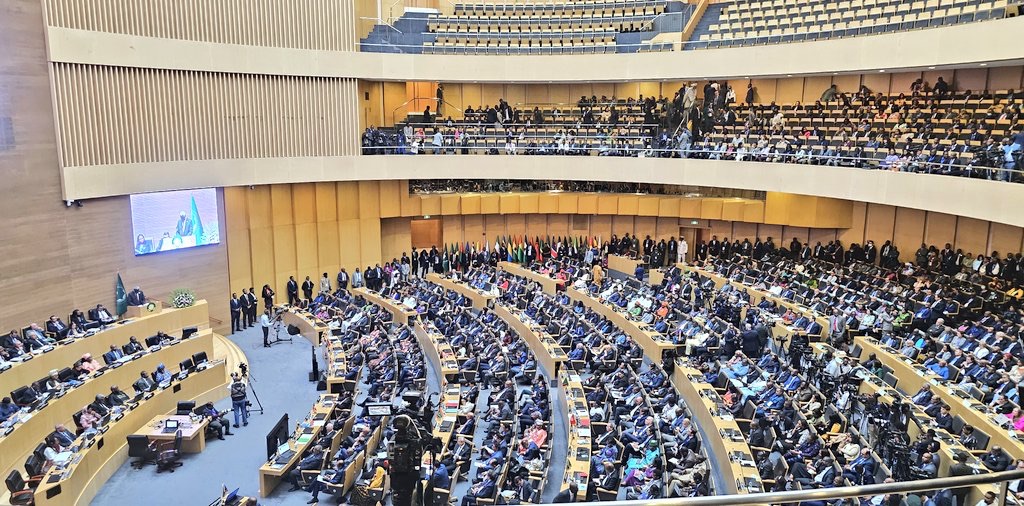
Peace and security will remain the Summit’s political gravity center. Ongoing conflicts in Sudan, eastern Democratic Republic of Congo, the Sahel, and Libya continue to inflict devastating civilian harm while exposing the limits of fragmented mediation, militarized responses, and externalized security solutions.
The Assembly will consider the Peace and Security Council’s annual report, and a Heads-of-State-level PSC engagement during Summit week is likely, an acknowledgment of the severity of the moment.
Here, the AU confronts a familiar but urgent dilemma: the gap between strong normative frameworks and weak, inconsistent enforcement. The real test will be whether the AU can advance and African-led political solutions rather than outsourced mediation; civilian protection and accountability over narrow stability fixes; and an inclusive peace process that center women, youth, and affected communities.
The assumption of the AU Chairmanship by the Burundian’s President for 2026 will shape the tone of this engagement, with expectations that the Chair will not only act as a bridge-builder across regional and political divides, but also defend and project Africa’s collective agency on the global stage, asserting continental positions, resisting external pressure, and ensuring that Africa engages international partners from a position of unity and strategic confidence.
Burundian President Évariste Ndayishimiye is actively preparing for his term. His mandate will likely be anchored in a strategy of diplomatic normalization, political assertion, and engagement on the continent’s major security files, with particular attention to the crises in the Great Lakes region and the Sahel. Drawing on his recent experience as Chair of the East African Community and COMESA, as well as his current role as the AU’s Special Envoy for the Sahel, President Ndayishimiye is reported to have begun structuring a dedicated team in Addis Ababa, supported by an interministerial coordination mechanism in Bujumbura.

Conclusion
The 2026 Summit is an important moment for Africa’s continental project. It will test whether the African Union can effectively respond to intersecting crises human rights, democratic backsliding, armed conflict etc with coherence, unity, and political courage.
I also hope that African leaders will seize this Summit as a rare moment for frank, strategic reflection on the geopolitical hurricane reshaping the world, and on what it demands of Africa collectively. The erosion of multilateralism, the selective application of international law, intensifying great-power competition, and a renewed scramble for African resources are not distant forces; they are already constraining Africa’s policy space and exposing divisions across the continent. This gathering offers an opportunity not only to diagnose these shifts, but to agree on shared positions, red lines, and collective strategies that strengthen African solidarity, protect sovereignty, and enhance Africa’s leverage. Without such deliberate coordination, individual states will continue to absorb global shocks alone while the continent as a whole, risk being shaped by decisions made elsewhere rather than acting as a coherent force in a turbulent world.
Overall, the Summit should not be just about decisions and declarations adopted in closed sessions. African citizens are waiting to see whether the Africa’s premier multilateral institution can convert ambition into actions, moral clarity into leverage, and principles into durable political change.
 Assodesire