Politics, Economics, and Geopolitical Repositioning
“Amandla! Aweetu!” (“Power to the people!”).
This slogan resonating deeply through South Africa’s history echoed throughout our Open Society Foundation Team Learning Tour in Johannesburg this week. Over a few days of rich interaction with community leaders, political analysts, activists, and ordinary citizens, one thing became clear: the struggle for genuine freedom and dignity in South Africa is far from over.
South African Democracy at 30: Gains and Pains

South Africa reaches three decades of democracy, marked by the end of apartheid and the rise of the African National Congress (ANC). Yet, this period is not celebrated unanimously.
As we engaged with local experts, social activists and ordinary citizens this pressing question emerged repeatedly: “Can we truly say we are free today?” Alarmingly, many South Africans we encountered felt democracy’s dividends remain elusive, summarizing their experiences by stating, “30 years of democracy have been painful, paid for in blood.”
While the advent of democracy signaled hope and equity, many comrades cited the erosion of trust in public institutions as democracy’s core crisis. Corruption, nepotism, and government inefficiency have fostered deep-rooted cynicism. One of the political experts we met, pointed out that liberation movements in Southern Africa are witnessing dramatic declines in public support precisely because they failed to deliver on their democratic promises. South Africa is no exception, with the ANC’s electoral dominance notably declining in recent years.
From Chains to Change: Our Inspiring Journey at South Africa’s Constitutional Court

Our visit to South Africa’s Constitutional Court as part of our Learning Tour was deeply moving; a reminder of how far this country has journeyed. More than just a court of law, the Constitutional Court is a living testament to South Africa’s courageous transformation from the shadows of apartheid to the light of democracy.
Built on the grounds of a former prison where countless men and women were unjustly imprisoned for their political beliefs or simply because of their race, the Constitutional Court stands today as a powerful symbol of redemption and resilience. Its walls, crafted from the very red bricks that once enclosed prisoners, represent a profound act of reclaiming pain, transforming it into purpose, and embracing the lessons of history to shape a brighter future.
Holding our meetings at Constitution Hill reinforced our belief in justice; not merely as a principle to uphold, but as a profound human experience to embody. This space remains a beacon of hope, dignity, and strength, reminding us that true justice must not only be delivered; it must be felt, deeply and unambiguously, by every citizen.
Coalition Politics and New Agendas
Amid declining single-party dominance, South Africa is increasingly governed by coalitions. Experts we engaged with noted that coalitions, while turbulent, also present unique opportunities for the voices of marginalized communities and social movements to influence policy agendas.
Yet, despite this opportunity, coalitions are still dominated by elites. “Even in coalitions, governments are still governments of elites”: said one of the invited experts. For social movements to effectively influence policies, they must become key stakeholders rather than merely beneficiaries of political gestures.
South African Economy: A Story of Unfulfilled Promises and Deepening Inequality
The economic realities we witnessed in South Africa underscore a troubling stagnation, sharply divided along racial and social lines. Today, over half of South Africans, more than 30 million people, live in poverty, struggling daily with food insecurity and inadequate housing. Youth unemployment escalated from 36.8% in 2014 to 45.5% in 2024, but this figure skyrockets to nearly 70% among black youth, who continue to bear the brunt of economic exclusion.

Townships like Phola in eMalahleni, Mpumalanga Province, are surrounded by mines exploitations and power plants, yet residents suffer regular power outages and water shortages. Local hospitals and clinics, often under-resourced and overcrowded, fail to adequately serve communities battling chronic illnesses caused by pollution and poor sanitation.
During our visit to coal-affected communities in Mpumalanga, residents expressed deep concerns regarding government’s proposed “just energy transition.” Community members expressed fears over employment instability. Coal mining currently sustains thousands of jobs in the region; however, transitioning to renewable sectors such as solar energy might drastically reduce available employment. Residents highlighted specific anxieties about job numbers, noting that while mines employ large workforces, proposed solar projects might offer only a handful of positions. This stark contrast underscores their apprehension about economic security and stability.
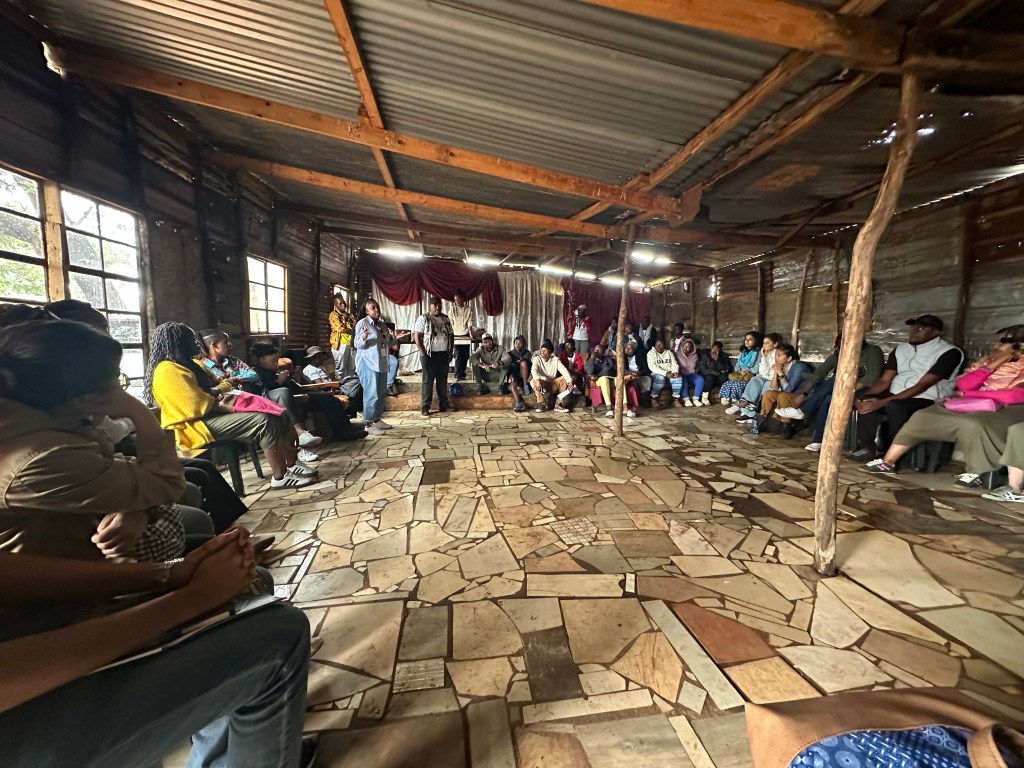
Additionally, communities raised significant issues around engagement and information-sharing. They felt largely excluded from discussions shaping their future, with critical details about the energy transition rarely reaching beyond small groups. The harsh realities were voiced clearly by a young leader in Phola who sharply criticized plans for a transition from coal to hydrogen energy. He described the proposed “just transition” as “a scam,” arguing passionately that such policies exclude local communities, who fear even higher levels of unemployment and deeper poverty.
Community skepticism was fueled not by resistance to scientific change but by a historical mistrust rooted in persistent structural injustices and exploitation. Residents emphasized that meaningful participation, genuine transparency, and clear communication from authorities are crucial for any transition to be truly “just” and inclusive.
Progress Amidst Inequality: Foundations of South Africa’s Post-Apartheid Development
Despite significant ongoing challenges, South Africa has made notable strides in economic and social development since the end of apartheid. The mining sector, historically pivotal, laid the foundations for the country’s modern economy, facilitating important regional economic linkages through remittances and industrial supply chains. Revenue generated from mining and related industries has enabled substantial public investments, notably in social protection programs such as social grants, which support millions of vulnerable South Africans. Additionally, progress has been made in expanding basic infrastructure, improving access to health services, education, water, and electricity for large segments of the population previously excluded from such essential services. Although these systems currently face considerable strain, their establishment represents meaningful advancements towards social equity and economic inclusivity.
Supporting Social Movements: The Power of People
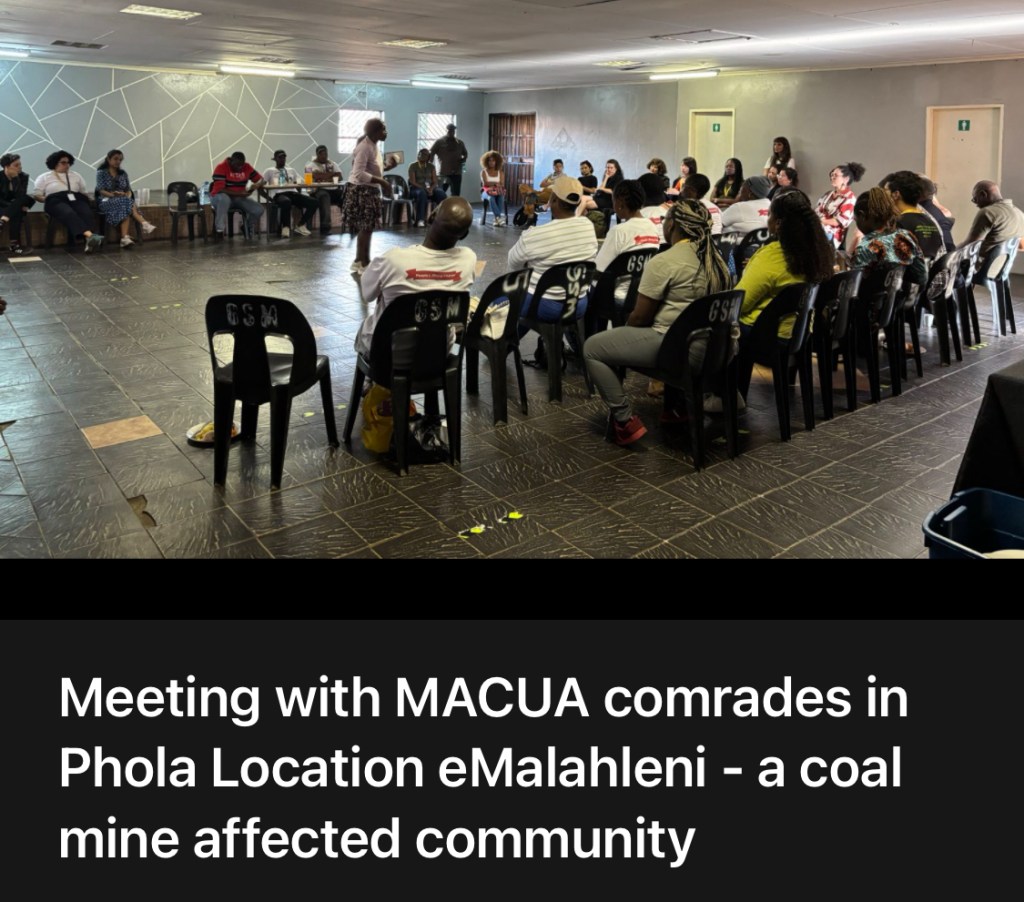
Social movements represent the real heartbeat of South Africa’s democratic potential. Organizations such as MACUA (Mining Affected Communities United in Action), a nationwide radical network, highlight this power strongly. MACUA is driving grassroots resistance to exploitation by mining corporations, challenging corruption, and pushing for accountability in community consultations.
Our discussions with MACUA representatives stressed the importance of authentic partnerships with social movements. As articulated by activist leaders: “We want partners to walk side by side with us, not ahead of us.”
They further urge partner to:
- Invest in building community capacity to advocate autonomously for their rights.
- Facilitate platforms where marginalized community voices inform policy decisions, especially regarding environmental justice and economic transitions.
Their powerful stance reflects a broader desire for autonomy, dignity, and effective participation in decision-making processes.
Land, Justice, and Economic Reform: Reclaiming Dignity
One of our resource persons, brought our attention to the enduring challenge of land justice; calling landlessness an engineered crisis born of centuries of settler colonialism. The prolonged legacy sees up to 72% land ownership still concentrated within a small white minority, causing indignity for millions.
The absence of meaningful economic reform further entrenches inequality. South Africa, once heavily reliant on mining, has struggled to diversify and democratize its economic base. Advocates demand comprehensive policies geared toward economic redistribution and genuine transformation, insisting that “Land reform has become land management; what we need is land justice.”
The way Forward: Inclusive Prosperity
Our learning tour crystallized a critical realization: South Africa is at a crossroads. Coalition politics, economic diversification, just energy transitions, and geopolitical repositioning must be leveraged to genuinely include marginalized communities. Unity governance cannot be superficial; it must empower communities, enabling them to reclaim their agency and dignity.
The journey towards genuine democracy and sustainable development in South Africa continues. As we concluded our visit, reflecting on diverse narratives shared with us, it became clear that South Africa’s future rests not only in policy frameworks or electoral politics but fundamentally in the strength and resilience of its people and their persistent struggle for a truly inclusive, just, and prosperous society.
Amandla! Aweetu! Power indeed belongs to the people.

 Assodesire