AU Summit 2026: What Is at Stake for Africa in a Fractured World

La version en Français ici

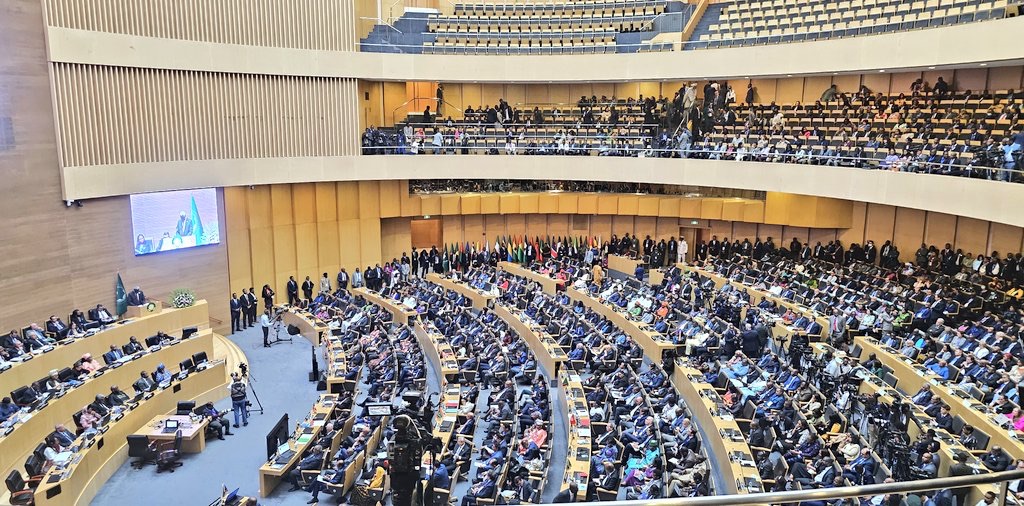
When African Heads of State and Government convene in Addis Ababa on 14-15 February 2026 for the 39th Ordinary Session of the Assembly of the African Union, they will do so at a moment of exceptional political gravity for the continent and the international system.

The Summit comes against a backdrop of intensifying global fragmentation, shrinking multilateralism, escalating conflicts, deepening debt distress, and growing climate stress. Despite the official Theme of the Year on water, peace and security is likely to sit at the center of gravity of this gathering, as escalating conflicts, regional instability, and fragile political transitions continue to dominate Africa’s political reality.

 Across Africa, democratic and Human Rights regression, contested elections, repression of dissent, and prolonged states of emergency are testing the credibility of governance institutions.

At the same time, Africa’s strategic importance, driven by critical minerals, demographic weight, and geopolitical competition has never been higher, increasing both external pressure and internal fragmentation.

In this context, the 2026 Summit is not just a routine gathering. It is a test of Africa’s collective political agency, its capacity to act with unity, and the relevance of the African Union as a forum for continental leadership.
Water as Power: Climate, Development, and Political Stability

The AU Theme of the Year 2026, “Water as a Vital Resource for Life, Development and Sustainability”, reflects a deliberate political choice. Water is no longer treated as a technical or sectoral issue; it is increasingly understood as a strategic economic, social, and security asset.

Across Africa, climate change is manifesting through prolonged droughts, catastrophic floods, declining agricultural productivity, urban water stress, food price volatility, and heightened public health risks. Water scarcity and mismanagement are already contributing to local conflicts, forced displacement, and cross-border tensions, while water abundance, when poorly governed, can also fuel inequality and elite capture.

The AU Commission has framed the 2026 theme as delivery-oriented, anchored in Agenda 2063, with a focus on water security, climate adaptation, WASH and sanitation as questions of dignity, public health, and state legitimacy.

Reparations: From Moral Claim to Institutionalized Political Project

Alongside the 2026 water theme, the Summit will decisively advance the AU’s 2025 Theme on “Justice for Africans and People of African Descent through Reparations.”

Crucially, Heads of State will consider a landmark legal and political study examining the implications of defining colonization as a crime against humanity and characterizing certain acts of slavery, deportation, and colonial violence as genocide against African peoples.

This marks a historic shift from symbolic recognition to legal framing, norm-setting, and institutional responsibility under international law.

The AU has already taken some steps to operationalize this agenda. Dedicated expert and legal reference mechanisms have been established and are now functional, coordinated by the AU Commission through system-wide structures. Partnerships with CARICOM, the United Nations, and civil society have deepened, while reparations language has, for the first time, entered formal intercontinental declarations.

By extending the reparations agenda into a 2026-2035 Decade, Africa is signaling that reparatory justice is not an episodic diplomacy, but a long-term political project linking debt justice and illicit financial flows, climate loss and damage, cultural restitution and narrative justice, reform of global governance and financial systems.

The credibility test now lies in follow-through: whether the AU can translate moral authority into coordinated diplomacy, concrete mandates, and measurable outcomes.

Africa, the G20, and the Politics of Conditional Multilateralism

Africa’s growing role in global governance will also be under close scrutiny. The Assembly will receive a formal briefing on the outcomes of South Africa’s 2025 G20 Presidency, a milestone that symbolized Africa’s leadership into the world’s most powerful economic forum, the G20.

Yet this progress now faces controversy around President Trump’s decision not to invite South Africa to the 2026 G20 Leaders’ Summit., raising concerns about selective multilateralism and political conditionality.

This episode is bigger than South Africa. It is a test of African solidarity and a warning signal: if African participation in global governance is contingent on political alignment with powerful states, then Africa’s seat at the table remains precarious.

How the AU responds, or remains silent, will shape its collective credibility, not only within the G20 but across broader multilateral reform debates.
Peace and security: the Summit’s Political Gravity Center

Peace and security will remain the Summit’s political gravity center. Ongoing conflicts in Sudan, eastern Democratic Republic of Congo, the Sahel, and Libya continue to inflict devastating civilian harm while exposing the limits of fragmented mediation, militarized responses, and externalized security solutions.

The Assembly will consider the Peace and Security Council’s annual report, and a Heads-of-State-level PSC engagement during Summit week is likely, an acknowledgment of the severity of the moment.

Here, the AU confronts a familiar but urgent dilemma: the gap between strong normative frameworks and weak, inconsistent enforcement. The real test will be whether the AU can advance and African-led political solutions rather than outsourced mediation; civilian protection and accountability over narrow stability fixes; and an inclusive peace process that center women, youth, and affected communities.

The assumption of the AU Chairmanship by the Burundian’s President for 2026 will shape the tone of this engagement, with expectations that the Chair will not only act as a bridge-builder across regional and political divides, but also defend and project Africa’s collective agency on the global stage, asserting continental positions, resisting external pressure, and ensuring that Africa engages international partners from a position of unity and strategic confidence.

Burundian President Évariste Ndayishimiye is actively preparing for his term. His mandate will likely be anchored in a strategy of diplomatic normalization, political assertion, and engagement on the continent’s major security files, with particular attention to the crises in the Great Lakes region and the Sahel. Drawing on his recent experience as Chair of the East African Community and COMESA, as well as his current role as the AU’s Special Envoy for the Sahel, President Ndayishimiye is reported to have begun structuring a dedicated team in Addis Ababa, supported by an interministerial coordination mechanism in Bujumbura.

Conclusion

The 2026 Summit is an important moment for Africa’s continental project. It will test whether the African Union can effectively respond to intersecting crises human rights, democratic backsliding, armed conflict etc with coherence, unity, and political courage.

I also hope that African leaders will seize this Summit as a rare moment for frank, strategic reflection on the geopolitical hurricane reshaping the world, and on what it demands of Africa collectively. The erosion of multilateralism, the selective application of international law, intensifying great-power competition, and a renewed scramble for African resources are not distant forces; they are already constraining Africa’s policy space and exposing divisions across the continent. This gathering offers an opportunity not only to diagnose these shifts, but to agree on shared positions, red lines, and collective strategies that strengthen African solidarity, protect sovereignty, and enhance Africa’s leverage. Without such deliberate coordination, individual states will continue to absorb global shocks alone while the continent as a whole, risk being shaped by decisions made elsewhere rather than acting as a coherent force in a turbulent world.

Overall, the Summit should not be just about decisions and declarations adopted in closed sessions. African citizens are waiting to see whether the Africa’s premier multilateral institution can convert ambition into actions, moral clarity into leverage, and principles into durable political change.

African Union Summit in Niger: Historic Rendezvous!

Last update: 1st July 2019

The African Union Heads of State will hold an extraordinary Summit on the African Continental Free Trade Area (AfCFTA) on the 7th July 2019 in Niamey, Niger. The Summit will be dedicated to the launch of the operational phase of the AfCFTA as well as its operational instruments.

The extraordinary Summit will be held in the margins of the inaugural session of the Mid-Year Coordination Meeting of the African Union and the Regional Economic Communities (8th July) that replaces the previous mid-year AU Summit, as decided within the framework of the ongoing African Union reform.

The Executive Council of the AU (Ministers of Foreign Affairs) will have its ordinary session on the 4th & 5th July on the same occasion deliberate on important documents and reports of AU organs including most likely the 2020 budget of the Union the legal documents of the new African Union Development Agency (AUDA-NEPAD), the theme of the year 2020 among other things.

In this personal blog I am sharing an overview of the key items on the Agenda of these important gatherings, the outcome of which would be a big step toward the  implementation of the Agenda 2063, the Africa we want.

The Launch of the African Continental Free Trade Area: What Expectations?

The Treaty establishing the African Continental Free Trade Area aims to 1/ Create a single continental market for goods and services, with free movement of business persons and investments, therefore, pave the way for accelerating the establishment of a continental customs union, 2/ Expand intra-Africa trade through better harmonization and coordination of trade liberalization, facilitation regimes and instruments across the continent, 3/ Resolve the challenges of multiple and overlapping memberships and expedite the regional and continental integration processes , 4/Enhance competitiveness at the industry and enterprise level through exploiting opportunities for scale production, continental market access and better reallocation of resources in Africa.

The African Continental Free Trade Area then provides an opportunity to promote policies  and resources that could create conditions for harnessing Africa demographic dividend in the context of creating space for jobs, especially for the youth and economic diversification. This requires attention to expediting domestic capital formation and using capital market strategies to drive the creation and expansion of small and medium enterprises involving youth ownership.

If genuinely implemented, the AfCFTA will provide a framework to ease the cost of doing business within Africa. It will aggregate the very fragmented African market  but,… will the continent quickly address non-tariff barriers, such as infrastructure backlogs, border corruption, poor communication means etc? Above all I am also wondering if we have enough to trade among ourselves with this ambitious trade agreement while our economies are mostly alike and largely dominated by the exportation of raw material. To take full advantage of the AfCFTA African leaders should deliberately and aggressively invest in industrialization without waiting. An initial focus should be on agriculture and agro-industry development.

The Agreement establishing the African Continental Free Trade Agreement (AfCFTA) entered into force on 30th May 2019 for the 24 countries that ratified it. 52 of the 55 AU Member states signed the AfCFTA. Only Benin, Eritrea and Nigeria have not signed the Treaty. If fully ratified, the AfCFTA will open the largest free trade zone in the world with a collective GDP of over $3 trillion and more than 1.2 billion consumers. AfCFTA is expected to boost intra-Africa trade, which accounts roughly for 17% only of all the continent’s exports. The UN Economic Commission for Africa (UNECA) has estimated that intra-Africa trade would likely increase to 52.3 % by 2020 due to the AfCFTA.

The Extraordinary Summit

Hotel Niamey

Beside the launch of the operational phase of the AfCFTA, the AU Summit’s delegations to be hosted in the newly built Radisson Blu Hotel of Niamey are expected to launch the following operational instruments of the treaty.

  • Rules of Origin Portal
  • Tariff Concession Portals
  • Portal on Monitoring and Elimination of Non-Tariff Barriers
  • Digital Payments and Clearing System
  • African Trade Observatory Dashboard

The Niamey Summit will surely be one of the most attended  AU Summit by Heads of State and other personalities in recent time.  Special guests will likely include the Secretary General of the United Nations António Guterres, the Director General of the World Trade Organization, Roberto Azevêdo, the Secretary General of the United Nations Conference on Trade and Development Dr.  Mukhisa Kituyi, the President and Chairman of the Board of Directors of the African Export–Import Bank (AFREXIMBANK) Professor  Benedict Okey Oramah, the Executive Director of International Trade Center Dr. Arancha Gonzalez, the European Commissioner for International Cooperation and Development Neven Mimica among others.

The Summit will also consider and approve a set of other decisions coming from the Executive Council as part of the reform of the African Union.

On the Agenda of the Executive Council

The Ministers of Foreign Affairs will most likely discuss and eventually make decisions on the following:

  • The legal instruments of the new African Union Development Agency – NEPAD including the statutes and the rules of procedures of its governing structures
  • The new statutes of the African Peer Review Mechanism (APRM)
  • AU budget for 2020: the current draft budget is around 647 Million USD, more than 60% of which will be paid by external partners
  • The Theme of the year 2020. The current proposal is:“Silencing the Guns: Creating Conducive Conditions for Africa’s Development”
  • The Implementation of Agenda 2063
  • The African Court on Human and People’s Rights
  • The African Commission on Human and People’s Rights
  • The Challenges and Ratification/Accession and Implementation of the OAU/AU Treaties and decisions

In addition the Council will consider the agenda, working documents and expected outcomes of the Mid-Year Coordination Meeting of the African Union and the Regional Economic Communities.

Discussions and decisions on the new departmental structure of the AU Commission in the framework of the African Union reform will likely be differed  to the February 2020 Summit.

Several side events are also on the Summit agenda.

The Mid-Year Coordination Meeting of the African Union and the Regional Economic Communities: The way forward toward Effectiveness and Efficiency?

au-summit_banners_july2019_website

From now on, according to a decision of the Assembly of the Union, there will be only one ordinary AU Summit per year instead of the two Summits previously held. The Mid-year Summit has now become a Coordination Meeting with the Regional Economic Communities (RECS). The Permanent Representatives Committee (Ambassadors) and the Executive Council of the Union will normally convene as before, prior to the Coordination Meeting. In Niamey, the rules of procedure of the coordination meeting will be considered and eventually adopted. The Mid-Year Coordination Meeting will normally be the highest committee for the African Union and RECs to align their work and coordinate the implementation of the continental integration agenda. The rules of procedures to be discussed in Niamey will define the composition of the gathering, criteria for participation, the running of its business, powers and decision making mechanisms. These policies would have to be adopted ultimately by the Assembly of the Union.

Regional Economic Communities (RECs) are regional groupings of African States each lead by a Head of State or Government on a rotational basis.  Currently the African Union recognizes 8 RECs from the 5 geographical regions of the continent. They are seen as the building blocks of the African Union in its economic integration process. The 8 RECs are: AMUCEN-SADCOMESAEACECCASECOWASIGAD and SADC.

The RECs work more and more closely with the African Union and are expected to serve their member States with the implementation of the regional integration agenda. The RECs were formed on either historical, political or economic basis. Their members are generally of more than one regional economic community and they operate at different levels of capacity and efficiency. You can read more about the RECs here.

The launch of the mid-year coordination meeting between the AU and the RECs carries the hope to deal with the cumbersome issue of overlap, duplication and sometime competition between the African Union and the RECs, to finally insure complementarity, subsidiarity and to use the comparative advantages  of each of the regional bodies vis a vis the African Union. It will also create an important platform to track the implementation of the African Union decisions at country level; more than 80% of which remain in the shelves untouched according to various reports.

If you would like to continue receiving my articles, follow this blog at the bottom left of this page.

Please share the article within your network using the link. Your comments and suggestions are also welcome on this site or directly to my email address: Desire.Assogbavi@assodesire.com or Assogbavi@me.com

The African Union Summit in Rwanda: Which Human Rights?

The 27th Summit of the Heads of State of the African Union will be held in Kigali, Rwanda from 10 -18 July 2016 under the theme: “African Year of Human Rights with Specific focus on the Rights of Women”. The African Union Commission decided not to invite observers (Non-African countries, Non-State Actors and other) to this summit. I would like to share the following personal reflections on the Summit:

Issues likely to dominate the AU Summit

Which Human Rights? The year 2016 has been declared as the “African Year of Human Rights with Specific focus on Women’s Rights”.  Officially, this theme is premised on the realisation that 2016 marks a watershed in the continent’s efforts to promote and protect human rights and provides an opportunity to take stock of the gains made over the years by the human rights bodies within the continent.

Interestingly 2016 is being marked by a serious decline on fundamental human rights in Africa with numerous violations of basic political rights and a denial of the African Union “shared values” by a number of leaders, most of whom have been clinging to power for decades by all means including changing the supreme law of the land… the constitution.

In Kigali, Heads of State and Government will have an interactive discussion following a presentation on the theme by the African Union Commission and a decision or a solemn declaration/commitment may be be adopted on the theme as usual.

am not sure what an additional decision or declaration on Human Rights will be for… while in Gambia politicians and activists are being tortured to death and in Uganda  political opposition leaders and candidates  jailed before, during and after the elections… and this did not prevent regional and continental “observers” to declare  the elections free and fair….

After  failing to send troops to protect innocent civilians, can the heads of state really convince Burundians that this is their “Year of Human Rights” ?

If  our leaders are really serious about the “Year of Human Rights” they should consider  the  concrete suggestions below while making their decisions.  The upcoming Summit is also an opportunity for progressive, like-minded and pro-democracy and pro-” AU’s shared values” leaders to break the silence against old school dictators who are  only pulling our continent backward.

Elections of the AU Commission Leadership: The “hottest” business of the Summit is the election of the AU Commission Cabinet. The 10 cabinet members of the AU Commission including the Chairperson, the Deputy Chairperson and 8 Commissioners will be elected/re-elected in Kigali if everything goes well. The current Chairperson Dr. Nkosazana Dlamini-Zuma, who has only served one 4-year term (from 2012) is re-eligible but she is not contesting (officially) for another term.  The Deputy Chairperson, Erastus Mwencha and two other commissioners (Infrastructure and Energy, Rural Economy and Agriculture), having been elected twice (in 2008 and 2012) are not eligible for re-election.  The other six commissioners (Political Affairs, Peace and Security, Social Affairs, Trade and Industry,  Economic Affairs and Human Resources Science and Technology), who have only served one term are eligible for re-election. However except the Commissioner for Political Affairs and the Commissioner for Human Resources, Science and Technology, these have all put forward their candidature.

Some analysts think that, even if the election happens, it is unlikely for any of the current candidates for the Chairpersonship to gather the 2/3 votes from Member States,  needed to be elected. So, there is an eventuality for a postponement of the elections. Some countries/regions are  pushing for the postponement of the election and the  re-opening of the applications to new candidates.

Peace and Security: The summit is expected to discuss the on-going conflicts in the continent. The Peace and Security Council will also meet at Heads of State level. The Summit will normally adopt an omnibus decision on the state of peace and security in the continent. The following burning and unresolved situations will be discussed: Burundi, South Sudan, Sudan, DRC, Somalia, CAR, Western Sahara, Mali etc. Emerging threats to peace and security, such as maritime security and terrorism are also likely to be discussed.

Constitutionalism, Governance, Electoral Fraud/Violence & Unlimited Presidential Terms: It is not sure who will champion discussions on electoral frauds and violence as well as unlimited presidential terms issues in Kigali, but it is now in the common knowledge that if these issues are not resolved soon in Africa, more violent conflicts will emerge and our development plans including the Agendas 2063 /2030 will remain just “beautiful papers” with no prospect for realisation. It is expected that some progressive leaders will table these issues for discussion.

One African Passport/Free Movement: As part of the 10-year implementation plan of the agenda 2063, the AU is making efforts to create a single African passport for travel across the continent. Such a passport will presented to the heads of states in Kigali. In an attempt to promote free movement of people, related decisions are expected to happen during the Kigali summit. There is already a plan to adopt a protocol on free movement in Africa in 2018.  A few countries including Rwanda, Ghana and Namibia have issued “visa on arrival” policies for African passport holders. More countries must do so in the mean time.

African Agenda 2063: The AU’s Agenda 2063 has been adopted by African Heads of State and Government as the Continent’s new long-term vision for the next 50 years. Priority programmes and projects of the Agenda include: An Integrated High Speed Train Network, the Continental Free Trade Area, the African Passport and Free Movement of people, Unification of African Air Space, the Grand Inga Dam Project etc.  The 10-year implementation plan is having hard time to show concrete steps 3 years after the adoption of the Agenda while basic conditions for a true development move are getting worse in the continent.

Other issues: A number of other issues including the illicit financial flows out of Africa, the alternative sources of funding of the AU, the restructuring of the African Union Commission, the ICC etc. will also be on the agenda of the Kigali Summit. Find out more in the coming weeks on www.assodesire.com

Calendar of the Summit

  • From 10 to 12 July 2016: Ordinary Session of the Permanent Representatives’ Committee (Ambassadors)
  • From 13 to 15 July 2016: Ordinary Session of the Executive Council (Ministers of Foreign Affairs)
  • From 17 and 18 July 2016: Ordinary Session of the Assembly (Heads of State and Government)

Closing of the mid-year Summits to observers

In January 2015, the Assembly of the Union directed the Commission to make proposals on the streamlining of the AU Summits and the working methods of the Union in order to accelerate the implementation of the Agenda 2063. In June 2015, the Commission proposed a set of recommendations to the Assembly including a proposal that only one summit be open to partners and that only partners (observers accredited to the AU/with MOUs with AU) with business related to the theme of the Summit be invited to the AU Summit. The Assembly then decided among other things to “continue with 2 summits which should be streamlined with one Summit focusing on policy issues with participation of partners (…) and the other Summit focusing on the implementation of decisions”. The decision did not precise which of the 2 Summits will be open and which will be closed but given the practice of the last 2 years, it is looking like the January Summit will be open and the June/July summit closed.

The AU Commission is not inviting observers to the Kigali Summit. So, CSOs, non-African countries and other observers are not invited and their side events may not be allowed within and around the summit premises. This move is being strongly contested by the civil society and is seen as part of the whole strategy of governments to shrink civic space. (See my blog on this issue here: https://assodesire.com/2016/06/06/the-controversial-closing-of-the-au-summits-to-citizensobservers/ )

To give a true meaning to the “Year of Human Rights” The Kigali Summit should adopt the following decisions/ Commitments

1- On Civic Space: The Summit should decide a moratorium on all existing national laws that restrict CSOs’ operations and call for the revision of those laws before the end of the year in accordance to universal rights to freedom of peaceful assembly and of association. Since 2012, at least 29 restrictive laws  on civic space have been introduced in African countries.

2- All AU Members should commit to ratify the  African Court of Human and People’s Rights Protocol before the end of 2016. on  As of December 2015 only 29 out of the 54 AU members were Parties to the Protocol seventeen years after its adoption.

3- All AU Members  should accept the competence of the African Court of Human and People’s  Rights to receive cases from individuals and NGOs before the end of the year.  As of December 2016 only 7 countries have done so.

4- Kigali Summit should demand the immediate release of all political prisoners, stop intimidations and cases against political leaders  in all AU Members states and call for investigations on the recent cases of torture to death in Gambia, force disappearance and other gross HR violations in the continent.

5- The Kigali Summit should decide on concrete sanctions applicable to countries that do not comply to the HR Courts  decisions and the list of those countries should be published  regularly.

6- The African Passport in preparation for the Summit must be issued to  a number of ordinary citizens of the continent… not just to heads of state as currently planned.

7- Because of the high risk that constitutional amendments present now on  peace and security in Africa, the Kigali Summit should decide a moratorium on those changes aiming  to prolong presidential terms until a serious discussion happens and decisions  made at continental level in this.  Not doing it will be like jeopardizing the realisation of our Agenda 2063, “the Africa we want” and a denial of our shared values.

8- On the rights of women: all member states  should show case of  the concrete national policy and practice changes (with figures)  that they have operated since the adoption of the AU Women Rights Protocol and the Solemn Declaration on Gender Mainstreaming.