Can the Closing Space for CSOs in Africa be reopened?

By Désiré Assogbavi

This article was published in GREAT Insights Volume 4, Issue 3 (April/May 2015).

Can the closing space for CSOs in Africa be reopened?

The African Union Agenda 2063 recognises that people’s ownership and mobilisation is needed as one of the critical enablers to concretise the seven aspirations of what can be called the business plan of Africa. However, as the Agenda is being launched, citizens’ and civil society organisations’ space is being terribly challenged in a growing number of countries on the continent.


Active citizens for effective and prosperous states


The positive and inclusive economic development that we are aspiring to in Africa requires a vibrant civil society and citizens taking a participative stand in it. Active citizens are fundamental prerequisites for the effective states that we need to change in Africa in order to meet the 2063 outcomes. It is therefore important that the issue of closing of CSOs’ space is dealt with at all levels and now urgently at continental level with a strong role from the African Union (AU) itself.

In a prosperous and democratic society, state and vibrant civil society are two sides of the same coin and must complement each other. Civil society must be seen as a reservoir of social capital capable of contributing to all aspects of the country’s development including health, education, peace, security etc. The role and influence of civil society in national and regional policy making does not diminish the relevance of governmental or inter-governmental processes —rather it enhances it. Nor does it lessen the authority of governments. While civil society can help to put issues on the agenda, only governments have the power to decide on them. The constructive engagement of civil society can reinforce deliberations by informing them, sensitising them to public opinion and grass-roots realities, increasing public understanding of decisions and enhancing accountability.

On peace and security for example, because of its immersion within the society, civil society has vocation and the ability to contribute to peace building initiatives and social cohesion. Civil society has shown its capacity to organise collection, analysis and evaluation of first-hand information allowing the identification of the sources of potential tensions as well as emerging conflicts. Whereas traditional conflicts were well understood by diplomats and specialists in political science, adequately addressing new conflicts requires much more on-the-ground understanding, new skills of social and cultural analysis, the active involvement of communities and their leaders, links to vulnerable groups, bridges into mainstream development processes and new ways of working. Most of the time, civil society organisations have unique capacities in all those areas.


Increased control and undue restrictions on CSOs


Unfortunately, in a growing number of African countries, there is increased control and undue restrictions on the formation and the activities of CSOs.

A common trend on this is to use the issue of foreign funding received by national civil society groups while there are no alternatives proposed by the government. Governments raise a variety of other reasons to justify the restrictive regulations. Some of the concerns are understandable, especially those genuinely linked to security, terrorism, religious extremism and other unlawful activities, but the majority are not and rather reflect a wiliness to shut down legitimate claims for fundamental human rights. In some cases even criticisms and alternative proposals for economic development and social choices are not tolerated. This is happening not just in Africa but globally. Some governments perceive CSOs as economic saboteurs, inciters of violence, or an extension of political opposition parties or even agents of foreign interest. Unfortunately in many cases, reacting to the shrinking of CSOs space, the international community and partner countries balance their interventions in preserving fundamental rights with competing economic and security interests. This is an additional wakeup call for citizens, especially in Africa, that the fight for civic space must be grounded within the continent at national, sub-regional and continental level.


Civil society space at regional and continental level


Regional civil society and coalitions targeting regional and pan African institutions have an important role to play as a complement and a backup to national groups. They are less exposed to risks compared to national CSOs and in many cases they can really contribute, influence and pressurise member states through the regional and continental bodies on regional policy issues. Regional Economic Communities (RECs) react differently to CSO/non-state actor engagement. ECOWAS for example seems to be more open to CSOs than the other RECs but the general trend is more encouraging at regional than at national level.

Despite the recent polemic of the closure of the mid-year African Union Summit to observers including non-African countries but also CSOs, I have observed an increased participation of non-state actors, CSOs and coalitions in the policy process of the African Union over the last five years. Technical experts and ministerial policy debates have been incredibly opened to CSOs as observers all year long in between the bi-annual Summits of the AU. In 2014, the African Union Commission even authorised non-state actors to hold a Continental Conference on Agriculture and Food Security at the AU headquarters. At the same time, Addis Ababa-based country representatives and members of the Peace and Security Council have been open to meet and engage with various CSO groups to discuss important policy issues. Part of the mandate of Oxfam Liaison Office to the African Union is to support this engagement by CSOs.

My office, in the framework of its Active Citizenship programme sponsors over 100 CSOs representatives each year to engage with various organs of the AU. This includes an annual training on Understanding the African Union jointly conducted with the AU Commission. But despite its importance, regional and continental engagement should not replace national CSO spaces, but rather complement it.


Reopening CSOs at national level: The African Union must step in


African countries can only gain from their definitive move towards economic and social development in allowing a genuine participation of all stakeholders, but too many countries on the continent, members of the AU, have adopted and continue to adopt national legislations reducing civic space. It is then important that the AU steps in on this unfortunate trend to seriously question the shrinking of civil society space in a number of its member states and stop it. Agenda 2063 rightly said that the realisation of the agreed aspirations needs the ownership and mobilization of African People (…) in their various formations”. This must start at national level. While discussions are currently happening on the implementation plan of Agenda 2063, the AU must consider adopting a special declaration to stop the closing of civic space in its member countries. The African Year of Human Rights (2016) declared by the Assembly of the Union is another opportunity for the AU to boldly free CSO spaces in its member states. This will be a precious gift to African citizens that will make them proud of the continental body. Of course the implementation of or the compliance to such a declaration by member states is another issue to question but this can be the starting point of a process towards a stronger policy framework and commitment of the AU members to ensure the realisation of Agenda 2063. The African Commission on Human and People Rights’ existing working group on CSOs’ space could also play an important and decisive role in tracking those hostile CSOs’ laws and bring them to AU policy organs. In fact, the AU task force in charge of the implementation of Agenda 2063 must take this issue seriously into consideration.

desire assogbavi photo

Désiré Assogbavi is the Resident Representative and Head of Oxfam International Liaison Office to the African Union.

The views expressed in this article are those of the author and do not necessarily represent the views of Oxfam.



 

24th African Union Summit: High Expectations !

By Desire Assogbavi, Head of Oxfam Liaison Office to the African Union

The Heads of State and Government of the 54 Member States of the African Union are gathering this week in Addis Ababa for the 24th Ordinary Summit of the African Union. The year 2015 has been declared by the Assembly of the African Union as the “Year of Women Empowerment and Development towards Africa’s Agenda 2063”. Both bi-annual Summits of the AU will then be organized around this theme. In practice, the theme will be symbolically launched during this Summit but actual discussions on the theme will happen in June/July.

This week Oxfam has been following a number of significant issues dominating the AU Summit agenda reflecting the high expectations from African citizens.

Ebola Crisis: Ebola has already claimed more than 8,000 lives in Africa. Currently the AU response is on the right path. The recent move of the AUC Chairperson Mrs. Dlamini-Zuma to call for funds from the private sector within the continent is excellent, but there is a long way to go with the number of cases still increasing and West African economies being extremely hard hit. Beyond the transmission rates, the disease has caused a crisis across the non-Ebola health sector, and major concerns around food security, livelihoods, vulnerability and long term economic impacts are now surfacing. Will the AU take action to prioritize prevention of further infections?  Can the AU member States revive the AU’s Abuja Declaration by which they have committed to allocate 15% of their national budget on health? Beyond containing the epidemic, efforts are needed to begin building stronger and more resilient public health systems. The Assembly should call upon all member states to prioritise free public health care, and increase public expenditure on health care to achieve targets as a minimum.  We’ll be looking forward to seeing the AU Commission’s report this week on the crisis and what decisions are taken.

At a bare minimum, the Summit must strongly call on all member states to intensify their contribution to the fight Ebola. The setting up of the African Centre for Disease Control and Prevention must be speedy.  We need to improve our collective response and make sure this never happens again. This can only be realized through a partnership that includes communities, civil society alongside private sector. The Summit must encourage member states to work proactively to build this partnership.

African Union Agenda 2063: The drafted 50-year plan of the continental body is expected to be adopted during the January Summit. A previous decision taken in Malabo this year by the Executive Council strongly recommended to member states to consult nationally on this important plan but this had not happened in many countries.

There are some bold targets in this visionary document such as the eradication of poverty in one generation by 2025, the elimination of hunger and food security by 2025 including reducing imports of food by 50% and ensuring that women farmers access at least 30% of agricultural financing,            silencing all guns by 2020 to end wars, conflicts, human rights violations, gender based violence and genocide, achieve gender parity in five years in all public & private institutions, abolish visa requirements for all African citizens in all African countries in 3 years, doubling of intra-Africa trade  from 12% to 24% in seven years and by 50% by 2045, among other elements.

This vision is definitely a ground-breaking achievement for Africa. It will enable Africa to give direction to its citizens and all public and private actors in its territories. It will enable Africa to speak with one voice, and negotiate with clarity on what the continent seeks to achieve in all partnerships it engages in.

The milestones and targets articulated in Agenda 2063 are an important catalyst for communicating the urgency required to implement the plan – however much has to move/happen to meet some of the milestones. Are African governments really willing to resolve the immigration issues so that Africans can travel to any African country without requiring a visa in three years? The only regions that have achieved this are ECOWAS and EAC.

Alternative Sources of Financing the African Union: There is still no consensus among AU Members on how to stop or at least to reduce the current financial dependency of the African Union on external donors. Currently, external donors pay 72% of all AU expenses (including peace and security budget). Proposals made by President Obasanjo and a report of the UNECA are the following:

$2 hospitality levy per hotel stay and a $10 airfare levy on international flights originating in or out of Africa (Obasanjo) and a half a cent per SMS levy.

If adopted and implemented, these proposals will theorically generate over 1.8 Billion per year for the AU but how can all this be implemented in practice? Will these be collected directly from the sources or will Member States be able to gather these funds and asked to hand them over to the AU? Are there not more options available from other sectors to generate what funds are needed? Is the SMS option sustainable at a time when many people are moving to free social media such as Viber and What’s Up to communicate? And is the African Union Commission in its current configuration capable of absorbing more than its current budget? But the goal is admirable –   the African Union cannot continue to depend financially from outside donors and keep Africa’s Agenda on track. Something bold and major must be decided…

Presidency of the African Union for 2015: The Chairmanship of the AU shall normally go to Southern Africa for 2015 and the established tradition is that the region presents a candidate. It is vital that the selected Chairperson of the African Union symbolizes and reflects the shared values of democracy, respect for human rights and accountability adopted by the Union.

Citizens’ Participations: Observers (including citizens and CSOs) have been invited for this January Summit- this is great news!!!  In June last year, the African Union did not invite African non-state actors to the Summit held in Malabo, Equatorial Guinea. There is an unfinished discussion on whether observers should be invited to both the January and the July Summit of the Union. There are a growing number of member states that support the idea that observers are to be invited only to the January Summit in order to reserve the July Summit for closed discussions within member States only. CSOsare not in favour of any restriction of access to the Summit. This 24th African Union Summit must clarify this policy.

We should however note our appreciation that, in between the AU summits, other policy spaces including experts and ministerial meetings have been more and more open to non-state actors from civil society in recent years.

Peace and Security: The Summit will review the state of peace and security in the continent and will adopt decisions on each situation. Hot spots include South Sudan, Sudan, DRC, Somalia, CAR and Mali. It is also expected that terrorism including the situations in Nigeria and Kenya will come up. We are hoping for real progress on the situation in the Great Lakes region as it will be discussed in a special meeting on the DRC Framework Agreement at Heads of State level.

On DRC, there is a need for a credible, accountable disarmament, demobilisation, and reintegration process for FDLR which requires stronger action from the government. While working towards its goal of silencing the guns by 2020, the AU must intervene to ensure the protection of Congolese civilians during the recent political unrest.

A High Level dialogue, to include space for CSOs, under the auspices of the UN Secretary General’s Special Envoy for DRC and the Great Lakes must happen.

It is also important to cut the economic channels which allow FDLR and other armed groups to prolong their activities, in accordance with the UN arms embargo, and strengthen accountability mechanisms within the PSCF to ensure signatories uphold their responsibilities.

In Central Africa Republic, there is a concern that since the handover of peacekeeping to the UN, CAR seems to have fallen down on the AU agenda. This is a missed opportunity to ensure sustainable peace and stability in CAR. Atrocities are still being committed against civilians outside the capital of Bangui. AU must remain strongly engaged in CAR to bolster the UN’s intervention.

Illicit Financial Flows and unfair exploitation of mineral resources of Africa: Illicit outflows from Africa are estimated at almost$ 50-60 billion per year. This represents 1 billion per week leaving the continent through extractive industries, tax evasion and trade mispricing. President Tabo M’beki, Chair of the AU High-level Panel on Illicit Financial Flows from Africa is now confirmed to present a report on the issue on January 31st. This issue should be closely tied to AU positions on financing for the further development of the continent as it could mean solutions to numerous African problems.

Citizens are expecting African leaders to act boldly!

African Union Summit: What to expect in January 2015?

An updated version…

Desire Assogbavi's avatarAssodesire

By Desire Assogbavi

The year 2015 has been declared by the Assembly of the African Union as the “Year of Women Empowerment and Development towards Africa’s Agenda 2063”. Both bi-annual Summits of the AU will then be organized around this theme. In the practice, the theme will be symbolically launched during the January Summit but a number of related activities will be organized throughout the year 2015. However, some other burning issues will dominated the various policy discussions during the Summit.

The Summit will be as usual organized in 3 steps:

– The Permanent Representatives Committee (Ambassadors): 23 – 24 January

– The Executive Council (Ministers of Foreign Affairs): 26 – 27 January

– The Assemble of the AU (Heads of State and Government) 30 – 31 January

A number of other parallel/side meetings will also normally be held by states and non-state actors.

What is likely to dominate the…

View original post 945 more words

The African Union Summit Process in 10 Questions

The African Union Summit Process in 10 Questions

The African Union Ordinary Summit is the gathering of all policy organs of the African union. Two ordinary Summits are held every year and each Summit consists of three 2-day meetings that always take place in the same sequence. Usually, there are 1 or 2 days breaks between these meetings. The Permanent Representatives Committee (all ambassadors representing their countries to the AU) meets first, followed by the Executive Council (Ministers of Foreign Affairs) and then the Assembly of Heads of State and Government.

When are the AU Summits Organized?

As a rule, the January Summit takes place at the AU headquarters in Addis Ababa, Ethiopia. The June – July Summit is held in a different Member State each year. The AU can also convene extraordinary Summits at the request of the Chairperson or a Member State with approval by a two-thirds majority of the Member States.

Who Participates in the AU Summit?

The AU Summit gathers up to 4,000 delegates, observers and media from the 54 African Countries, AU organs, partners countries, UN Agencies, other International Organizations and NGOs

How to Obtain Accreditation to the AU Summit?

Accreditation to a summit is a separate process from obtaining observer status with the AU. It is not necessary to have observer status to be accredited to a summit. Accreditation starts three months before a summit. If the summit is taking place elsewhere than Addis Ababa, the host government will usually establish a separate website with protocol information and application forms. This information is normally also posted on the AU website. There are different types of accreditations:

Delegate – Governments of Member States

Observer – NGOs, non-African governments, UN agencies

Staff – Host government, AU Commission and other AU organs

Media – national and international press

Special Guest

Security etc.

Civil society organisations wishing to obtain accreditation to a summit should request accreditation from CIDO (CIDO@africa-union.org) at least 3 months in advance of the Summit. Other AU Directorates and Departments may also forward the names of selected partner organisations to be accredited as observers. The Office of the Chairperson of the AU Commission, where CIDO is located, draws up the final invitation list. Two types of badges are required for the summits. One is a security badge bearing your photograph. The other type (conference badge) indicates the meetings which you can attend. Normally only 2 of the later are given per organization. The Security badge allows access to all open area where you can meet delegates for interactions.

What does Observer Status Mean at the AU Summit?

Observer status at a summit does not give speaking rights, or even the right to attend more than the opening and closing ceremonies of the Executive Council and Assembly sessions but productive lobbying and advocacy can be done in the corridors of the meeting venues and at the parallel side meetings. However, the AU Commission mentions on the invitation letters that observers can be authorized to participate in working sessions of the Council dealing with agenda items of which the AU Commission considers that they are concern.

The PRC and Executive Council meetings may be more productive to engage than the Assembly of Heads of State meetings.

 How Decisions are taken at the AU Summit?

Decisions of the African Union Executive Council and Assembly are normally the result of work done months before each summit by the Commission and other organs, and in decision-making processes within individual member states. The majority of proposals presented to the Assembly have already been largely agreed before they are tabled at a summit. Documents adopted by the Assembly usually start life as a policy proposal from one of the AU Commission’s departments, from another AU organ or from a Member State. These proposals are debated in an experts’ meeting, whose members are nominated by Member States, and then in a meeting called for the relevant Ministers from Member States to approve or amend the experts’ proposals. With the exception of decisions with implications for the budget which are then considered by the PRC, the final documents from the ministerial meeting will go directly to the Executive Council and/or Assembly for adoption.

A group composed of 15 AU member states, supported by the AU Commission, form the Drafting Committee. On the basis of the various reports and recommendations from policy organs and AU members and the AU Commission, the drafting committee prepares decisions for the Executive Council and Assembly normally prior to the Summit. This draft is of course deeply debated and can be widely differ from the actual decision adopted. Reaching consensus, which is the preferred method of the AU, is not always easy; as some Member States attempt to influence the process in order to safeguard their national interests.

Are there any influencing opportunities at the AU Summit for Non State Actors?

Normally, there is very little room to catalyse deep policy changes at the Summit level only. Engagement must start from the birth of the process described above. However influence may happen on current or on-going issues or issues on which countries have failed to reach strong consensus during the process. The AU Summit presents also important opportunities for networking for further engagements and for media work to raise and draw policy makers’ attention on important and current issues. It is also a unique opportunity for organizations, donors and other personalities operating on a wide range of issues from the whole continent and elsewhere to be at the same place at the same time. Non-State actors can hold policy influencing side events during the AU Summit and have their delegates present at the AU Commission, UNECA and in various hotels where official delegates stay. A number of pre-summit consultations are held by CSOs including women groups. ECOSOCC and CIDO are also supposed to hold a CSOs pre-summit event but this has not been consistent in recent years.

What is the criteria for CSOs Accreditation at the Summit?

Access to AU meetings is not automatic. It is based on rules and procedures of the AU. Due to space constraint, the AU Commission makes choices based on the timing of application, role envisaged in the Summit, activities related to the themes of the Summit, history of association and institutional relation with the AU etc. So, not all applicants are accredited. Over the last few years, the number of CSOs invited has been increasing.

 Which Other Meetings are Held during the Summit?

 Other AU organs also hold official side meetings during summits, such as:

– The Peace and Security Council

– The African Peer Review Forum/Mechanism

– The NEPAD Heads of State and Government Implementation

– Sub – Committee etc.

How is Media Work Organized at the AU Summit?

The AU Commission always set up a high-tech press centre offering 24-hour internet facilities, daily press briefings, and press kits. NGOs can also request to use briefing rooms of the Commission to hold their press events. The Department of Information and Communication of the Commission helps to invite the Medias to all press events held at the Commission. Press events are an excellent way to reach policy makers during the Summit.

2015: Opportunities and Challenges for Africa and the African Union

By Desire Assogbavi

On the threshold of this New Year 2015 and on the eve of the Summit of policy and decision-making bodies of the African Union, I would like to share my analysis on the opportunities and challenges facing Africa for the next 12 months.

2014 is gone! Despite some progress in terms of growth it was an eye-opening year of a contradictory reality between the slogan of an Africa whose economies recorded the highest growth rates in the world and a strip of deep failings at many levels and which our continent has to look at seriously in 2015.

Economic growth was real and will continue in 2015 or at least will stabilize but its effects are still not distributed and have not benefited ordinary people. On the contrary, inequality has increased and the youth employment problem is not resolved. States, supported by experts from the African Union, the Economic Commission for Africa and the African Develop Bank should look for urgent and immediate solutions to the problem of inequality in Africa.

Ebola has brought to light the structural deficits of the affected countries but also and especially the fragility and the delusion of “African solidarity” … Ebola has already claimed 7,500 daughters and Sons of the continent in a very short time . The African Union was not prepared to respond to a major crisis such as Ebola and is still financially dependent on partners with 72 % of its expenses  paid from outside. The latest initiative of the African Union to mobilize funds in Africa is positive and should serve as an example to reproduce but the war against Ebola remains largely carried out and funded by external partners. My fear now is that all attentions being turned to Ebola, other diseases that kill 100 times more than Ebola will be forgotten for a time.

Ebola is a serious wake-up all for all African countries and institutions for a real re-prioritization of health. It is time to achieve the free universal health coverage in our countries. The African Union’s Abuja Declaration on health must now be put into action. We need healthy citizens to manage the development we are working for.

The growing attaks easily conducted by Islamists/terrorists show the deficit in leadership in our continent.   Nigeria,  the first African Power in several areas cowardly fled before the bandits …. Kenya is not doing better job to protect its citizens.

The conflicts in South Sudan and Libya have not found solution … we are not even close … There are no concrete signs of hope in the Central Africa Republic and very little progress has been registered in Mali. Africa must focus on the conflicts in 2015 while preventing others, especially those related to political governance to burst. Of course a big part of the continent enjoys peace and better governance over the last few years. We must preserve this.

In 2014, 3,000 of our citizens perished in the Mediterranean Sea … They were fleeing their own continent because life is too hard … Nothing concrete is being done from our side  to solve this problem.

The African Union has had hard time in front of the multiple conflicts mentioned above and our continent has more foreign intervention his the last few years than 20 years before. Apart from the United Nations operations, more than 20,000 foreign soldiers are currently in Africa for various reasons. There has been some progress in Somalia but it remains to be consolidated. The African Union forces have played a key role but US drones have helped tremendously.

The cleaning up of the AU Commission to ensure greater efficiency in its operation has not taken place, or at least is not felt as promised by its Chairperson Dr. Dlamini-Zuma. I think the civic space of citizens has been enlarged and available, far more than in the member states. Discussions on the vision for the next 50 years called Agenda 2063 are still on going. The agenda shall be adopted in late January with a focus on the priorities of the next 10 years.

The issue of exploitation of mineral resources is becoming more crucial. It is compounded by illicit financial flows amounting 60 Billion Dollars a year, leaving Africa illegally and fraudulently. This money could be used to finance development, reduce inequality and pay the debts…. Africa must move quickly in a harmonized process to control the exploitation of its resources. Our resources continue to be sold for cheap … and contracts are fanciful. The International Law Commission of the AU needs to address the issue of contracts. The Conference of Heads of State must take a firm stand for the Implementation of the “African Mining Vision”

Democratic Governance, the subject of higher risk for the Year 2015!

At least 15 crucial elections will be held in the following countries: Benin, Burkina Faso, Burundi, Central Africa Republic, Comoros, Cote d’Ivoire, Ethiopia, Guinea, Nigeria, DRC, Togo, Sudan, South Sudan, Tanzania, Chad, Zambia. The question of limitation of presidential terms will spice up some of these elections … and the risk is serious to see young populations, who can no more wait, to shout and express their anger. The African Union must tighten its belt in anticipation of such eventualities.

Climate Change Negotiations

Africa suffers the most of impacts of climate change. Effects include spreading of deserts, unpredictability of the seasons,   flooding, drought, diseases etc… Some African countries are even forced to divert funds from education and health project to face climate change mitigation issues.

African Governments must prepare a strong common position for the upcoming treaty and put their political weight in the system, start pushing for their position ahead of the Paris Diplomatic Conference in December 2015.

Since we lost Ethiopian Prime Minister Meles Zenawi, the then Champion of climate change issues for Africa, the momentum went down and this is a serious concern. CSOs must mobilize to support African leaders on this. The Tanzanian President  Jakaya Kikwete is now the Coordinator of the Committee of African Heads of State and Government on Climate Change. 2015 must be a Year for Action on climate change.

Integration: There are good and visible signs in some regions. West Africa is well  advanced but the East is catching up. This must be encouraged and duplicated in other regions. Kenya, Uganda, Rwanda, joined by South Sudan and recently by Ethiopia have embarked together in numerous economic/commercial integration projects. I don’t think  a speedy political continental integration is feasible overnight but rather a well managed economic integration that produces concrete results in favour of the citizens. The Africa Free Trade Area project must be fuelled. All these will lead automatically to a wider and comprehensive continental integration with time.

Civil society must be increasingly mobilized. The civic space is being diminished in many countries. We need to stop this trend. The African Union should help to do so. There should be a strong position of the AU on the matter. The AU Commission and some progressive states must take the initiative.

After several years of lethargy and failures, ECOSSOC, the Economic, Social and Cultural Council of the African Union has just woken up with the election of its second General Assembly: Good news !  We need to work with them, support them to ensure that the views of civil society, the affected populations, the youth, are heard in the decision making process of the African Union organs. Its composition will improve with time.

Follow me on Twitter @assodesire for more analysis. I wish you a Happy and Blessed Year 2015 !

Disclaimer: My analysis and opinions are personal and do not necessarily represent the views of the organization for which I work

/home/wpcom/public_html/wp-content/blogs.dir/708/67335281/files/2015/01/img_0087.jpg

2015 : Opportunités et Défis pour l’Afrique et l’Union Africaine

Par Desire Assogbavi

Au seuil de cette nouvelle année 2015 et à la veille du Sommet des organes politiques et décisionnels de l’Union Africaine,    J’aimerais partager mes analyses sur les opportunités et les défis qui attendent l’Afrique au cours des 12 prochains mois.

2014 s’en est allée !  Malgré quelques progrès en termes de croissance elle a été une année révélatrice d’une réalité contradictoire entre le slogan d’une Afrique dont les économies  ont enregistré les meilleurs taux de croissance  au monde et une  mise à nu des manquements profonds sur beaucoup de plans et dont notre continent doit s’occuper sérieusement en 2015.

La croissance économique a été réelle et va continuer en 2015 ou au moins se stabiliser à un taux toujours record par rapport aux moyennes mondiaux  mais ses effets qui ne sont toujours pas distribués, n’ont pas profité aux populations ordinaires. Bien au contraire, l’inégalité s’est accrue et le problème de l’emploi des jeunes n’est pas réglé. Les Etats, appuyés par les experts de l’Union Africaine, de la Commission Economique pour l’Afrique et de la Banque Africaine de Développent doivent plancher sur des solutions urgentes et immédiates au problème des inégalités en Afriques.

Ebola a mis au grand jour les déficits structurels des pays affectés mais aussi et surtout la fragilité et le leurre de la « solidarité africaine »… elle a déjà emporté 7.500 filles et fils du continent en un temps record. L’Union Africaine n’a pas été préparée à répondre à des crises majeures comme Ebola et elle est toujours financièrement dépendante de ses partenaires puisque 72% de ses dépenses sont payés de l’extérieur. La dernière initiative de l’Union Africaine pour mobiliser des fonds en Afrique est positive et doit servir d’exemple à reproduire  mais la guerre contre Ebola demeure largement menée et financée  par les partenaires extérieures. Ma crainte en ce moment est que toutes les attentions sont tournées vers Ebola de sorte que d’autres maladies 100 fois plus dévastateurs qu’Ebola, risquent d’être oubliées.

Les attaques aisément menées par des groupes Islamistes terroristes ont révélé des manquements sérieux dans la gouvernance de nos pays. Le Nigeria,  1ere Puissance continentale dans plusieurs domaines fuit lâchement devant ces bandits….  Le Kenya  ne fait pas mieux pour protéger ses populations.

Les conflits au Sud Soudan et en Libye n’ont pas trouvés de solution… on n’en est même pas proche… Il n’y pas de signe concret d’espoir en République Centrafricaine et très peu de progrès  ont été enregistré au Mali.  L’Afrique doit se concentrer sur ces conflits en 2015 tout en prévenant d’autres, surtout celles liées à la gouvernance politique de s’éclater.

En 2014, 3000 de nos concitoyens on périt dans la mer méditerranéenne… Ils fuyaient leur propre continent car la vie y est trop dure… Rien de concret n’est encore fais de notre côté pour régler ce problème

L’Union Africaine a eu la vie dure face à ces  multiples conflits cités plus haut et notre continent a connu plus d’intervention étrangère ses dernières années qu’il a 20 ans. A part les opérations des Nations Unies, plus de 20,000 soldats étrangers sont en Afrique pour différentes raisons.  Il y a eu quelques progrès en Somalie mais cela reste à consolider. Les Forces de l’Union Africaine y ont joué un rôle déterminant mais les drones américains ont aidé énormément.

Le toilettage de la Commission de l’Union Africaine en vue de garantir plus d’efficacité dans son fonctionnement n’a toujours pas eu lieu ou du moins n’est pas sentis comme l’avait promis la Présidente Dlamini-Zuma. A mon avis,  l’espace civique des citoyens y a été  plus élargis et disponible, beaucoup plus que dans les états membres. Les discussions sur la vision pour les 50 prochaines années dénommée Agenda 2063 sont toujours en cours. L’agenda devra être adopté  fin Janvier avec un accent sur les priorités des 10 prochaines années.

La question de l’exploitation des ressources minières devient de plus en plus cruciale. Elle est  aggravée par les flux financiers  qui s’élèvent à 60 Milliard de Dollars par an, et  qui quittent l’Afrique   de façon illégale et frauduleuse.  Cet argent suffirait largement à financer  le développement,  réduire les inégalités et  payer les dettes…. L’Afrique doit avancer rapidement dans un processus harmonisé  de contrôle de l’exploitation et du pillage de ses ressources.  Nos ressources continuent de se vendre à vil prix… et les contrats sont fantaisistes. La commission du Droit International de l’UA doit se pencher sur la question des contrats.  La Conférence des Chefs d’Etats doit prendre une position ferme pour la Mise en œuvre du « African Mining Vision »

La gouvernance démocratique, le sujet à plus haut risque de l’année 2015 !

Au moins 15 Elections cruciales seront organisées  dans les pays suivants: Benin, Burkina Faso, Burundi, Centrafrique, Comores, Cote d’Ivoire, Ethiopie, Guinée, Nigeria,  RDC, Togo, Soudan, Sud Soudan, Tanzanie, Tchad,  Zambie. La question de la limitation des mandats présidentiels devrait pimenter certains de ces consultations électorales… et le risque est sérieux de voir les jeunes, impatients crier et manifester leurs colère. L’union Africaine doit serrer sa ceinture en prévision de ces éventualités.

Négociations sur le climat

L’Afrique souffre le plus des impacts du changement climatique. Les effets comprennent l’avancée des déserts, l’imprévisibilité des saisons, les inondations, la sécheresse, les maladies etc … Certains pays africains sont même contraints de détourner des fonds de l’éducation et projets de santé pour faire face à des questions d’atténuation des changements climatiques.

Les gouvernements africains doivent préparer une position commune forte pour le prochain traité et faire peser  leur poids politique dans le système, commencer à pousser pour leur position avant  la Conférence diplomatique de Paris en Décembre 2015.

Depuis que nous avons perdu le Premier Ministre Ethiopien Meles Zenawi, alors champion des questions de changements climatiques pour l’Afrique, l’élan s’est amoindri  et c’est une grave préoccupation. Les organisations de la société civile doivent se mobiliser pour soutenir les dirigeants africains à ce sujet. Le Président Tanzanien Jakaya Kikwete est maintenant le Coordonnateur du Comité des Chefs d’Etat et de gouvernement sur les changements climatiques. 2015 doit être une année d’action sur le changement climatique.

Intégration: Il y a de bons signes  dans certaines régions. Afrique de l’Ouest est bien avancée, mais l’Est est en train de rattraper. Ceci doit être encouragée et dupliquer dans d’autres régions. Le Kenya, l’Ouganda, le Rwanda, rejoint par le Sud-Soudan et récemment par l’Éthiopie se sont lancés ensemble dans de nombreux projets d’intégration économique / commercial. Je ne crois pas qu’ une intégration continentale politique rapide est possible mais plutôt une intégration économique bien gérée qui produit des résultats concrets en faveur des citoyens. Le projet Africain de libre-échange doit être alimenté. Tout ceci  conduira avec le temps automatiquement à une intégration plus large au niveau continental.

La Société Civile doit être de plus en plus mobilisée. L’espace civique s’amoindris dans beaucoup de pays.  Nous devons arrêter cette tendance.   L’Union Africaine doit aider à le faire. Il faut une prise de position concrète de l’UA en la matière. La Commission de l’UA et certains Etats progressistes  doivent en prendre l’initiative.

Apres plusieurs années de léthargie et de ratées,  ECOSSOC, le Conseil Economique, Social   et Culturel de l’Union Africaine vient de se réveiller avec l’élection de sa deuxième Assemblée Générale.  Nous devons travailler avec eux, les soutenir afin de s’assurer que l’opinion  de la société civile est entendue dans le processus e prise de décision dans les organes de l’Union Africaine. Sa composition s’améliorera avec le temps.

NB : Mes analyses et opinions sont personnelles et ne représentent pas les positions de l’organisation pour laquelle je travaille.

My Address Today to Peace and Security Council: Inequality, Illicit Financial Flows and Instability in Africa

PSC inq PSC Inequality 5

Addis Ababa, 16 December 2014

Your Excellency, Chair of the Peace and Security Council

On behalf of Oxfam International, I would like to thank your Council for inviting us to address your session on Inequality, Illicit Financial Flows and Instability in Africa.

The Progress that our continent has achieved over the last decade is under threat by the rapid rising of inequality. Money, but also Power, and Opportunities are concentrated in the hands of a few, and this has reached an extreme level.

The consequences are corrosive for everyone. Extreme inequality encourages corruption fuels crime and violent conflicts. It’s wasteful for talent, potential and undermine the foundations our societies.

Homicide rates are 4 times higher in countries with extreme economic inequality than in more equal nations. Today, in many of our countries, access to justice is on sale, legally or illegally insuring impunity for the powerful.  The results are evident. The frustrated poor, mostly young people have nothing to loose… The can only get into violence or are just vulnerable to all kind of temptations.

Your Excellency;

The other issue on your agenda today which are the Illicit Financial Flows, are money from transactions, illegally removed or transfer from our countries… Money that escape public knowledge.

50% of illicit financial flows result from profit shifting by multinationals and up to 70% of those are from Extractive Industries in Africa.

Illicit outflow from Africa drags over $ 50 billion out of the continent every year. This represents about 1 billion per week.

The Africa Progress Panel estimated that $38 billion leave Africa every year through trade mispricing only… companies undervalue the prices of imports and exports so they don’t have to pay the appropriate tax.

 The Following solutions can be considered both to tackle inequality and resolve the issue of IFF:

Transparency: is a great disinfectant. It will put pressure on governments to account for how they spend the money received.

We must enact policies that force mining companies to publish payments to governments.

Some African States have been having the Right moves to manage resource wealth responsibly. Ghana for example has the Petroleum Revenue Management Act… a good example of how targeted regulation can promote shared prosperity –

The African Mining Vision (AMV)…. adopted in 2009 by the AU is not known in our continent. We need a deliberate effort to promote it and encourage member states to implement it.  In a long term, we must make it a binding document for all African Countries.

Oxfam Liaison Office to the African Union has just set a program in Addis Ababa to support the effort of the AU Commission in the promotion of the AMV.

Extreme Inequality can be overcome… if we make Government to truly work for citizens.

  • Tax system: is one of the most important tools governments have to address inequality.
  • Clinics, classrooms and other public services free of charge can help to close the gap in life chances.

We must also close the international tax loopholes and fill the gap in tax governance.  – – – –

I thank you.

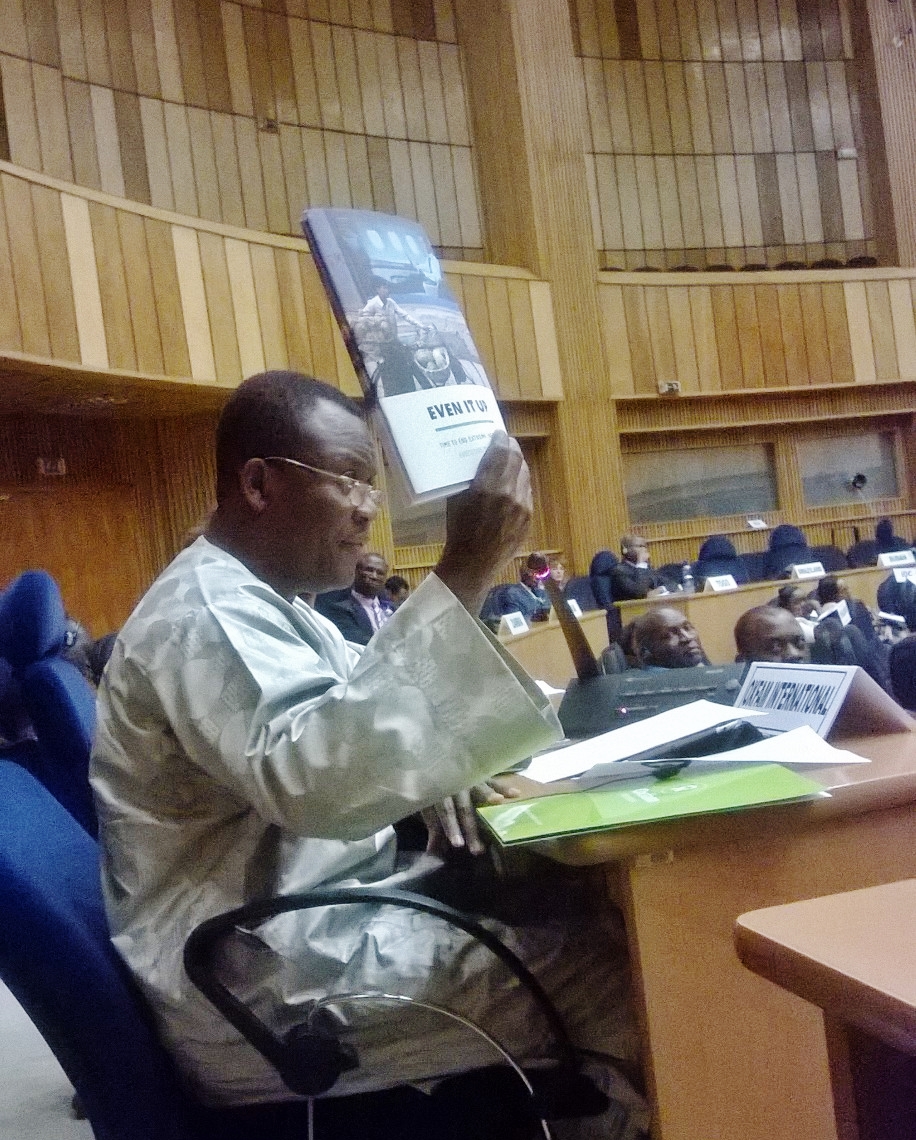
PSC Even it up dec 14

My address to the PSC on Ebola : 28 Nov 2014

Meeting of the Peace and Security Council: Open Session on Ebola outbreak in West Africa and AU Support Mission to Ebola outbreak in West Africa (ASEOWA)

Your Excellencies, Ladies and Gentlemen

On behalf of Oxfam, I would like to thank the PSC for inviting us to this important debate.

With the current Ebola outbreak, Health services have collapsed and other diseases are going untreated.  Household income is going down, poverty level is increasing, schools are closed and, If not contained, the likelihood of the spread of this virus to a larger area in our continent is high!

Ebola crisis has wiped away, years of development gains, and, is now threatening to increase the fragility of the affected countries and the stability of the region.

 Ebola crisis requires a multi-sectorial response to reduce infection rates. My organization, is now responding to the crisis with a planned budget of 43 Million USD. Our focus now is mostly to prevent further spread of the disease.

This is being achieved through supporting improving capacity of inpatient care with a WASH programme as well as material support to medical facilities together with more effective community level prevention and control mechanisms.

We are now operating mainly in Sierra Leone and Liberia with the aims to reach at least 3.2 Million people at risk.

In additions to recommendations already proposed, I will mention 3 more from our end:

  • Prioritize Prevention of further infections – In addition to the mobilisation of funding for treatment and medical personnel, response, should also focus on a systematic education of communities, equipping them with means to protect themselves, in order to prevent further spread of the virus. Community mobilisation and engagement is the only way to ensure that treatment facilities work to their full potential – by ensuring that people know how and when to access treatment –  by removing the blocks to behavioural change)…. Treatment and Prevention must go hand in hand.


  1. We should not forget preparedness for “countries at risk”.  At least 15 countries have been identified as “countries of concern”. My previous point on prevention goes for them as well.
  • Revive the AU Abuja Declaration on health: 


One of the lessons we learn today is that, affected countries were not equipped to detect and contain the epidemic on time… Universal access to quality and free healthcare should be at the heart of making poverty history in our continent.

In April 2001, AU member states pledged in Abuja to increase government funding for health to at least 15% of their national budget. 13 years after, most of the countries in the region allocated less the 7% to health. In Guinea for example, reports show that only 3% of the national budget goes to health. This is a wakeup call to us!!!    We call upon the PSC today to remind to member states, their Abuja commitments and urge them to implement it.

I thank you.


African Union Summit: What to expect in January 2015?

By Desire Assogbavi

The year 2015 has been declared by the Assembly of the African Union as the “Year of Women Empowerment and Development towards Africa’s Agenda 2063”. Both bi-annual Summits of the AU will then be organized around this theme. In the practice, the theme will be symbolically launched during the January Summit but a number of related activities will be organized throughout the year 2015. However, some other burning issues will dominated the various policy discussions during the Summit.

The Summit will be as usual organized in 3 steps:

– The Permanent Representatives Committee (Ambassadors): 23 – 24 January

– The Executive Council (Ministers of Foreign Affairs): 26 – 27 January

– The Assemble of the AU (Heads of State and Government) 30 – 31 January

A number of other parallel/side meetings will also normally be held by states and non-state actors.

What is likely to dominate the Summit?

Beside the official launch of the theme of the Summit “Women Empowerment and Development towards Africa’s Agenda 2063”, no major decision is expected to be taken on this issue. The Assembly usually organizes a public debate and adopts a declaration/commitment on the main theme but this normally happens during the July Summit. The following issues are expected to dominate the Summit:

Ebola Crisis: Ebola has already claimed close to 7, 500 lives in Africa. Response to Ebola is on the right path. The recent move of AUC Chairperson Mrs. D-Zuma  raising fund from the private sector within the continent is excellent, but there is a long way to go with the number of cases still increasing exponentially. Beyond transmission rates, there is already a crisis in non-Ebola health, and major concerns around food security, livelihoods, vulnerability and long term economic impact. There is a need to prioritize prevention of further infections and the AU member States must revive the AU Abuja Declaration by which they have committed to allocate 15% of their national budget on health. AU policy organs will consider a report of the AU Commission on the crisis and take a decision on it. Read my address to the PSC on Ebola wp.me/p4ywYV-2w

African Union Agenda 2063: The drafted 50-year plan of the continental body is expected to be adopted during the January Summit. A previous decision taken in Malabo this year by the Executive Council strongly recommended to member states to organize systematic national consultations on the Agenda but this had not happened in many countries. The AU Commission however conducted some targeted stakeholder consultations over the year. Priority programmes and projects of the Agenda 2063 include: An Integrated High Speed Train Network, the Continental Free Trade Area, the African Passport and Free Movement of people, Unification of African Air Space, the Grand Inga Dam Project etc… The AU Commission has been asked to propose concrete steps towards the implementation of these priorities. See the June 2014 version of the Agenda 2063: http://issuu.com/assogbavi/docs

Alternative Sources of Financing the African Union: There is still no consensus among AU Members on how to stop or at least to reduce the current financial dependency of the African Union from external donors. Currently, external donors pay more than 70% of all AU expenses (including peace and security budget). Proposals made by President Obasanjo, if implemented will generate over USD 750 Million annually to the AU (more than the current budget which is 522 Million USD excluding Peace and Security). Discussions will continue on this but I suspect member states are far from reaching a full consensus on this.

Presidency of the African Union for 2015: Will the AU elect Robert Mugabe as its Chairperson for 2015? The Chairmanship of the AU shall normally go to Southern Africa for 2015 and the established tradition is that the region presents a candidate. Speculations indicate that Robert Mugabe is likely to be the candidate of Southern Africa… I wish he is not! – Read my blog on this next week on: https://assodesire.wordpress.com/

Observers (including CSOs)’s participation in the AU Summits: Observers are now receiving invitation for the January Summit. – Great news!!!

In July this year, the African Union did not invite African non-state actors to the Summit held in Malabo, Equatorial Guinea. There is an unfinished discussion on whether observers should be invited to both the January and the July Summit of the Union. There is a growing number of member states that stand for observers to be invited  only to the January Summit in order to reserve the July Summit for closed and quiet discussions within member States only. Of course CSOs and donors/partners are not in favour of any restriction of access to the Summit. I suspect this is becoming the practice.

Peace and Security: The Summit will review the state of peace and security in the continent and will adopt decisions on each situation. Hot spots include South Sudan, Sudan, DRC, Somalia, CAR and Mali. It is also expected that terrorisms including the situations in Nigeria and Kenya will come up. The Situation in the DRC will be particularly discussed in a special meeting around the DRC Framework Agreement at Heads of State level.

Illicit Financial Flow and unfair exploitation of mineral resources of Africa: Illicit outflows from Africa are estimated for about $ 50-60 billion per year. This represents 1 billion per week, leaving the continent through extractive industries, tax evasion and trade mispricing. President Tabo M’beki, Chair of the AU High-level Panel on Illicit Financial Flows from Africa is now confirmed  to present a report on the issue. This issue should be definitely linked to the financing for the development of the continent which will bring solution to numerous other problems. See my blog on this: https://assodesire.wordpress.com/

Elections

There will be elections for the following organs of the African Union

  • 11 Members of the Advisory Board of Corruption
  • 7 Members of the African Union Commission on International Law
  • President and Vice president on the Pan Africa University
  • Selection of the Host Country of the Pan African University

AU Summit: An influencing and Networking Opportunity

The upcoming Summit presents an important advocacy opportunity on some of the issues I have mentioned above. These include Ebola response and priority actions, Financing for Africa Development and Illicit Financial Flow, Africa Agenda 2063, Peace and Security, CSOs space etc. Even though the AU summit is not the best moment to influence actual policies, it creates a unique opportunity for various actors to raise some priority issues trough media work, direct lobby and advocacy. The Summit is also a unique networking moment for future collaboration between actors from various backgrounds.