Tanzania: The Ballot Box Becomes a Battlefield

When elections cease to be a moment of choice and become an instrument of control, democracy turns into theater and citizens, no longer believing in the script, start to write their own story in the streets. The unfolding crisis in Tanzania is another troubling chapter in Africa’s growing catalogue of democratic rituals without governance substance.

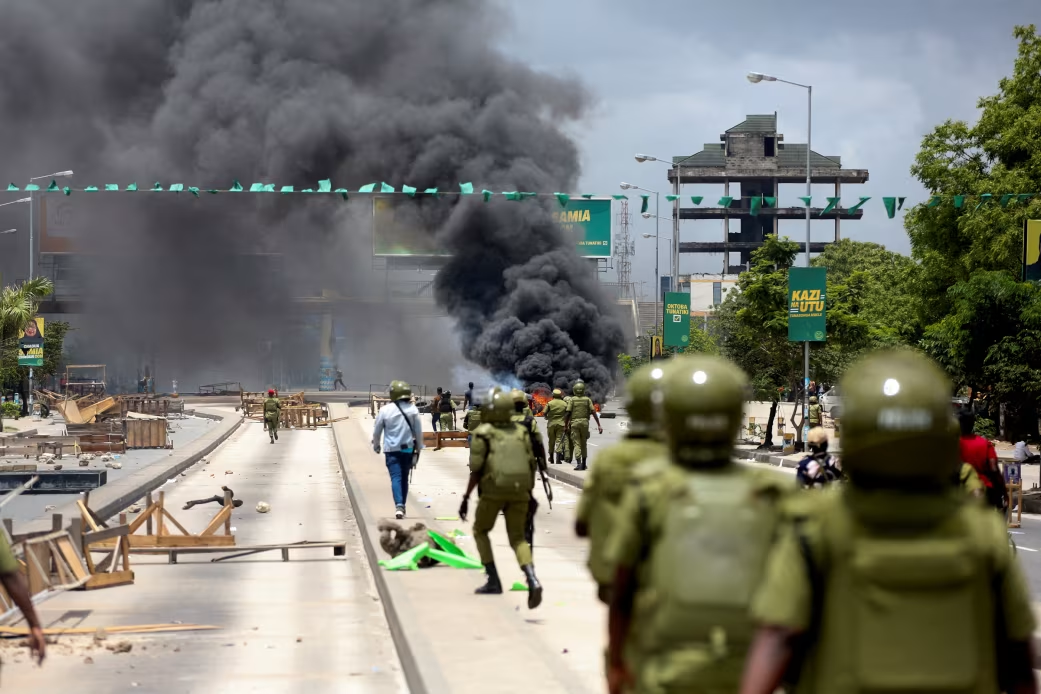
Tanzania, once hailed as a stable democracy in East Africa, is now facing its most serious political unrest in decades. The October 2025 elections, meant to reaffirm democratic legitimacy, instead exposed the fragility of the country’s institutions. Following a tightly controlled vote, President Samia Suluhu Hassan was declared the overwhelming winner, some constituencies reporting absurd margins of 100,000 votes to less than 100 for the opposition. But beyond the numbers, the scenes on the ground tell a different story: cities under curfew, internet blackouts, and live ammunition fired at unarmed civilians.

Witnesses in Dar es Salaam, Arusha, and Mbeya describe a climate of fear and chaos. Human rights organizations indicate that hundred have been killed in just a few days, as security forces cracked down on protestors contesting what they see as an empty ritual of democracy. Lawyers, journalists, and opposition figures have either been silenced or disappeared.

Democracy Without Oxygen

Like Cameroon and Côte d’Ivoire, Tanzania’s crisis is not merely electoral, it is structural. It reflects a pattern where regimes hold regular elections but hollow out the very foundations of democracy: accountability, pluralism, and citizen participation. The symptoms are familiar, youth unemployment, corruption, shrinking civic space, and the instrumentalization of state institutions for political survival. When people cannot breathe politically, repression becomes their air, and protest becomes their only language.

The government’s response, labeling demonstrators “criminals” and tightening its grip on digital communication, has only deepened the divide. Cutting the internet and silencing dissent does not restore order; it merely postpones reckoning. Tanzania’s young population, frustrated by joblessness and impunity, is no longer willing to watch in silence as its future is mortgaged to a small elite. As one activist put it, “There is no oxygen left, we can’t speak, we can’t tweet, we can’t hope.”

A Continental Warning

Tanzania’s turbulence is another call for Africa’s democratic institutions who still measure progress by the number of elections held rather than their integrity. Our continent is sliding into a dangerous normalization of managed democracy, where ballots replace bullets, but the outcomes are just as predetermined.

For us at the Open Society Foundations (OSF), guided by our unwavering commitment to promoting human rights, equity and justice across the world, this moment demands not just condemnation but deeper engagement, supporting those on the frontlines of civic courage, amplifying independent voices, and pressing for genuine institutional reforms that go beyond the façade of periodic voting. The crisis in Tanzania, like those in Cameroon and Côte d’Ivoire, reminds us of that Africa’s democratic project will not be saved by rituals, but by renewal, rooted in justice, inclusion, and accountability. When citizens risk their lives to make their voices heard, the world cannot afford to look away. What is happening in Tanzania today is not just a national crisis; it is a mirror held up to a continent standing once again at a democratic crossroads.
If you’d like to receive my articles automatically as soon as they’re published, simply follow this blog using the “Follow” button at the bottom left of this page or send me an email at: Desire.Assogbavi@Assodesire.com.

Burundi: The African Union Must Catch Up Quickly!

La version en Français ici: wp.me/p4ywYV-4J

The situation in Burundi is becoming more and more serious. Police is firing live ammunitions at protesters; armed militias are terrorizing citizens. 24,000 people have already fled the country, including mayors of some areas … At least 12 people have died dozens were seriously injured and over 600 arrested and detained in inhumane conditions…

Yesterday, the Vice President of the Constitutional Court of Burundi Sylvère Nimpagaritse denounced pressures and death threats on his person during the assessment of the constitutionality of 3rd term of the incumbent president. He then fled the country. During deliberations of the Court, while 4 out of 7 members thought the 3rd mandate is unconstitutional, the court deferred its decision. Thus, the death threats started by the government … It is now clear that this court is no more credible and none shall consider its decisions.

The African Union Must Catch up

In its communiqué of 28 April 2015, The Peace and Security Council (PSC) of the African Union has merely ” took note that the Burundian Senate has seized the Constitutional Court on the interpretation of the Constitution regarding the eligibility of President Pierre Nkurunziza’s candidature for re-election and urged all Burundian stakeholders to respect the decision of the Constitution”. The Chairperson of the AU Commission took the same position on her Twitter account a few days before… I had already found this position as weak and ineffective in view of the gravity of the situation on the ground, being aware of the strong influence of the political authorities on the State institutions. Limiting the solution of the Burundian problem to the decision of the current Constitutional Court is simply paving the way for a constitutional coup by the current authorities.  Everyone knows about this practice in many countries in our continent.

Given the gravity of the situation in Burundi, it is no longer enough to just ask the “stakeholders to respect the constitution and the Arusha Agreements.” The African Union must be clear and state that a 3rd term is purely against the constitution and the spirit of the Arusha Agreement.

I believe that the African Union has a certain influence on Burundi. In the past, the AU has led with success a peacekeeping operation in Burundi. The AU has invested its troops and resources in Burundi. Today, the African Union must avoid hesitation and be categorical. We can no more allow a new civil war in Burundi. Our continent has no mean to handle it. We already have too many problems to solve; too many challenges to face. The last civil war in Burundi killed 250,000 people.

Now that the Constitutional Court has no more credibility, the African Union and the PSC must seek advice of their legal bodies on the constitutionality of the 3rd term in Burundi in order to fix this issue once and for good. It is a historic responsibility. Yesterday our continental body missed similar opportunity in Burkina Faso until citizens ousted their dictator. Today a new opportunity shows up for the African Union to join the rest of the world and isolate President Nkurunziza.

The risk of a military coup in Burundi is very high right now. We should not get there. Africa must stop projecting the image of a continent with brutal methods. Political isolation of President Nkurunziza by the African Union will certainly force him to pull back…

The Peace and Security Council must meet urgently to denounce the interference of the Burundian authorities in the functioning of the Constitutional Court, dissociate itself from any decision of a court being ordered by the political power and declare the 3rd term unconstitutional and against the Arusha Agreements.

Note: My opinions are absolutely personal and do not commit my organization