2015 : Opportunités et Défis pour l’Afrique et l’Union Africaine

Par Desire Assogbavi

Au seuil de cette nouvelle année 2015 et à la veille du Sommet des organes politiques et décisionnels de l’Union Africaine,    J’aimerais partager mes analyses sur les opportunités et les défis qui attendent l’Afrique au cours des 12 prochains mois.

2014 s’en est allée !  Malgré quelques progrès en termes de croissance elle a été une année révélatrice d’une réalité contradictoire entre le slogan d’une Afrique dont les économies  ont enregistré les meilleurs taux de croissance  au monde et une  mise à nu des manquements profonds sur beaucoup de plans et dont notre continent doit s’occuper sérieusement en 2015.

La croissance économique a été réelle et va continuer en 2015 ou au moins se stabiliser à un taux toujours record par rapport aux moyennes mondiaux  mais ses effets qui ne sont toujours pas distribués, n’ont pas profité aux populations ordinaires. Bien au contraire, l’inégalité s’est accrue et le problème de l’emploi des jeunes n’est pas réglé. Les Etats, appuyés par les experts de l’Union Africaine, de la Commission Economique pour l’Afrique et de la Banque Africaine de Développent doivent plancher sur des solutions urgentes et immédiates au problème des inégalités en Afriques.

Ebola a mis au grand jour les déficits structurels des pays affectés mais aussi et surtout la fragilité et le leurre de la « solidarité africaine »… elle a déjà emporté 7.500 filles et fils du continent en un temps record. L’Union Africaine n’a pas été préparée à répondre à des crises majeures comme Ebola et elle est toujours financièrement dépendante de ses partenaires puisque 72% de ses dépenses sont payés de l’extérieur. La dernière initiative de l’Union Africaine pour mobiliser des fonds en Afrique est positive et doit servir d’exemple à reproduire  mais la guerre contre Ebola demeure largement menée et financée  par les partenaires extérieures. Ma crainte en ce moment est que toutes les attentions sont tournées vers Ebola de sorte que d’autres maladies 100 fois plus dévastateurs qu’Ebola, risquent d’être oubliées.

Les attaques aisément menées par des groupes Islamistes terroristes ont révélé des manquements sérieux dans la gouvernance de nos pays. Le Nigeria,  1ere Puissance continentale dans plusieurs domaines fuit lâchement devant ces bandits….  Le Kenya  ne fait pas mieux pour protéger ses populations.

Les conflits au Sud Soudan et en Libye n’ont pas trouvés de solution… on n’en est même pas proche… Il n’y pas de signe concret d’espoir en République Centrafricaine et très peu de progrès  ont été enregistré au Mali.  L’Afrique doit se concentrer sur ces conflits en 2015 tout en prévenant d’autres, surtout celles liées à la gouvernance politique de s’éclater.

En 2014, 3000 de nos concitoyens on périt dans la mer méditerranéenne… Ils fuyaient leur propre continent car la vie y est trop dure… Rien de concret n’est encore fais de notre côté pour régler ce problème

L’Union Africaine a eu la vie dure face à ces  multiples conflits cités plus haut et notre continent a connu plus d’intervention étrangère ses dernières années qu’il a 20 ans. A part les opérations des Nations Unies, plus de 20,000 soldats étrangers sont en Afrique pour différentes raisons.  Il y a eu quelques progrès en Somalie mais cela reste à consolider. Les Forces de l’Union Africaine y ont joué un rôle déterminant mais les drones américains ont aidé énormément.

Le toilettage de la Commission de l’Union Africaine en vue de garantir plus d’efficacité dans son fonctionnement n’a toujours pas eu lieu ou du moins n’est pas sentis comme l’avait promis la Présidente Dlamini-Zuma. A mon avis,  l’espace civique des citoyens y a été  plus élargis et disponible, beaucoup plus que dans les états membres. Les discussions sur la vision pour les 50 prochaines années dénommée Agenda 2063 sont toujours en cours. L’agenda devra être adopté  fin Janvier avec un accent sur les priorités des 10 prochaines années.

La question de l’exploitation des ressources minières devient de plus en plus cruciale. Elle est  aggravée par les flux financiers  qui s’élèvent à 60 Milliard de Dollars par an, et  qui quittent l’Afrique   de façon illégale et frauduleuse.  Cet argent suffirait largement à financer  le développement,  réduire les inégalités et  payer les dettes…. L’Afrique doit avancer rapidement dans un processus harmonisé  de contrôle de l’exploitation et du pillage de ses ressources.  Nos ressources continuent de se vendre à vil prix… et les contrats sont fantaisistes. La commission du Droit International de l’UA doit se pencher sur la question des contrats.  La Conférence des Chefs d’Etats doit prendre une position ferme pour la Mise en œuvre du « African Mining Vision »

La gouvernance démocratique, le sujet à plus haut risque de l’année 2015 !

Au moins 15 Elections cruciales seront organisées  dans les pays suivants: Benin, Burkina Faso, Burundi, Centrafrique, Comores, Cote d’Ivoire, Ethiopie, Guinée, Nigeria,  RDC, Togo, Soudan, Sud Soudan, Tanzanie, Tchad,  Zambie. La question de la limitation des mandats présidentiels devrait pimenter certains de ces consultations électorales… et le risque est sérieux de voir les jeunes, impatients crier et manifester leurs colère. L’union Africaine doit serrer sa ceinture en prévision de ces éventualités.

Négociations sur le climat

L’Afrique souffre le plus des impacts du changement climatique. Les effets comprennent l’avancée des déserts, l’imprévisibilité des saisons, les inondations, la sécheresse, les maladies etc … Certains pays africains sont même contraints de détourner des fonds de l’éducation et projets de santé pour faire face à des questions d’atténuation des changements climatiques.

Les gouvernements africains doivent préparer une position commune forte pour le prochain traité et faire peser  leur poids politique dans le système, commencer à pousser pour leur position avant  la Conférence diplomatique de Paris en Décembre 2015.

Depuis que nous avons perdu le Premier Ministre Ethiopien Meles Zenawi, alors champion des questions de changements climatiques pour l’Afrique, l’élan s’est amoindri  et c’est une grave préoccupation. Les organisations de la société civile doivent se mobiliser pour soutenir les dirigeants africains à ce sujet. Le Président Tanzanien Jakaya Kikwete est maintenant le Coordonnateur du Comité des Chefs d’Etat et de gouvernement sur les changements climatiques. 2015 doit être une année d’action sur le changement climatique.

Intégration: Il y a de bons signes  dans certaines régions. Afrique de l’Ouest est bien avancée, mais l’Est est en train de rattraper. Ceci doit être encouragée et dupliquer dans d’autres régions. Le Kenya, l’Ouganda, le Rwanda, rejoint par le Sud-Soudan et récemment par l’Éthiopie se sont lancés ensemble dans de nombreux projets d’intégration économique / commercial. Je ne crois pas qu’ une intégration continentale politique rapide est possible mais plutôt une intégration économique bien gérée qui produit des résultats concrets en faveur des citoyens. Le projet Africain de libre-échange doit être alimenté. Tout ceci  conduira avec le temps automatiquement à une intégration plus large au niveau continental.

La Société Civile doit être de plus en plus mobilisée. L’espace civique s’amoindris dans beaucoup de pays.  Nous devons arrêter cette tendance.   L’Union Africaine doit aider à le faire. Il faut une prise de position concrète de l’UA en la matière. La Commission de l’UA et certains Etats progressistes  doivent en prendre l’initiative.

Apres plusieurs années de léthargie et de ratées,  ECOSSOC, le Conseil Economique, Social   et Culturel de l’Union Africaine vient de se réveiller avec l’élection de sa deuxième Assemblée Générale.  Nous devons travailler avec eux, les soutenir afin de s’assurer que l’opinion  de la société civile est entendue dans le processus e prise de décision dans les organes de l’Union Africaine. Sa composition s’améliorera avec le temps.

NB : Mes analyses et opinions sont personnelles et ne représentent pas les positions de l’organisation pour laquelle je travaille.

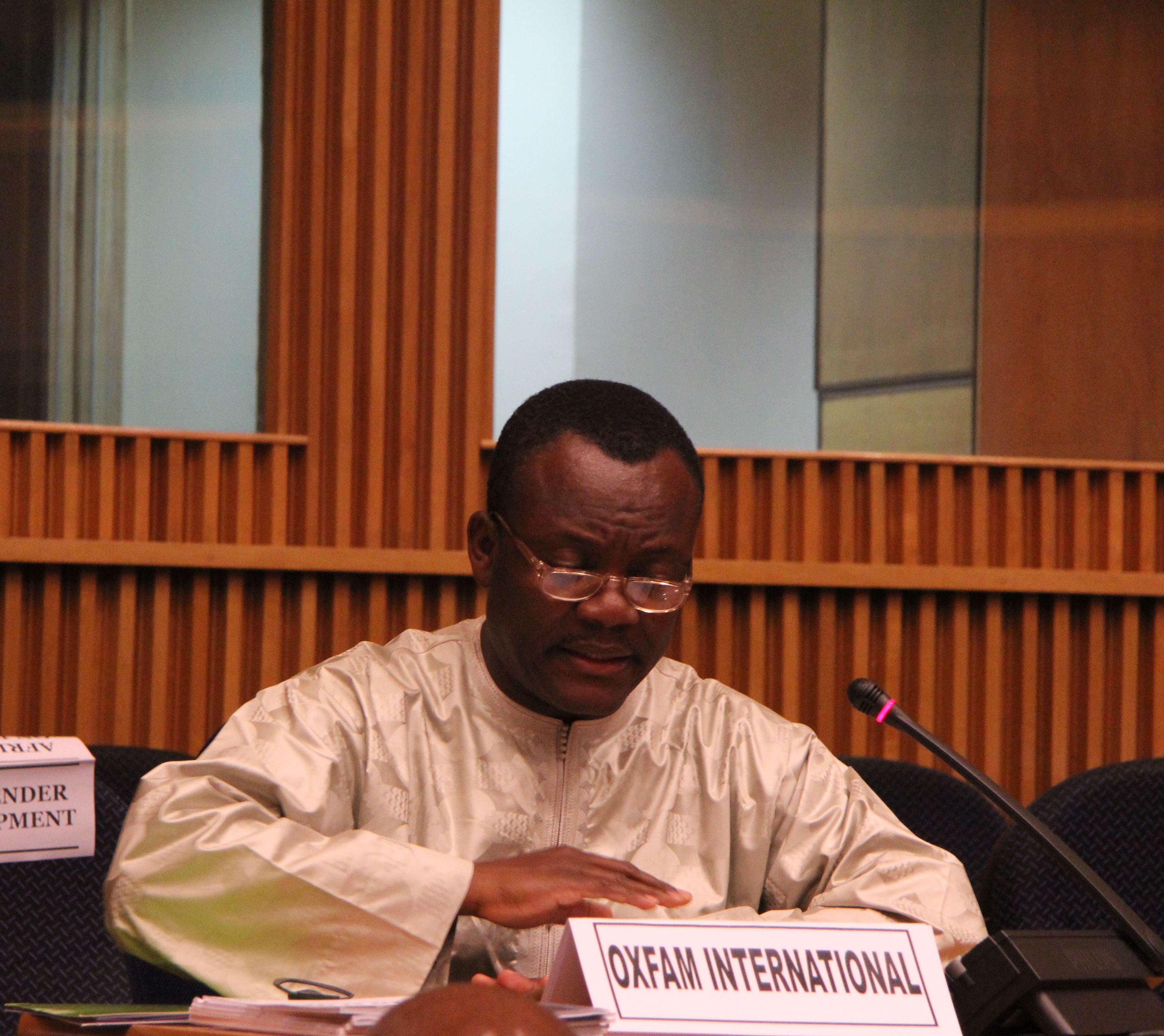
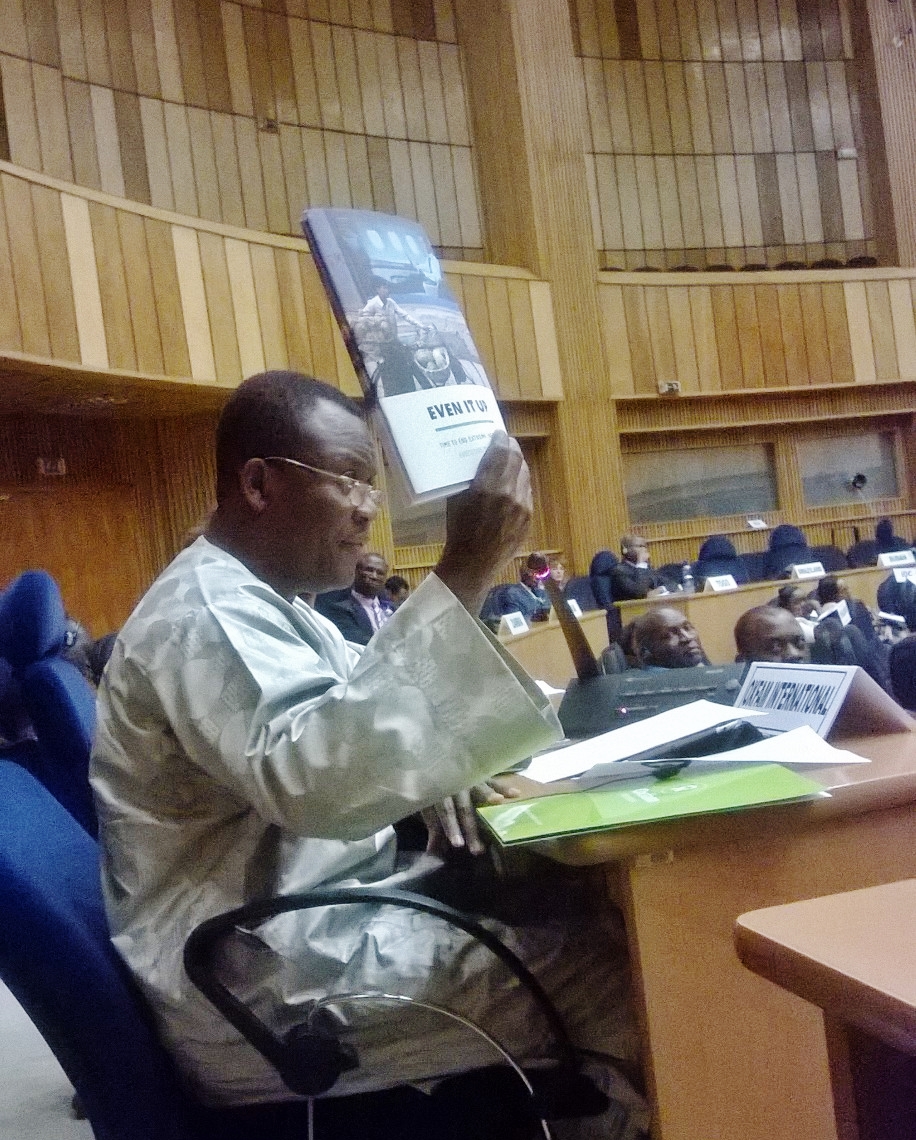
My Address Today to Peace and Security Council: Inequality, Illicit Financial Flows and Instability in Africa

PSC inq PSC Inequality 5

Addis Ababa, 16 December 2014

Your Excellency, Chair of the Peace and Security Council

On behalf of Oxfam International, I would like to thank your Council for inviting us to address your session on Inequality, Illicit Financial Flows and Instability in Africa.

The Progress that our continent has achieved over the last decade is under threat by the rapid rising of inequality. Money, but also Power, and Opportunities are concentrated in the hands of a few, and this has reached an extreme level.

The consequences are corrosive for everyone. Extreme inequality encourages corruption fuels crime and violent conflicts. It’s wasteful for talent, potential and undermine the foundations our societies.

Homicide rates are 4 times higher in countries with extreme economic inequality than in more equal nations. Today, in many of our countries, access to justice is on sale, legally or illegally insuring impunity for the powerful.  The results are evident. The frustrated poor, mostly young people have nothing to loose… The can only get into violence or are just vulnerable to all kind of temptations.

Your Excellency;

The other issue on your agenda today which are the Illicit Financial Flows, are money from transactions, illegally removed or transfer from our countries… Money that escape public knowledge.

50% of illicit financial flows result from profit shifting by multinationals and up to 70% of those are from Extractive Industries in Africa.

Illicit outflow from Africa drags over $ 50 billion out of the continent every year. This represents about 1 billion per week.

The Africa Progress Panel estimated that $38 billion leave Africa every year through trade mispricing only… companies undervalue the prices of imports and exports so they don’t have to pay the appropriate tax.

 The Following solutions can be considered both to tackle inequality and resolve the issue of IFF:

Transparency: is a great disinfectant. It will put pressure on governments to account for how they spend the money received.

We must enact policies that force mining companies to publish payments to governments.

Some African States have been having the Right moves to manage resource wealth responsibly. Ghana for example has the Petroleum Revenue Management Act… a good example of how targeted regulation can promote shared prosperity –

The African Mining Vision (AMV)…. adopted in 2009 by the AU is not known in our continent. We need a deliberate effort to promote it and encourage member states to implement it.  In a long term, we must make it a binding document for all African Countries.

Oxfam Liaison Office to the African Union has just set a program in Addis Ababa to support the effort of the AU Commission in the promotion of the AMV.

Extreme Inequality can be overcome… if we make Government to truly work for citizens.

  • Tax system: is one of the most important tools governments have to address inequality.
  • Clinics, classrooms and other public services free of charge can help to close the gap in life chances.

We must also close the international tax loopholes and fill the gap in tax governance.  – – – –

I thank you.

PSC Even it up dec 14

My address to the PSC on Ebola : 28 Nov 2014

Meeting of the Peace and Security Council: Open Session on Ebola outbreak in West Africa and AU Support Mission to Ebola outbreak in West Africa (ASEOWA)

Your Excellencies, Ladies and Gentlemen

On behalf of Oxfam, I would like to thank the PSC for inviting us to this important debate.

With the current Ebola outbreak, Health services have collapsed and other diseases are going untreated.  Household income is going down, poverty level is increasing, schools are closed and, If not contained, the likelihood of the spread of this virus to a larger area in our continent is high!

Ebola crisis has wiped away, years of development gains, and, is now threatening to increase the fragility of the affected countries and the stability of the region.

 Ebola crisis requires a multi-sectorial response to reduce infection rates. My organization, is now responding to the crisis with a planned budget of 43 Million USD. Our focus now is mostly to prevent further spread of the disease.

This is being achieved through supporting improving capacity of inpatient care with a WASH programme as well as material support to medical facilities together with more effective community level prevention and control mechanisms.

We are now operating mainly in Sierra Leone and Liberia with the aims to reach at least 3.2 Million people at risk.

In additions to recommendations already proposed, I will mention 3 more from our end:

  • Prioritize Prevention of further infections – In addition to the mobilisation of funding for treatment and medical personnel, response, should also focus on a systematic education of communities, equipping them with means to protect themselves, in order to prevent further spread of the virus. Community mobilisation and engagement is the only way to ensure that treatment facilities work to their full potential – by ensuring that people know how and when to access treatment –  by removing the blocks to behavioural change)…. Treatment and Prevention must go hand in hand.


  1. We should not forget preparedness for “countries at risk”.  At least 15 countries have been identified as “countries of concern”. My previous point on prevention goes for them as well.
  • Revive the AU Abuja Declaration on health: 


One of the lessons we learn today is that, affected countries were not equipped to detect and contain the epidemic on time… Universal access to quality and free healthcare should be at the heart of making poverty history in our continent.

In April 2001, AU member states pledged in Abuja to increase government funding for health to at least 15% of their national budget. 13 years after, most of the countries in the region allocated less the 7% to health. In Guinea for example, reports show that only 3% of the national budget goes to health. This is a wakeup call to us!!!    We call upon the PSC today to remind to member states, their Abuja commitments and urge them to implement it.

I thank you.


African Union Summit: What to expect in January 2015?

By Desire Assogbavi

The year 2015 has been declared by the Assembly of the African Union as the “Year of Women Empowerment and Development towards Africa’s Agenda 2063”. Both bi-annual Summits of the AU will then be organized around this theme. In the practice, the theme will be symbolically launched during the January Summit but a number of related activities will be organized throughout the year 2015. However, some other burning issues will dominated the various policy discussions during the Summit.

The Summit will be as usual organized in 3 steps:

– The Permanent Representatives Committee (Ambassadors): 23 – 24 January

– The Executive Council (Ministers of Foreign Affairs): 26 – 27 January

– The Assemble of the AU (Heads of State and Government) 30 – 31 January

A number of other parallel/side meetings will also normally be held by states and non-state actors.

What is likely to dominate the Summit?

Beside the official launch of the theme of the Summit “Women Empowerment and Development towards Africa’s Agenda 2063”, no major decision is expected to be taken on this issue. The Assembly usually organizes a public debate and adopts a declaration/commitment on the main theme but this normally happens during the July Summit. The following issues are expected to dominate the Summit:

Ebola Crisis: Ebola has already claimed close to 7, 500 lives in Africa. Response to Ebola is on the right path. The recent move of AUC Chairperson Mrs. D-Zuma  raising fund from the private sector within the continent is excellent, but there is a long way to go with the number of cases still increasing exponentially. Beyond transmission rates, there is already a crisis in non-Ebola health, and major concerns around food security, livelihoods, vulnerability and long term economic impact. There is a need to prioritize prevention of further infections and the AU member States must revive the AU Abuja Declaration by which they have committed to allocate 15% of their national budget on health. AU policy organs will consider a report of the AU Commission on the crisis and take a decision on it. Read my address to the PSC on Ebola wp.me/p4ywYV-2w

African Union Agenda 2063: The drafted 50-year plan of the continental body is expected to be adopted during the January Summit. A previous decision taken in Malabo this year by the Executive Council strongly recommended to member states to organize systematic national consultations on the Agenda but this had not happened in many countries. The AU Commission however conducted some targeted stakeholder consultations over the year. Priority programmes and projects of the Agenda 2063 include: An Integrated High Speed Train Network, the Continental Free Trade Area, the African Passport and Free Movement of people, Unification of African Air Space, the Grand Inga Dam Project etc… The AU Commission has been asked to propose concrete steps towards the implementation of these priorities. See the June 2014 version of the Agenda 2063: http://issuu.com/assogbavi/docs

Alternative Sources of Financing the African Union: There is still no consensus among AU Members on how to stop or at least to reduce the current financial dependency of the African Union from external donors. Currently, external donors pay more than 70% of all AU expenses (including peace and security budget). Proposals made by President Obasanjo, if implemented will generate over USD 750 Million annually to the AU (more than the current budget which is 522 Million USD excluding Peace and Security). Discussions will continue on this but I suspect member states are far from reaching a full consensus on this.

Presidency of the African Union for 2015: Will the AU elect Robert Mugabe as its Chairperson for 2015? The Chairmanship of the AU shall normally go to Southern Africa for 2015 and the established tradition is that the region presents a candidate. Speculations indicate that Robert Mugabe is likely to be the candidate of Southern Africa… I wish he is not! – Read my blog on this next week on: https://assodesire.wordpress.com/

Observers (including CSOs)’s participation in the AU Summits: Observers are now receiving invitation for the January Summit. – Great news!!!

In July this year, the African Union did not invite African non-state actors to the Summit held in Malabo, Equatorial Guinea. There is an unfinished discussion on whether observers should be invited to both the January and the July Summit of the Union. There is a growing number of member states that stand for observers to be invited  only to the January Summit in order to reserve the July Summit for closed and quiet discussions within member States only. Of course CSOs and donors/partners are not in favour of any restriction of access to the Summit. I suspect this is becoming the practice.

Peace and Security: The Summit will review the state of peace and security in the continent and will adopt decisions on each situation. Hot spots include South Sudan, Sudan, DRC, Somalia, CAR and Mali. It is also expected that terrorisms including the situations in Nigeria and Kenya will come up. The Situation in the DRC will be particularly discussed in a special meeting around the DRC Framework Agreement at Heads of State level.

Illicit Financial Flow and unfair exploitation of mineral resources of Africa: Illicit outflows from Africa are estimated for about $ 50-60 billion per year. This represents 1 billion per week, leaving the continent through extractive industries, tax evasion and trade mispricing. President Tabo M’beki, Chair of the AU High-level Panel on Illicit Financial Flows from Africa is now confirmed  to present a report on the issue. This issue should be definitely linked to the financing for the development of the continent which will bring solution to numerous other problems. See my blog on this: https://assodesire.wordpress.com/

Elections

There will be elections for the following organs of the African Union

  • 11 Members of the Advisory Board of Corruption
  • 7 Members of the African Union Commission on International Law
  • President and Vice president on the Pan Africa University
  • Selection of the Host Country of the Pan African University

AU Summit: An influencing and Networking Opportunity

The upcoming Summit presents an important advocacy opportunity on some of the issues I have mentioned above. These include Ebola response and priority actions, Financing for Africa Development and Illicit Financial Flow, Africa Agenda 2063, Peace and Security, CSOs space etc. Even though the AU summit is not the best moment to influence actual policies, it creates a unique opportunity for various actors to raise some priority issues trough media work, direct lobby and advocacy. The Summit is also a unique networking moment for future collaboration between actors from various backgrounds.

For A People Centred African Union: Lessons from Burkina Faso

By Desire Assogbavi

Following the events that take place in Burkina Faso, which led to the fall of the regime of Blaise Compaoré and the seizure of power by the military, the Peace and Security Council of the African Union met on November 3rd, 2014 and gave a 15-days deadline to the military to hand over power to a civilian authority of consensus. The Concil specifically “demanded that the Army Burkina Faso leaves power, which must be transferred to a civilian authority, in accordance with the Constitution, within a maximum period of two weeks …”

This is certainly a positive and categorical position in favor of the rule of law and democracy which our brothers and sisters of Burkina Faso are looking for. I was then expecting (perhaps naively) a very positive response from the people of Burkina Faso vis a vis that support of the AU. However I have seen a totally different set of reactions posted online. Here is a selection that I copied from the website of Radio France International –  RFI. I have tried to avoid the most insulting comments:

  • “Where was the AU, the Union of dictators, when Compaore threatened democracy by denying the right to change of power in Burkina Faso? What we want is an Union  of peoples who care for progress on the continent”
  • “The AU !!! they still exist ??? “
  • “Go to hell! Where was this UNION of DISHONESTS when Blaise wanted to do his constitutional coup? What did the AU do or said when NATO killed his father Gaddafi? “They are concerned only about their pockets and their stomach …
  • “When Blaise was killing the revolution we heard neither the AU nor France nor the United States nor the United Nations …”
  • “We urge the AU to say a word about what is happening in DRC before it is too late, soon there will be revolt against the constitutional revision
  • “The African Union is an organization to be removed from the list of international organizations because of its inefficiency …”
  • “Why the AU would not punish Blaise Compaoré when he wanted to amend Article 37 and now it is the people of Burkina it wants to punish shame in all its institutions”
  • “Better for the AU to deal with Ebola, we set our business …”

In all honesty, these comments reflect a real feeling experienced by the people  of our continent vis a vis the only Pan African organization that we have. These comments must alert the African Union leadership. These comments should be taken seriously.

The African Union has responded positively but unfortunately too late … as usual … after the people had themselves driven the dictator out with all the risks that this entailed. There was not a single statement of principle towards Compaore since he was trying to change the constitution to run for another term after 27 years of absolute power following the murder Thomas Sankara Lingani and Zongo. Today, the African Union itself is chaired by another author of Coup, the Mauritanian Abdel Aziz … the Peace and Security Council is chaired by the Equatorial Guinea, a country led by another author of coup, Obiang Nguema (35 years in power) …. Many other presidents have seized power for decades and are not ready to go: Dos Santos (35 years), Robert Mugabe (34 years as PM and PR) Paul Biya (32 years), Sassou Ngesso (30 years), Museveni (28 years), Isaias Afwerki (23 years), Yahya Jammey (20 years) etc, the list goes on …. Unfortunately they are the African Union decision makers … So who can say what to whom?

What is the way forward?

1- The Commission of the African Union and its leadership must play their role as the engine of the Union seizing appropriate opportunities to publicly remind Heads of States of the commitments contained in the beautiful texts and principles they themselves, adopted including the shared values

  1. The AU should make a serious, honest and non-discriminatory efforts to encourage citizens’ participation in its business and make the AU and its challenges better known to African citizens.

3- The AU Commission must react faster and make upstream position on the basis of existing texts and principles when such problems arise. This would catalyse its credibility with populations

  1. The Union and the Commission should understand that without the support of the African people the organization is doomed to failure. It must work seriously to show people concrete acts and facts it can generate. I am convinced that it is capable if the political will and courage are there.

5- Having worked for 8 years with the African Union (not for AU ), I am convinced that the AU is full of important resources and potentials that are still unused … leadership must be depoliticized and get to work with courage with the sole objective a collective welfare and the future of Africa, which already lags far behind.

PS: My opinions are personal, they are that of a son of the continent and do not commit the organization for which I work.

I also recommend you read my blog last week: Options for Burkina Faso https://assodesire.wordpress.com/2014/10/31/quelles-sont-les-options-pour-le-burkina-faso/

Pour Une Union Africaine des Peuples: Les Leçons du Burkina Faso

Par Désiré Assogbavi

Suite aux évènements qui ont cours au Burkina Faso et qui ont conduit à la chute du régime de Blaise Compaoré et à la prise du pouvoir par les militaires, le Conseil de Paix et de Sécurité de ‘Union Africaine s’était réuni le 3 Novembre 2014  et avait donné un délai  de 15  jours aux militaires pour remettre le pouvoir a une autorité civile de consensus.   Le Conseil a notamment « exigé que l’Armée du Burkina Faso quitte le pouvoir, qui doit être transféré à une autorité civile, conformément à la Constitution, dans un délai maximal de deux semaines … »

Ceci est certainement une prise de position catégorique en faveur de la primauté du droit et de la démocratie auxquelles aspirent nos frères et sœurs du Faso. Mais alors que je m’attendais (peut être naïvement) à une réaction très positive et de soulagement du peuple Burkinabè face à ce soutien de l’UA les commentaires des internautes du Faso et d’ailleurs nous interpellent. En voici une sélection que j’ai copiée sur le site de RFI tout en évitant les plus insultants :

  • « Où était l’UA, ce syndicat de dictateurs, quand Compaoré menaçait la démocratie en refusant aux Burkinabè le droit à l’alternance? Ce que nous voulons, c’est une Union africaine des peuples, qui se préoccupe un peu plus du progrès du continent »
  • « L’UA !!! ça existe toujours??? »
  • « Que l’UA aille se faire voir en l’enfer. Où était ce SYNDICAT DE MALHONNETE quand Blaise voulait faire son coup constitutionnel? Qu’est-ce que l’UA a dit ou fait quand l’OTAN a tué son père Kadhafi? » Ils ne s’occupent que de leurs poches, de leurs VENTRES…
  • « Quand Blaise matait la révolution on n’a entendu ni l’UA ni la France ni les USA ni l’ONU… »
  •  « Nous demandons à l’UA de dire un mot sur ce qui se passe en RDC avant qu’il ne soit trop tard, bientôt il y aura révolte contre la révision constitutionnelle
  • « L’Union Africaine est une organisation à supprimer sur la liste des organisations internationales a cause de son inefficacité… » 
  • « pourquoi l’UA n’a pas voulu sanctionner Blaise Compaoré lorsqu’il voulait modifier l’article 37 et maintenant c’est le peuple Burkinabé qu’elle veut sanctionner honte à toutes ses institutions »
  • « Mieux vaut pour l’UA de s’occuper d’Ébola, nous réglons nos affaires… »

En toute honnêteté, ces commentaires sont le reflet d’un sentiment réel éprouvé par les fils et filles de notre continent face à la seule organisation panafricaine  dont nous disposons. Ces commentaires doivent interpeller l’Union Africaine e son leadership. Ces commentaires doivent être pris au plus grand sérieux. L’Union Africaine a réagi positivement mais hélas trop tard… comme d’habitude… après que le peuple ait lui-même chassé le dictateur avec tous les risques que cela comportait. Il n’y a pas eu une seule déclaration de principe en direction de Compaoré depuis qu’il machinait pour changer la Constitution  afin de briguer un autre mandat après 27  ans de pouvoir absolu suite à l’assassiné Thoma Sankara, Lingani et Zongo.  Aujourd’hui,  l’Union Africaine est elle-même dirigée un autre auteur de Coup d’Etat le Mauritanien Abdel Aziz… le Conseil de Paix et de Sécurité est présidé par la Guinée Equatorial, pays dirigé par un autre auteur de coup d’Etat, Obiang Nguema  (35 ans au pouvoir)…. Beaucoup d’autres présidents ont confisqué le pouvoir depuis des décennies et ne sont pas prêts à partir : Dos Santos (35 ans), Robert Mugabe (34 ans comme PM puis PR) Paul Biya (32 ans), Museveni (28 ans), Yahya Jammey (20 ans) etc, la liste est longue…. Malheureusement ils constituent l’Union Africaine … Alors qui peut dire quoi a qui ?

Que faut-il faire ?

  1. La Commission de l’Union Africaine et son leadership doivent effectivement jouer leur rôle de moteur de l’Union en saisissant les occasions appropriées pour rappeler publiquement aux Chefs d’Etats  les contenus des beaux textes et principes  qu’ils ont eux-mêmes adoptés y compris les valeurs partagées
  2. L’Union doit faire un effort sérieux, honnête et non-discriminatoire pour encourager la participation citoyenne dans ses affaires et mieux faire connaitre l’Union et ses défis aux citoyens africains.
  3. La Commission de l’Union doit réagir plus promptement et prendre position en amont sur la base des textes et principes déjà existants quand de pareils problèmes de posent. Ceci catalyserait sa crédibilité auprès des populations
  4. L’Union et la Commission doivent comprendre que sans le soutien des populations africaines l’organisation serait vouée à l’échec. Elle doit donc travailler sérieusement pour montrer aux populations des actes et faits concrets qu’elle peut générer. Je suis convaincu qu’elle en est capable si la volonté politique et le courage y sont.
  5. Pour avoir travaillé pendant 8 ans auprès de l’Union Africaine (pas pour l’Union Africaine), je suis convaincu que l’Union regorge de ressources importantes et de potentialités qui sont encore non-utilisées… le leadership doit être dépolitisé et se mettre au travail avec courage en ayant comme seul objectif le bienêtre commun et l’avenir de l’Afrique qui accuse déjà beaucoup de retard.

NB : Je précise que mes opinions sont personnelles, elles sont celle d’un fils du continent et n’engagent aucunement l’organisation pour laquelle je travaille.

Je vous recommande aussi de lire mon blog de la semaine dernière : Quelles Options pour le Burkina Faso ? https://assodesire.wordpress.com/2014/10/31/quelles-sont-les-options-pour-le-burkina-faso/

Options for Burkina Faso: My Opinion…


  1. Establish a consensual transitional government with a Prime Minister and Ministers who agree not to run for the next presidential election, regardless of whether He/She comes from the army or not, but it should be a civilian PM . The PM must have executive power.
  2. It is important that Blaise Compaore is out of the transition for several reasons: He has no more legitimacy before the people even if he remains the “elected ” president. Given his past and his implications in a number of issues on the continent starting with Burkina Faso , Blaise is still able to dribble everybody and rely on a part of the army if his given time, He can  even complicate the situation and make it unmanageable …. I fear disappearances and other retaliations…. I also fear economic crimes which may affect the country. It is important to turn the page here and now.
  3. However, to avoid giving the shadow of Coup d’Etat to the situation and make sure it does not become the only way out in Africa, Blaise can be simply asked to resign against a calm and quiet way out. If he refuses, then he should be forced out by all possible means and why not bring him to court?
  4. Another option is to keep him if he wants to remain president to finish his term but appoint a strong Prime Minister with executive powers.
  5. There is a need for a People’s Council, an interim parliament for the one-year transition which should lead to democratic elections. The Council will be able to monitor the Government. It must be inclusive but with not too strong power.
  6. The army must be represented in the bodies of the transition but must not interfere as such in the conduct of the business. The transition must absolutely be led by civilians and the military must be in their service.
  7. An election timetable should be adopted and strictly adhered to. But a mechanism allowing some flexibility is needed to avoid bottlenecks that could justify other disorders.
  8. A Regional Contact Group of the African Union , ECOWAS and other partners should be set up to ensure compliance with the transition plan.

Finally, victims of the recent events must be treated with dignity. They should get into the History of Burkina Faso.

Quelles sont les Options pour le Burkina Faso?

1- Former un gouvernement consensuel de transition avec un Premier Ministre et des Ministres qui acceptent de ne pas se présenter aux prochaines élections présidentielles. Peu importe s’il ou elle vient de l’armée mais il doit être un PM civil. Le PM doit avoir un pouvoir exécutif.

Il importe que Blaise soit écarté pour plusieurs raisons: Il n’a plus de légitimité devant le peuple même s’il demeure le Président “élu”. Vu son passé et ses implications dans un certain nombre de basses besognes à son actif sur le continent à commencer par le Burkina Faso, Blaise est capable de dribbler encore tout le monde et s’appuyer sur une partie de l’armee s’il a du temps, au même de compliquer la situation et de la rendre ingerable…. Je crains des disparitions et autres règlements de comptes…. Je crains aussi des crimes economiques qui peuvent remettre en cause les aquis du BF. Il importe de tourner la page ici et maintenant.

Cependant, pour éviter de donner la connotation de Coup D’Etat à la situation, et éviter ça ne fasse tâche d’huile, on pourra demander a Blaise tout simplement de démissionner contre une sortie calme et tranquille. S’il refuse, on le boute dehors par tous les moyens possibles et pourquoi pas le juger….

2- Une autre option est de le garder s’il tient à rester President pour finir son mandat mais on lui flanque un Premier Ministre fort avec pouvoir exécutif.

3- Il faut en plus une sorte de Conseil du Peuple, un parlement provisoire pour la transition d’un an qui doit aboutir aux élections démocratiques. le Conseil constituera un contre pouvoir pour surveiller l’exécutif. Il dois être composé de façon très variée incluant toutes les couches sociales du pays avec un pouvoir législatif pas trop fort.

L’armée doit être représentée dans les instances de la transition mais ne doit pas interférer en tant que tel dans la conduite des affaires. La transition doit absolument être dirigée par des civiles et l’armée doit être à leur service.

Un calendrier électoral doit être adopté et scrupuleusement respecté. Mais il faut un mécanisme permettant un peu de flexibilité pour éviter des blocages qui pourraient justifier d’autres désordres.

Un Groupe Regional de Contact de l’Union Africaine, la CEDEAO et autres partenaires doit etre mis en place pour veiller au respect du plan de transition.

Il faut enfin un traitement digne des victimes des événements… Elles doivent rentrer dans l’histoire du Faso.