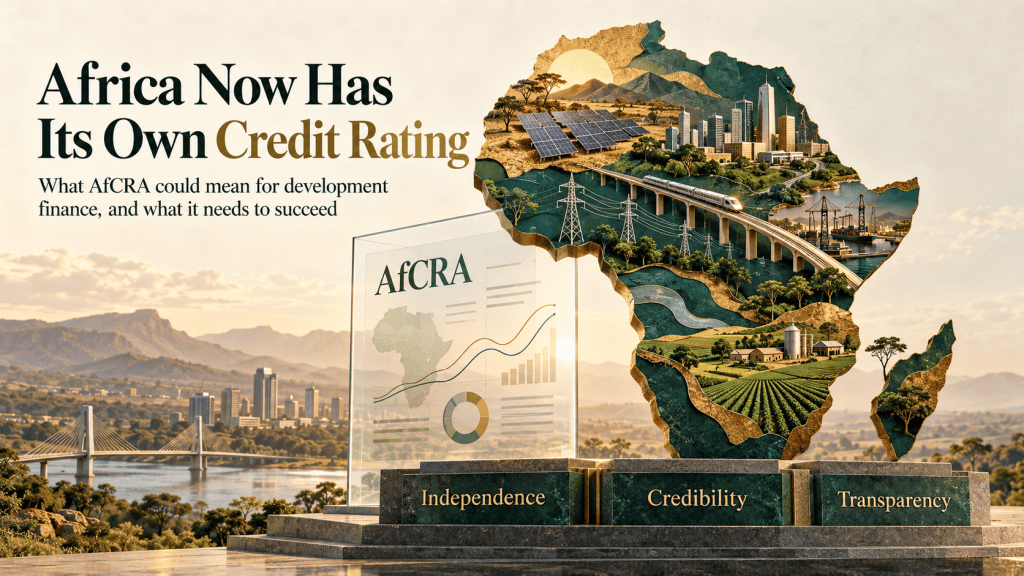
What AfCRA could mean for development finance, and what it needs to succeed
An important part of my work at the Open Society Foundations, focuses on development finance and on our engagement with Pan African institutions including the African Union, the African Development Bank and the United Nations’ Economic Commission for Africa.
For Africa’s development, what borrowed money costs matters as much as how much of it is available. That is why in this article I reflect on what the Africa Credit Rating Agency (AfCRA) could change for development finance, and what it will take to get there.
Three months ago in Abidjan, AfCRA was still a plan presented to African Ministers of Finance, Economic Development and Trade. This week in Port Louis, Mauritius, it becomes real. I am watching the launch from Bangkok, Thailand, where the IMF and World Bank meet next week for their 2026 Annual Meetings to discuss the very questions this new agency wants to answer: how risky is Africa?
On Wednesday, 7 October 2026, the African Union officially launched AfCRA in Port Louis, Mauritius, eight years after African leaders endorsed the idea in 2018. Backed by institutions such as Afreximbank, the new agency will rate governments, sub-national authorities such as cities and regions, financial institutions and private companies. One of its first goals is to give a rating to the 23 African countries that Moody’s, S&P and Fitch do not rate today. The stakes are high: Africa’s external debt service reached $163 billion in 2024, and every percentage point of interest Africa pays above what its risk justifies means less money for development.
Many of the issues to be discussed in Bangkok, such as debt and how to attract private money for development, come back to one simple question: how risky is it to lend to Africa, and how much should Africa pay to borrow?
The launch of AfCRA is a real achievement. The African Union asked the African Peer Review Mechanism (APRM) to study the idea in 2017, and African leaders approved it in 2018. Since then, it has been discussed, redesigned and delayed many times. But creating an agency is one thing. Lowering the cost of borrowing for Africa is another. The first happens this week. The second depends on conditions that are still far from being met. AfCRA will complement existing global credit rating agencies by offering an alternatif perspective rooted in African contextual data, expertise and realities.
What ratings cost Africa
A credit rating is a grade that tells lenders how likely a borrower is to repay. It affects who can lend to a government or a company, and at what interest rate. Some investors, such as pension funds and insurance companies, are often only allowed to buy bonds that have a rating.
Africa faces two problems here. The first is that much of the continent is invisible to investors. 23 African countries have no credit rating at all. APRM says Africa’s financial markets are worth about $4 trillion, but less than 5% of them are rated. UNDP estimates that rating more companies and cities could unlock about $46 billion in business.
The second problem is that, where ratings do exist, African governments say they are often based more on perception than on facts. UNDP has estimated that this unfair part of ratings could cost African countries up to $74.5 billion, through higher interest payments and loans they never receive. Not everyone agrees with this number, and it is best seen as a maximum rather than an exact bill. But the concern behind it is real.
There is another cost, and it concerns the IMF and World Bank directly. During the COVID-19 pandemic, the G20 offered poor countries a pause on their debt payments. When some countries applied, including Ethiopia, Moody’s warned that it might lower their rating. Several other African countries chose not to apply at all. When asking for help leads to punishment by the markets, the system is not working properly.
What AfCRA is, and what it is not
AfCRA will not replace the three big global agencies, Moody’s, S&P and Fitch. It will work alongside them. It is a private company, owned by Africans and based in Mauritius. It is meant to pay for itself and to be independent. APRM helped to set it up and will now step back.
At first, AfCRA will rate governments, regional and city authorities, company bonds, banks and other financial institutions. It will pay special attention to debt in local African currencies.
AfCRA is also not Africa’s first rating agency. Some operate on the continent, including GCR, Agusto & Co and Bloomfield. What Africa lacks is an agency that covers the whole continent, rates governments, and is taken seriously by investors in London and New York as well as in Lagos and Nairobi. That is the gap AfCRA wants to fill.
AfCRA has been honest about its limits. It says that an African rating cannot replace better information from governments. That is the right message. A rating agency measures risk. It does not reduce it.
What AfCRA needs to succeed
At least 5 conditions will decide whether AfCRA becomes truly useful or is politely ignored by investors.
First, real independence. AfCRA was created by an African Union decision, and its first clients will mostly be African governments paying to be rated. The global agencies are also paid by those they rate, which creates a conflict of interest. AfCRA faces the same risk, plus a political one. It must show clearly that no president or minister can influence its decisions. That means independent board members, public rules on conflicts of interest, ratings that are never negotiated with governments, and open information about its fees.
Second, the courage to deliver bad news. AfCRA is right that timing and communication matter during a crisis. But if investors believe it delays bad news to protect a government, they will stop trusting it.
Third, a clear and open method. AfCRA says its method reflects African realities. To convince investors, it must publish exactly how it works: what data it uses and how much weight it gives to each factor. Over time, it should also publish studies showing how accurate its ratings turned out to be.
Fourth, better data from governments. This depends on governments, not on AfCRA. Hidden loans, guarantees kept off the budget, and unclear debts of state-owned companies have damaged Africa’s credit more than any foreign agency. AfCRA cannot rate what governments hide. Countries that want fairer ratings must publish all their debts, including loans backed by oil, minerals or other resources.
Fifth, official recognition. Ratings matter most when the rules require people to use them. If African central banks and market regulators officially accept AfCRA ratings, banks and investment funds at home will have to take them into account. Work on this is already under way with the Association of African Central Banks and the Africa Securities Exchanges Association. Recognition by regulators in Europe and the United States will take years and a proven record. It is a good goal, but not something to count on soon.
What the IMF and World Bank can do
The IMF and World Bank do not control AfCRA, and they should not try to. But they shape the system it works in, and they can take four practical steps.
They can help improve data. Their support to help countries report all their debts gives every rating agency, African or not, better information to work with.
They can use AfCRA ratings where it makes sense. The World Bank’s private sector arms, IFC and MIGA, and the regional development banks increasingly lend and offer guarantees in local currencies. If they consider AfCRA ratings alongside others, the agency will gain early users who expect high quality.
They can make room for it in their analysis. The IMF and World Bank are reviewing the tool they use to judge whether poor countries’ debts are sustainable. That review should explain clearly how ratings are used, and leave room for trusted regional ratings as a reference.
They can tackle the punishment problem. As long as countries fear a rating cut when they ask for debt relief, they will avoid tools like the G20 Common Framework. The IMF and World Bank can bring global and African rating agencies together to agree on how ratings should treat countries that seek official debt relief.
The Real Test
AfCRA has taken a long time to arrive, and its launch is worth celebrating. But its real test will not take place in Port Louis this week or in Bangkok next week. It will come slowly, over the next five years: each time an African pension fund decides whether to buy a city bond, and each time AfCRA has to tell a government something it does not want to hear.