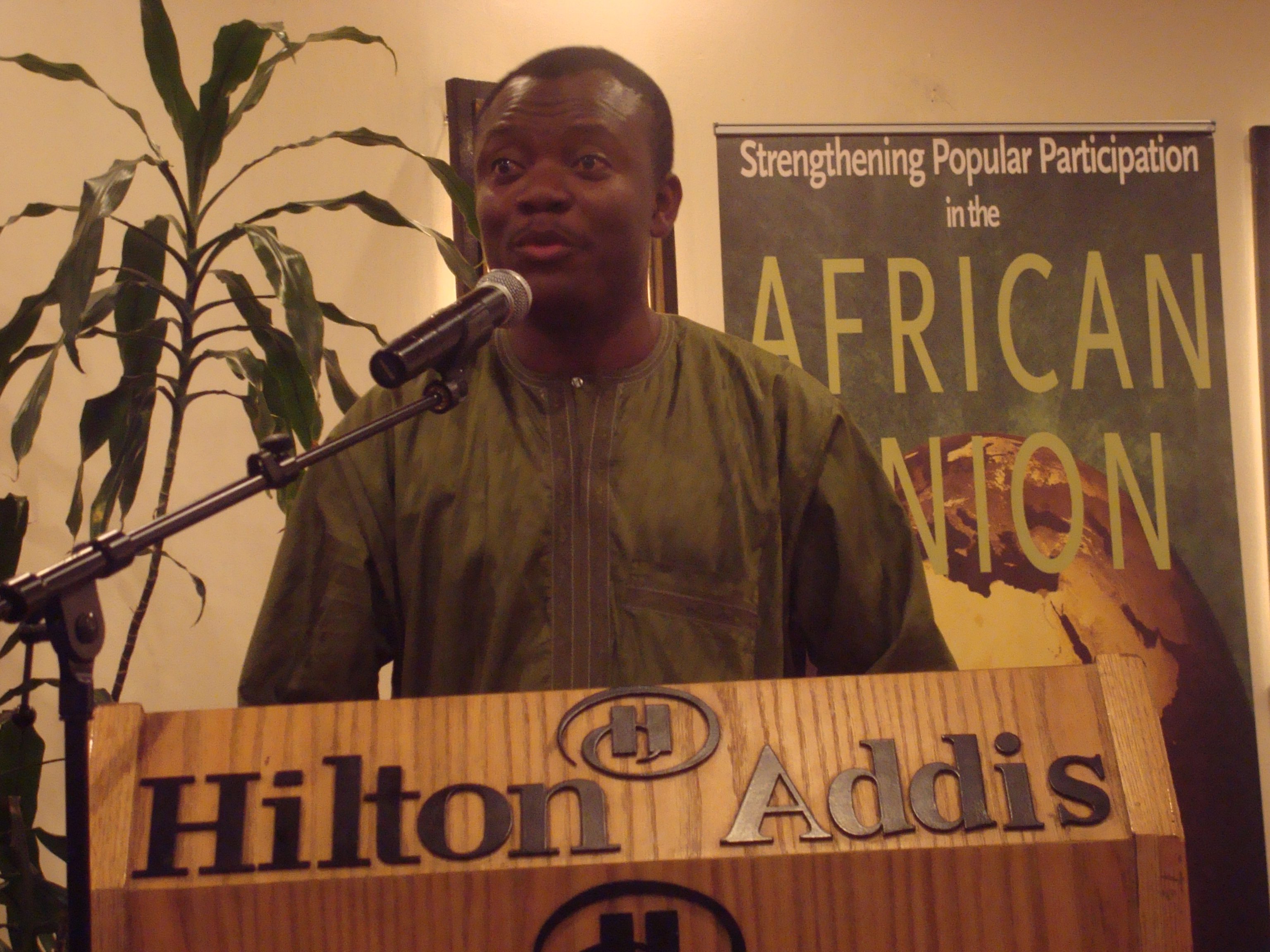
Citizens’ Participation in African Union Decision Making Process: Some Reflections

Recent developments at the African Union especially the launch of Agenda 2063 – The Africa We Want –  is a landmark step towards the realisation of “an integrated, prosperous and peaceful Africa, driven by its own citizens and representing a dynamic force in the global arena.” The Agenda itself recognises that people’s ownership and mobilisation is needed as one of the critical enablers to concretise the seven aspirations of what we can call the business plan of Africa. This must be true both at country, regional and continental level. Civic space is being terribly challenged in a growing number of countries on our continent. At the African Union level, CSOs/Citizens’ institutional space is clearly recognised in the founding documents of the AU (constitutive Act) as well as in other policies and instruments of the Union has been growing significantly in recent years but it is still not properly structured. Engagement is still informal in most cases.

Citizens/CSOs influencing space at the African Union must include two main set of targets: 1/AU Member States and 2/ African Union organs including the AU Commission (AUC) but also other organs based outside of Addis Ababa.  In addition, influencing and participation must be built on the decision making process of the African Union starting from policy proposals, the Permanent Representatives deliberations, Experts meetings, Ministerial meetings until the final adoption by the Summit or other organs of the Union. An efficient influencing strategy must include issue-based power analysis, countries’ geopolitical positions, and engaging specific departments of the AUC etc. without forgetting external actors’ influence.  Efficient influencing strategy must also take in consideration the annual calendar of events of the AUC normally adopted in January every year (now discussed in the June/July Summit). We should not also forget the fact that the African Union is looking for expertise and alternative analysis on particular issues. CSOs aiming to contribute must seek specialization and grassroots based perspectives that only CSOs have in most cases.

Decisions of the African Union Executive Council and Assembly are normally the result of work done months before each summit by the Commission and other organs, and in decision-making processes within individual member states. The majority of proposals presented to the Assembly at the Summit have already been largely agreed before they are tabled. Some of the reports on the Summit agenda are even adopted without any further discussions.

Documents adopted by the Assembly usually start life as a policy proposal from one of the AU Commission’s departments, from another AU organ or from a Member State. These proposals are debated in an experts’ meeting, whose members are nominated by Member States, and then in a meeting called for the relevant Ministers from Member States to approve or amend the experts’ proposals. With the exception of decisions with implications for the budget which are then considered by the PRC, the final documents from the ministerial meeting will go directly to the Executive Council and the Assembly for adoption.

desire2

Engaging with Experts and Ministerial Policy debate: Over the last 5 years or so, non-state actors’ engagement of the various steps of the AU Decision making process has been easier than ever, even though it remained informal and unstructured. Most of the departments of the AUC have been systematically inviting non-state actors to policy debates including experts and ministerial meetings. NGOs are even allowed to take the floor during those meetings and share their reports. Organizations that have shown interest in particular issues have normally had a chance to be part of policy discussions at experts and ministerial level as long as they keep contact with policy/desk officers at the AUC or other organs. In 2014/15 for example, my organization Oxfam and a number of its partners, African CSOs and other actors  have had numerous direct engagements with Experts and Minsters in charge of health, peace and security, humanitarian, rural economy and agriculture, economic affairs, trade and industries, human rights, gender etc. In many cases such engagement include participation in formal meetings, side meetings hosted by NGOs and well attended by policy makers including Ministers, Ambassadors, Commissioners and desk officer of the AUC. It is important to insist on the fact that, with very few exceptions, policy influence can only happen at ambassador, expert and ministerial meetings level. At the AU summit, most positions would have already been cooked and a good number of ministerial reports are no more open for discussion before adoption.

AU Summit, a networking opportunity: Normally, there is very little room to catalyze deep policy changes at the Summit level only. Engagement must start from the birth of the process described above. However influence on burning current or on-going issues are best done during the AU Summit. Also, issues on which countries have failed to reach strong consensus during the normal policy process come back to the Summit. The AU Summit equally presents an important opportunity for networking for further engagements and for media work to raise and draw policy makers’ attention on important and current issues. It is also an unique opportunity for organizations, donors and other personalities operating on a wide range of issues from the whole continent and elsewhere to be at the same place at the same time. Non-State actors can hold policy influencing side events during the AU Summit and have delegations to attend. A number of pre-summit consultations are held by CSOs including women groups. ECOSOCC and CIDO are also supposed to hold CSOs pre-summit events but this has not been consistent in recent years.

Observers (CSOs) Accreditation to the AU Summit: Non-state actors’ access to AU Summit has not been properly structured so far and it is difficult to know the actual criteria used by the AUC to identify CSOs to be invited. Organizations working with specific departments at the AUC can forward their applications to those departments. The Citizens and Diaspora Directorate normally post a call for application on the AU website 3 months before the Summit. I am not sure this has been systematic though.

Due to space constraint, the AU Commission makes choices likely based on the timing of application, role envisaged in the Summit, activities related to the themes of the Summit, history of the organization requesting accreditation and institutional relation with the African Union organs etc. CSOs intending to participate in the Summit must first of all apply formally and this needs to be done at least 3 months before the Summit. NGOs having a MoU with the African Union are normally systematically invited to the Summit even though it is not always the case. It is always advisable to make a request ahead of every summit if you wish to be invited.

The current trend since January 2013 is that January Summits seem to be more open to observers (CSOs & Non-African Countries, Int. Gov. Organizations etc.) while access to the mid-year summits are more and more restricted. Speculations indicate that Ambassadors complain about the disturbances at Summit meetings by partners (donors) who host multiple bi-lateral meetings with member state delegations while formal summit policy meetings are running. I have personally witnessed situations where Heads of State and their Ministers of foreign affairs and at times the Ambassadors leave Summit meetings in order to meet with partners. A formal decision is likely to be taken on this issue during the 25th Summit in South Africa in June 2015.

CSOs must not be restricted because of the disturbance caused by partners during the Summits. The AU Summit is an unique strategic and symbolic space where citizens and their formations have a chance to interact with high level policy makers in the corridors, during official opening and closing ceremonies and social events. CSOs also use it for media work including press briefings interview and other media programme.

It is well understood that CSOs do not attend close debates of policy makers during the Summit however the AU Commission itself recognises that Observers including CSOs “are entitled to attend the working sessions of the Executive Council dealing with agenda item of which the AU Commission considers that they are concerned I am not aware of any case where CSOs have used this provision always included in the AU invitation letters to Summits.

As a way forwards: while African CSOs must stand against any closure  or shrinking of the AU Summit space (an unique and legitimate continental policy and networking space for African citizens) we should effectively organize ourselves to engage on a consistent and continued basis, the most influential policy spaces of the African Union which are the experts and ministerial meetings as well as engagement of the Addis Ababa based Permanent Representatives, various AU organs/ desks etc. Access to those spaces is more and more open.

To read more on this issue, get our AU Compendium here: https://www.oxfam.org/en/research/african-union-compendium

Note: Views in this blog are absolutely personal.


La Journée de l’Afrique 2015: De l’OUA… retour à l’OUA?

La Journée de l’Afrique est célébrée chaque année le 25 mai. Elle marque la fondation de l’Organisation de l’unité africaine (OUA) le 25 mai 1963. Ce jour-là, les dirigeants de 30 des 32 Etats africains indépendants ont signé la charte fondatrice de l’OUA à Addis-Abeba, en Ethiopie. En 2002, l’OUA a été officiellement remplacée par l’Union africaine (UA).

Alors que les principaux objectifs de l’OUA étaient de débarrasser le continent des vestiges de la colonisation et de l’apartheid ainsi que de promouvoir l’unité et la solidarité entre les États africains, la nouvelle Union Africaine visait “une Afrique intégrée, prospère et en paix, tirée par ses propres citoyens et représentant une force dynamique dans l’arène internationale ».

Nous pouvons donc conclure que l’OUA a atteint ses principaux objectifs en assurant la pleine indépendance politique du continent et en contribuant à éliminer l’apartheid en Afrique du Sud. Franchement parlant, l’OUA n’a jamais été question de démocratie ou la participation des citoyens. L’OUA était une organisation de dirigeants africains, dont la majorité avait pris le pouvoir par la lutte politique ou par la force.

Lors du Sommet l’Union Africaine à Lomé en 2000, lorsque le nouvel Acte constitutif de l’UA a été adopté, Alors que j’etais responsable du département « Formation Civique » de la radio national du Togo “Radio Lomé”, j’ai diffusé une émission radio intitulée “De l’Union des Chefs d’Etat à l’Union des Citoyens ». Je me souviens encore de l’excitation et du grand espoir des citoyens africains à faire partie d’une nouvelle organisation continentale qui vise la sécurité humaine, la prospérité, le développement et la participation citoyenne.

Comment se portent aujourd’hui l’Union africaine et ses États membres depuis sa mise en place en 2002 pour ouvrir les portes de la prospérité, la sécurité la paix,  la démocratie et les droits de l’homme sur notre continent? Les citoyens ont – ils véritablement eu la chance de participer pleinement? Quid de la mise en œuvre des principes clés qui assureront une Afrique démocratique, respectueux des droits de l’homme et des peuples, et, pouvant débloquer le potentiel du développement? Qu’y a-t-il de la gestion responsable de nos ressources humaines et naturelles pour le bénéfice du continent et de ses filles et fils ?

Aujourd’hui, quand je regarde le Burundi, la RDC, le Togo, l’Ouganda, le Congo, le Soudan, le Soudan du Sud, le Zimbabwe, la Libye, le Cameroun, la Gambie … pour ne citer que quelques-uns, ma question est la suivante: 15 ans après la Déclaration de Lomé, avons vraiment fait chemin vers  l’UA? Ou sommes-nous toujours en train d’osciller autours des pratiques de l’OUA?

Quand je me souviens que 40.000 citoyens africains ont péri dans la mer Méditerranéenne au cours des 15 dernières années (2000 morts depuis Janvier 2015) en essayant de fuir le continent, je me demande si nos dirigeants sont vraiment fiers d’eux-mêmes.

Quand je vois le Président Burundais jouer au football publiquement avec ses amis lorsque plus de 110.000 de ses con-citoyens, y compris les enfants non-accompagnés se perdent dans les collines cherchant  refuge dans les pays voisins, fuyant la persécution … et, au moment où la protestation  se poursuivait, la police tirant à balles réelles et des dirigeants de l’opposition assassinés dans la ville … ma question: Est-ce l’Afrique que nous voulons pour le 21e siècle?

34 des 54 pays africains sont appelés «pays les moins avancés” dans un continent très riche, quand au moins 1 milliard de dollars sortent illégalement  du continent sous la forme de flux financiers illégaux chaque jour par des multinationales avec la complicité  de leurs pays d’accueil et bien sûr aussi de notre propre leadership.

L’Afrique possède  plus de 90% des ressources de chrome dans le monde, 85% de sa platine, 68% de cobalt, 54% d’or, en plus d’importantes réserves de pétrole et de gaz. Notre continent abrite également  des dépôts d’uranium, de manganèse, de diamants, de bauxite et de phosphate en très grandes quantité et qualité.

Dans l’ensemble, lorsque je constate le silence et l’hésitation de nos institutions régionales et pan africaines pour hausser le ton et prendre des mesures concrètes, je me sens terriblement triste, j’ai honte de mon continent, et je suis révolté ….

La Journée de l’Afrique 2015 devrait être un moment de réflexion continental … Le 25 mai n’est observé comme un jour férié que dans cinq pays africains: le Ghana, le Mali, la Namibie, la Zambie et le Zimbabwe. Elle doit être une journée de réflexion et d’action continentale.

Le Sommet des Chefs d’État  de l’UA qui se tiendra en Afrique du Sud dans quelques semaines est une occasion pour nos dirigeants d’examiner  leurs responsabilités et de prendre des décisions audacieuses.

Cette année et l’année à venir (2016: Année de droits de l’homme) devraient être des années pour nouvelle révolution des citoyens africains. Les partenaires du monde entier doivent soutenir fermement Une citoyenneté active, y compris les actions pour revendiquer et obtenir des comptes des détenteurs du pouvoir et la mise en œuvre de nos valeurs communes. Sans cela, notre Agenda 2063 sera un document vide et un pur mensonge pour les générations futures.

Je crois fermement que si le système de gouvernance est amélioré dans le continent, l’Union africaine et ses communautés régionales commencent à jouer leur rôle pleinement et véritablement en mettant la pression sur les gouvernants nationaux en vertu des principes adoptés, les traités et conventions; si les citoyens y compris les jeunes sont mobilisés et solidaires  nous verrons un meilleur continent émerger dans quelques années.

Bonne Journée de l’Afrique !

NB : Mes réflexions sont absolument personnelles en n’engagent pas mon organisation.

Financing for Development Debate @ African Union – Report.

Dear Friends

If you missed the Grand Debate on Financing for Development (FFD) on Tuesday, get the attached Press Statement/Report published by the African Union. You can also download it here:
http://ea.au.int/en/sites/default/files/PR%20128%20-%20Fridays%20of%20the%20Commission%20Debate%20stressed%20on%20a%20robust%20fair%20and%20equitable%20agreement%20during%20the%20July%202015%20Third%20Conference%20on%20Financing%20for%20.pdf 

  or 

http://ea.au.int/en/content/fridays-commission-towards-third-international-conference-financing-development 

How to Finance Africa Sustainable Development Post 2015?

Public Debate – Towards the Third Financing for Development Conference in July 2015 – Tuesday 19 May 2015 from 14:00  @ African Union Commission Headquarter

My Opening Remarks

**********

Excellency, Ladies and Gentlemen, all protocol observed,

Thank you for joining this public debate co-hosted by the African Union Commission’s Department for Economic Affairs and Oxfam Liaison Office to the African Union

The Third International Conference on Financing for Development (FfD) will take place on 13-16 July 2015, in Addis Ababa, Ethiopia.

We expected the conference to be held at the highest possible political level, including Heads of State or Government, relevant ministers – ministers for finance, foreign affairs and development cooperation – and other special representatives.

This conference will set the scene for governments’ efforts to mobilize development finance to achieve the Sustainable Development Goals (SDGs) set for the period 2016 – 2030.

Decisions of the  FfD must be bold, visionary, and lead to transformative change if today we are to create universal equitable and sustainable prosperity within planetary boundaries, and fulfil international human rights obligations for future generations.

FFD must build on the foundations of the previous FfD in 2002 in Mexico which is “to eradicate poverty, achieve sustained economic growth and promote sustainable development as we advance to a fully inclusive and equitable global economic system.”

The Third FFD Meeting will be then crucial to ending extreme poverty and tackling inequality everywhere. The conference will also lay the foundation for an agreement in September in New York on the new sustainable development goals, and for a binding climate-change agreement in December in Paris

The Financing for Development process come at a critical time, and must deliver on a number of issues for other crucial global agreements to bear fruit.

This conference will be the 3rd to be organized. The last one happened in Monterrey in Mexico in 2002.

The Addis Ababa event will have a different dimension compare to the previous FFD in Monterrey

  • Monterrey took place after agreement had been reached on the MDGs, while Addis will happen before formal the adoptions of the Sustainable Development Goals
  • Monterrey was focused on a government-to-government agreement but a larger number of stakeholders will be involved in Addis Ababa, including businesses, academics, civil society, scientists, and local authorities.

The conference should unlock finance from many different sources, including but not exclusively aid, to implement the upcoming Sustainable Development Goals.

Addis Ababa meeting will take place in the context of a slow global growth, in a world being devastated by conflicts and facing serious natural disasters and climate issues.

Agreements should have significant consequences for successful implementation of the SDGs at national, regional and global level.

Recommendations should be clearly actionable, with next steps in implementation that are easy to understand, easy to confirm and easy to tract.

There are other previous commitments already made which have not yet been met. There is a need for renewed efforts to meet these commitments; such commitments include meeting the target to provide 0.7% of Gross National Income in Official Development Assistance (ODA).

Given the high expectations placed on the FFD3 and the need to deliver tangible results, it is expected that the Addis Ababa Agreement mobilize international action around specific initiatives focusing on education, health, smallholder agriculture and nutrition, infrastructure etc.

The global scene and challenges have changed since the setting up of the MDGs.

We now have more scientific knowledge about climate change, rapidly growing tax evasion, unsustainable debt burdens, and the impact of trade agreements on domestic resource mobilization in developing countries.

Least Developed Countries (LDCs) have faced many of the greatest challenges in making progress toward the MDGs.

With limited trade and financial links to the rest of the world, LDCs have not gained substantial benefits from globalization, yet they are bearing many of the costs of global progress, such as climate change.

Since the FfD3 process began, lines seem to be drawn, between the global South and the global North.

The Group of 77 and China (G77) the African Group, the Least Developed Countries, Brazil, India, and other states and blocs consistently defend the right to development.

Developed countries including the European Union, the United Kingdom, the United States, Japan and others assert that all countries have to take responsibility.

FFD must result in finding resources for the upcoming SDGs: This must include both financial resources, non-financial measures including technology transfer and capacity building, as well as international systemic issues of finance, trade, tax etc.

Ladies and Gentlemen,

Radical change is needed in the development finance architecture to make it fair and just…

For every $1 dollar developing countries gain from development partners, they lose around $2 dollars (especially in illicit financial flows and debt repayments).

Aid figures are minimized by outflows from corporate tax dodging and illicit flows, lending to developed countries, and profits to private investors.

To rebalance the terms of international financing, to ensure developing countries get their just and fair share, courageous decisions must be taken in Addis Ababa.

As a priority, governments must create a system that ensures multinational companies pay tax where the economic activity takes place and limit discretionary tax incentives so that the hundreds of billions in potential tax revenue credit governments’ budgets.  


A Few Questions to Ourselves:

How are we going to deal with Domestic Public Finance?

Are we seeing it as Primary source of development, or complement to aid?

How do we mobilize it, How do we manage it properly?

How do we ensure accountability and transparency on the use of our national resources in order to finance our development?

Who has the responsibility to track and stop Illicit Financial Flows?

What about those assets illegally taken from Africa mostly through practices of tax evasion, trade and services mispricing as well as transfer pricing abuses by transnational corporations?

How do we deal with the lost of  $50-$60 billion a year in illicit financial outflows from Africa. An amount that is more or less equal to the total foreign direct investment (FDI) and more than the total Development Assistance that the continent receives annually?

How do we respond to Domestic and International Private Business and Finance, being promoted by western partners?

Are the current rules of International Trade favourable for Sustainable Development?

Ladies and Gentlemen, these are some of the questions on the table…

Make sure your opinion and your voice are heard in this debate.

The outcome of this discussion will be compiled in a report to be widely disseminated.
How should Africa’s development be financed?

Colleagues & Friends: You are all invited tomorrow to join us physically of virtually on twitter. Please share this advisory widely!

*** Media advisory for Tuesday, May 19 2015***

How should Africa’s development be financed?

Grand Debate will build consensus on African priorities before FfD3

WHAT: Oxfam and the African Union, as part of the Fridays of the AU Commission regular meeting schedule, invite media to a public discussion on what should be African priorities at the UN Third Conference on Financing for Development (FfD3) scheduled less than eight weeks from now in Addis Ababa.

Discussants will include diplomatic representatives from AU member states and other continents, AUC, Pan-African institutions such as UNECA, African Development Bank (AfDB), Pan-African Parliament and Regional Economic Communities (RECs), multi-lateral and donor agencies, African civil society organizations (CSOs), international non-governmental organizations (INGOs), academia, and community-based organizations.

The July FfD3 negotiations by member states must define innovative ways of mobilizing resources to drive development while addressing extreme poverty, inequality and underdevelopment – the framework to finance the post-2015 sustainable development goals (SDGs). Proposals may include domestic resource mobilization and tax reform, new commitments to Official Development Assistance (ODA), global changes for debt and macroeconomic policies, climate change financing, the role of private sector finance in development, and monitoring mechanisms to ensure commitments are met.

Oxfam is organizing this event to encourage the mobilization of all constituencies towards FfD3.

WHO: Speakers who will be available to meet with and answer questions from the media are:

  • Mr. Charles Akelyira: Chief Executive Officer, the Savannah Accelerated Development Authority & Commissioner: Ghana National Development Planning CommissionFormer Director of the United Nations Millennium Campaign for Africa
  • AUC Representative, presenting the results from the FFD African Regional Consultation 2015
  • Dr. Vanessa Inko-Dokubo, Oxfam Pan Africa Policy Advisor on Extractive Industries
  • Dr. Réné Kouassi, Director of Economic Affairs, African Union Commission
  • Mr. Desire Assogbavi, Head of Office, Oxfam International Liaison Office to the African Union (Moderator)

These speakers may be available at other times for interviews. Please contact us to arrange

WHEN: Tuesday, May 19, 2015 14:00 – 18:00 pm

WHERE: AU Commission Headquarters, New Builing, Addis Ababa http://ea.au.int/en/sites/default/files/announcement%20EN%20final_rev1.pdf

Please ask questions during the Debate online using #FFDdebate and follow @assodesire, @Oxfam_AU, @palabanapalms, @Octavio_diogo

Media Contact: Sue Rooks sue.rooks@oxfaminternational.org +1 917 224 0834

Why Should Africa Join the Arms Trade Treaty? – My Speech to African Ambassadors today

“African States and CSOs Consultation on the Arms Trade Treaty”

Why Should Africa Join the Arms Trade Treaty?

Opening Speech by Desire Assogbavi

Head of Oxfam International, Liaison Office to the African Union

Friday 15th May, 2014 – Radisson Blue Hotel, Addis Ababa

IMG_2379

Your Excellences, Ladies and Gentlemen

Welcome and thank you for joining us today in this informal discussion on the ATT co-hosted by Oxfam and Control Arms with the Support of PAX

Arm violence is having a huge impact on our continent. The costs of this violence can be found not just in the many innocent people killed or injured by arms, but also in the impact on the society more broadly. It undermines economies, over-burdens healthcare systems, causes the displacement of entire communities and disrupt education for millions of children. Some of this violence is being perpetrated with an existing pool of weapons, fresh supplies of arms and ammunition, flood into Africa on an almost daily basis.

95% of the weapons being used in Africa’s conflicts are made outside the continent. Greater efforts must be made, to prevent the irresponsible transfer of weapons fuelling Africa’s conflicts and poverty… Today The universalization and the implementation of the  ATT is the solution.

A commentator noted that, bananas, tomatoes and bubble gum are more restricted in markets than the trade of AK-47. Africa should aim for a universal ratification of the Arms Trade Treaty, and for its robust implementation, through regional cooperation.

Although there are many continental and regional agreements on arms in Africa, the globalization of the arms trade will best be controlled through

the Arms Trade Treaty (ATT) that came into force in December 2014.

The ATT binds exporters and importers and put firm regulations on the global, regional and national circulation of arms to minimize the impact of conflicts.

The unregulated trade in arms aggravates poverty and undermines our development goals.

We believe that African nations can contribute to the effective regulation of arms through ratifying, acceding to and implementing the ATT. This will lead to more effective governance of arms and security forces, reduce corruption and arms diversion, and help prevent arms entering illegal markets.

In addition, such action will help build a global practice for the effective control of arms transfers, and force sceptic states like Russia, the US and China to comply with the ATT in order to continue sales to African ATT member States. Signing and Ratifying the ATT alone will not bring peace to Africa but it will build a voice against uncontrolled arms and limit the horrifying effects of conflicts.

Insecurity in connection to arms has been one of the prime concerns of the AU. The initiative and framework of Silencing the Guns by 2020, and its inclusion with the AU vision 2063,  illustrates a strong commitment to control flow and unauthorized use of arms in the continent.

Oxfam is keen to work with the AU on ensuring that Africa becomes a leader on arms control, not just within the continent but across the world.

Africa’s place in ATT global forums awaits to be maximised but this will not happen without joining the Treaty.

So today, we would like to:

  1. Update you on the Arms Trade Treaty process
  2. Discuss opportunities and challenges on the ratification and implementation of the ATT,
  3. Draw roadmap to the first Conference of State Parties of August 2015

African States played an important role in the negotiations and the adoption of the ATT. Our continent insisted on the inclusion of ammunition in the treaty and supported calls for strong provisions based around international human rights and humanitarian law. Many African states played a pioneering role in making the ATT happen. Notably, Africa lobbying of China was decisive in achieving the inclusion of Small Arms and Light Weapons in the categories of arms controlled under the treaty. Forty seven African States voted in favour of ATT at the UN General Assembly.

However, despite this level of support, Africa is currently under-represented amongst ratifying States, with 10 States only having ratified the Treaty as of April 2015. In the course of consultations, with your support, we identify the reasons behind the modest number of countries ratifying the ATT and use this information to develop strategies to match each particular situation to contribute to your efforts towards a safer Africa.

If Africa remains largely outside the Treaty, the voices of the states and the voices of the people will not be heard in the current negotiations of key issues in the framework of the Preparatory Committees.

I would like to share with you some figures reflecting the cost of conflicts in Africa

The Cost of Peace Keeping Operations in Africa

MINUSCA: CAR: annual approved budget (07/2014– 06/2015): $628,724,400

  • United Nations Multidimensional Integrated Stabilization Mission in Mali (MINUSMA): Approved budget: (07/2014– 06/2015): $830,701,700
  1. United Nations Organization Stabilization Mission in the Democratic Republic of the Congo (MONUSCO): Approved budget (07/2014 – 06/2015): $1,398,475,300
  2. African Union-United Nations Hybrid Operation in Darfur (UNAMID): Approved budget (07/2014 – 06/2015): $1,153,611,300
  3. United Nations Mission in the Republic of South Sudan (UNMISS): Approved budget(07/2014 –Approved budget (07/2014 – 06/2015): $493,570,300

I am sure you would agree with me that Africa must join the ATT.

I thank you.

IMG_2459

Burundi: The African Union Must Catch Up Quickly!

La version en Français ici: wp.me/p4ywYV-4J

The situation in Burundi is becoming more and more serious. Police is firing live ammunitions at protesters; armed militias are terrorizing citizens. 24,000 people have already fled the country, including mayors of some areas … At least 12 people have died dozens were seriously injured and over 600 arrested and detained in inhumane conditions…

Yesterday, the Vice President of the Constitutional Court of Burundi Sylvère Nimpagaritse denounced pressures and death threats on his person during the assessment of the constitutionality of 3rd term of the incumbent president. He then fled the country. During deliberations of the Court, while 4 out of 7 members thought the 3rd mandate is unconstitutional, the court deferred its decision. Thus, the death threats started by the government … It is now clear that this court is no more credible and none shall consider its decisions.

The African Union Must Catch up

In its communiqué of 28 April 2015, The Peace and Security Council (PSC) of the African Union has merely ” took note that the Burundian Senate has seized the Constitutional Court on the interpretation of the Constitution regarding the eligibility of President Pierre Nkurunziza’s candidature for re-election and urged all Burundian stakeholders to respect the decision of the Constitution”. The Chairperson of the AU Commission took the same position on her Twitter account a few days before… I had already found this position as weak and ineffective in view of the gravity of the situation on the ground, being aware of the strong influence of the political authorities on the State institutions. Limiting the solution of the Burundian problem to the decision of the current Constitutional Court is simply paving the way for a constitutional coup by the current authorities.  Everyone knows about this practice in many countries in our continent.

Given the gravity of the situation in Burundi, it is no longer enough to just ask the “stakeholders to respect the constitution and the Arusha Agreements.” The African Union must be clear and state that a 3rd term is purely against the constitution and the spirit of the Arusha Agreement.

I believe that the African Union has a certain influence on Burundi. In the past, the AU has led with success a peacekeeping operation in Burundi. The AU has invested its troops and resources in Burundi. Today, the African Union must avoid hesitation and be categorical. We can no more allow a new civil war in Burundi. Our continent has no mean to handle it. We already have too many problems to solve; too many challenges to face. The last civil war in Burundi killed 250,000 people.

Now that the Constitutional Court has no more credibility, the African Union and the PSC must seek advice of their legal bodies on the constitutionality of the 3rd term in Burundi in order to fix this issue once and for good. It is a historic responsibility. Yesterday our continental body missed similar opportunity in Burkina Faso until citizens ousted their dictator. Today a new opportunity shows up for the African Union to join the rest of the world and isolate President Nkurunziza.

The risk of a military coup in Burundi is very high right now. We should not get there. Africa must stop projecting the image of a continent with brutal methods. Political isolation of President Nkurunziza by the African Union will certainly force him to pull back…

The Peace and Security Council must meet urgently to denounce the interference of the Burundian authorities in the functioning of the Constitutional Court, dissociate itself from any decision of a court being ordered by the political power and declare the 3rd term unconstitutional and against the Arusha Agreements.

Note: My opinions are absolutely personal and do not commit my organization

L’Union Africaine doit Sauver le Burundi en Urgence !

English version here: wp.me/p4ywYV-4S

La situation au Burundi devient de plus en plus grave. La police tire à balle réelle sur les manifestants, les milices armées par le pouvoir en place terrorisent les populations. 24,000 personnes ont déjà fui le pays y compris des maires des localités… Au moins 12 personnes ont déjà trouvé la mort des dizaines sont gravement blessées et plus de 600 personnes arrêtées et détenues dans des conditions inhumaines…

Hier, le vice-président de la Cour Constitutionnelle du Burundi Sylvère Nimpagaritse a dénoncé des pressions et menaces de mort sur sa personne dans le cadre de l’évaluation de constitutionalité de la 3eme candidature du président sortant, et a fui le pays.  Lors des délibérations de la Cour, alors que 4 membres sur 7 pensaient que le 3eme mandat est inconstitutionnel, la cour a reporté sa décision. Dès lors, les menaces de mort ont commencé de la part du pouvoir en place… Il est désormais claire que cette cour n’est plus crédible et personne ne dois plus prendre en compte sa décision.

L’Union Africaine doit vite se rattraper !  

Dans son communique du 28 Avril 2015, le Conseil de Paix et de Sécurité de l’Union Africaine s’est borné à « prendre note de la saisine de la Cour Constitutionnelle par le Sénat burundais pour l’interprétation de la Constitution du Burundi en ce qui concerne la recevabilité de la candidature du Président Nkurunziza pour réélection », en demandant aux parties prenantes burundaises de respecter la décision que prendra la Cour Constitutionnelle. La Présidente de la Commission de l’Union Africaine a pris la même position sur son compte Twitter quelques jours au paravent… J’avais déjà jugé cette position de faible et inefficace eu égard à la gravité de la situation sur le terrain étant conscient de la mainmise des autorités politiques  sur les institutions de l’Etat.  Ramener la solution Burundaise à la décision de la « Cour constitutionnelle c’est tout simplement paver la voie au coup d’état constitutionnel du Président Nkurunziza ; tout le monde connait cette pratique de certains pouvoirs africains.

Face à la gravité de la situation au Burundi, il ne suffit plus de demander  aux «parties prenantes de respecter la constitution et les accords d’Arusha». L’Union Africaine doit être claire en déclarant que le 3eme mandat est inconstitutionnel et contre les accords d’Arusha.

Je crois que L’Union Africaine a une influence certaine sur le Burundi, l’Union y a mené dans le passé, avec un certain succès des opérations de maintien de la   paix, l’Union y a investi ses hommes et ses ressources. Aujourd’hui,  l’Union Africaine doit éviter la tergiversation et être catégorique. Il n’est pas question de laisser une nouvelle guerre civile se déclencher au Burundi. Notre continent n’a pas de moyen pour la gérer. Nous avons déjà trop de problèmes à régler ; trop de défis à relever. La dernière guerre civile au Burundi avait fait 250,000 morts.

L’Union Africaine et le CPS devraient avoir demandé l’avis de leurs organes juridiques sur la constitutionalité du 3eme mandat au Burundi et en découdre une fois pour de bon. C’est une responsabilité historique. Hier, notre institution continentale a raté l’occasion de s’imposer au Burkina Faso jusqu’à ce que les citoyens Burkinabè aient chassé eux-mêmes leur dictateur. Aujourd’hui une nouvelle chance s’offre à l’Union Africaine  de se joindre au reste du monde pour isoler le Président  Nkurunziza.

Le risque d’un coup d’état au Burundi est très grand en ce moment. Il ne faut absolument pas en arriver. L’Afrique doit cesser de projeter l’image d’un continent aux méthodes brutales. Une isolation politique  et catégorique du Président Nkurunziza par l’Union Africaine pourra certainement le faire fléchir….

Le Conseil de Paix et de sécurité doit se réunir d’urgence  pour dénoncer l’entrave des autorités burundaise au fonctionnement de la Cour Constitutionnelle, se désolidariser de toute décision d’une Cour aux ordres du pouvoir politique et  déclarer le 3eme mandat inconstitutionnel et contre les accords d’Arusha.    

NB : Mes opinons sont absolument personnelles et n’engagent en rien mon organisation.  

Burundi is burning – Act NOW!

We cannot afford another conflict in Africa at this time. Burundi came from very far and it took a lot of resources, energy and human life to get to the Arusha Peace Agreement. The whole Africa, the African Union and other International actors must standup and be clear on this: No possibility for 3rd term! Please, no more diplomatic or ambiguous language! Citizens are being killed in Bujumbura now; the risk for another human made disaster is very high. Our continent already has enough challenges to face.

The Peace and Security Council must clearly say NO to a 3rd mandate. We have no resources for an additional peace enforcement mission. African cannot continue wasting its resources to make peace while it is easier to abide to democratic principles and our shared values. We need our resources to boost development and take care of our populations, provide free universal health care, promote education, science and technology etc. in order to reach our 2063 targets.

Me must not keep silence and let innocent populations being killed over and over again because of the selfishness of a few leaders. A strong position of the African Union against Nkurunziza’s move for a 3rd term can have an influence. Burkina Faso was a missed opportunity; our Continental Body must seize this one…

Burundi may not be like Burkina Faso because a lot fire arms are circulating there. We may not be able to stop it once it gets worst and the whole region will be affected… So, no time to waste – Act now !

Can the Closing Space for CSOs in Africa be reopened?

By Désiré Assogbavi

This article was published in GREAT Insights Volume 4, Issue 3 (April/May 2015).

Can the closing space for CSOs in Africa be reopened?

The African Union Agenda 2063 recognises that people’s ownership and mobilisation is needed as one of the critical enablers to concretise the seven aspirations of what can be called the business plan of Africa. However, as the Agenda is being launched, citizens’ and civil society organisations’ space is being terribly challenged in a growing number of countries on the continent.


Active citizens for effective and prosperous states


The positive and inclusive economic development that we are aspiring to in Africa requires a vibrant civil society and citizens taking a participative stand in it. Active citizens are fundamental prerequisites for the effective states that we need to change in Africa in order to meet the 2063 outcomes. It is therefore important that the issue of closing of CSOs’ space is dealt with at all levels and now urgently at continental level with a strong role from the African Union (AU) itself.

In a prosperous and democratic society, state and vibrant civil society are two sides of the same coin and must complement each other. Civil society must be seen as a reservoir of social capital capable of contributing to all aspects of the country’s development including health, education, peace, security etc. The role and influence of civil society in national and regional policy making does not diminish the relevance of governmental or inter-governmental processes —rather it enhances it. Nor does it lessen the authority of governments. While civil society can help to put issues on the agenda, only governments have the power to decide on them. The constructive engagement of civil society can reinforce deliberations by informing them, sensitising them to public opinion and grass-roots realities, increasing public understanding of decisions and enhancing accountability.

On peace and security for example, because of its immersion within the society, civil society has vocation and the ability to contribute to peace building initiatives and social cohesion. Civil society has shown its capacity to organise collection, analysis and evaluation of first-hand information allowing the identification of the sources of potential tensions as well as emerging conflicts. Whereas traditional conflicts were well understood by diplomats and specialists in political science, adequately addressing new conflicts requires much more on-the-ground understanding, new skills of social and cultural analysis, the active involvement of communities and their leaders, links to vulnerable groups, bridges into mainstream development processes and new ways of working. Most of the time, civil society organisations have unique capacities in all those areas.


Increased control and undue restrictions on CSOs


Unfortunately, in a growing number of African countries, there is increased control and undue restrictions on the formation and the activities of CSOs.

A common trend on this is to use the issue of foreign funding received by national civil society groups while there are no alternatives proposed by the government. Governments raise a variety of other reasons to justify the restrictive regulations. Some of the concerns are understandable, especially those genuinely linked to security, terrorism, religious extremism and other unlawful activities, but the majority are not and rather reflect a wiliness to shut down legitimate claims for fundamental human rights. In some cases even criticisms and alternative proposals for economic development and social choices are not tolerated. This is happening not just in Africa but globally. Some governments perceive CSOs as economic saboteurs, inciters of violence, or an extension of political opposition parties or even agents of foreign interest. Unfortunately in many cases, reacting to the shrinking of CSOs space, the international community and partner countries balance their interventions in preserving fundamental rights with competing economic and security interests. This is an additional wakeup call for citizens, especially in Africa, that the fight for civic space must be grounded within the continent at national, sub-regional and continental level.


Civil society space at regional and continental level


Regional civil society and coalitions targeting regional and pan African institutions have an important role to play as a complement and a backup to national groups. They are less exposed to risks compared to national CSOs and in many cases they can really contribute, influence and pressurise member states through the regional and continental bodies on regional policy issues. Regional Economic Communities (RECs) react differently to CSO/non-state actor engagement. ECOWAS for example seems to be more open to CSOs than the other RECs but the general trend is more encouraging at regional than at national level.

Despite the recent polemic of the closure of the mid-year African Union Summit to observers including non-African countries but also CSOs, I have observed an increased participation of non-state actors, CSOs and coalitions in the policy process of the African Union over the last five years. Technical experts and ministerial policy debates have been incredibly opened to CSOs as observers all year long in between the bi-annual Summits of the AU. In 2014, the African Union Commission even authorised non-state actors to hold a Continental Conference on Agriculture and Food Security at the AU headquarters. At the same time, Addis Ababa-based country representatives and members of the Peace and Security Council have been open to meet and engage with various CSO groups to discuss important policy issues. Part of the mandate of Oxfam Liaison Office to the African Union is to support this engagement by CSOs.

My office, in the framework of its Active Citizenship programme sponsors over 100 CSOs representatives each year to engage with various organs of the AU. This includes an annual training on Understanding the African Union jointly conducted with the AU Commission. But despite its importance, regional and continental engagement should not replace national CSO spaces, but rather complement it.


Reopening CSOs at national level: The African Union must step in


African countries can only gain from their definitive move towards economic and social development in allowing a genuine participation of all stakeholders, but too many countries on the continent, members of the AU, have adopted and continue to adopt national legislations reducing civic space. It is then important that the AU steps in on this unfortunate trend to seriously question the shrinking of civil society space in a number of its member states and stop it. Agenda 2063 rightly said that the realisation of the agreed aspirations needs the ownership and mobilization of African People (…) in their various formations”. This must start at national level. While discussions are currently happening on the implementation plan of Agenda 2063, the AU must consider adopting a special declaration to stop the closing of civic space in its member countries. The African Year of Human Rights (2016) declared by the Assembly of the Union is another opportunity for the AU to boldly free CSO spaces in its member states. This will be a precious gift to African citizens that will make them proud of the continental body. Of course the implementation of or the compliance to such a declaration by member states is another issue to question but this can be the starting point of a process towards a stronger policy framework and commitment of the AU members to ensure the realisation of Agenda 2063. The African Commission on Human and People Rights’ existing working group on CSOs’ space could also play an important and decisive role in tracking those hostile CSOs’ laws and bring them to AU policy organs. In fact, the AU task force in charge of the implementation of Agenda 2063 must take this issue seriously into consideration.

desire assogbavi photo

Désiré Assogbavi is the Resident Representative and Head of Oxfam International Liaison Office to the African Union.

The views expressed in this article are those of the author and do not necessarily represent the views of Oxfam.