Oxfam at the African Union: How Change Happened in 2015/16

I am pleased to present you, attached, our 2015/16 overview: a summary of the key outcomes and impacts of our work from January 2015 to March 2016. It can also be read online here: https://issuu.com/85991/docs/2016_review_final/1

Last year, our team worked closely with over 100 national and regional NGOs and coalitions OI-AU Annual Review 2015/16 to engage with and contribute in various decision-making processes of the African Union. Our partners and staff participated in more than 20 gatherings of AU policy organs, and met with AU Permanent Representatives and officials of the African Union Commission and other organs. Over 10,000 African citizens regularly received our “AU Weekly” bulletin and other daily alerts on policy issues and activities of the African Union Commission.

In collaboration with the AU’s Directorate of Information and Communication and other partners, we trained over 100 citizens, NGO leaders and media practitioners from the 5 geographical regions of Africa on Understanding and engaging the African Union. Throughout the year, we supported the work of the peace and security organs of the AU, linking policy makers with citizens and affected populations from the 35 African countries where Oxfam operates. Highlights included our work on Central African Republic, Liberia, Sierra Leone, and South Sudan. We worked with the Peace and Security Council to ensure that community voices were heard in the discussions at the PSC. Our experts were invited to serve as resource persons at several PSC sessions.

We were part of the 3rd UN Conference on Financing for Development in July advocating for a truly visionary financing framework to both bolster inclusive growth and tackle poverty across the developing world.

We launched an unprecedented Africa-China Dialogue Platform, a multi-stakeholders forum aiming to encourage and facilitate a permanent and constructive engagement and dialogue of citizens, policy makers, researchers and other stakeholders on the growing partnership between Africa and China.

Looking ahead, we will remain focused on addressing inequality and the injustice of poverty in communities affected by crises, food shortages, lack of educational opportunities, gender inequality, and lack of accessible health care. Our collective power to tackle these issues is remarkable. We are also committed to ensuring that civic space is open and available for citizens and affected populations to make their voices heard.

I would like to express my sincere gratitude to Oxfam colleagues in Addis Ababa and around the world as well as our volunteers who contributed to these achievements. I also thank the African Union leadership and departments of the African Union Commission, the embassies, and civil society partner organisations for their collaboration and support. Finally, I would like to thank our host, the Government of Ethiopia and in particular the Ministry of Foreign Affairs and the Department of Immigration for their consistent support.

Warm Regards

 **************

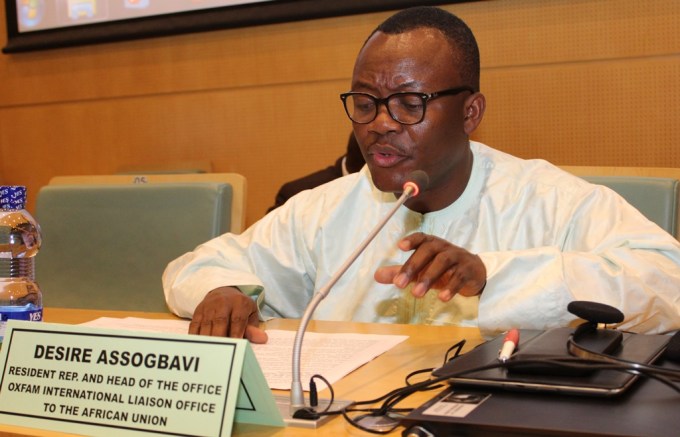
 DÉSIRÉ ASSOGBAVI (Mr) | Resident Representative & Head of Office

 Oxfam International Liaison Office to the African Union

 TK Building 2 – 6th Floor, Bole Airport Area | Addis-Ababa, Ethiopia | GMT+3

 Tel.: +251 11661 1601 | Mobile: +251 911 20 83 32 | Fax: +251 11 661 2795

 E-mail: Desire.Assogbavi@oxfaminternational.org | Alt e-mail: assodesire@yahoo.com

 www.oxfam.org | http://www.twitter.com/oxfam | Skype: assodesir

 l Personal twitter: @assodesire I Personal Blog: assodesire.com

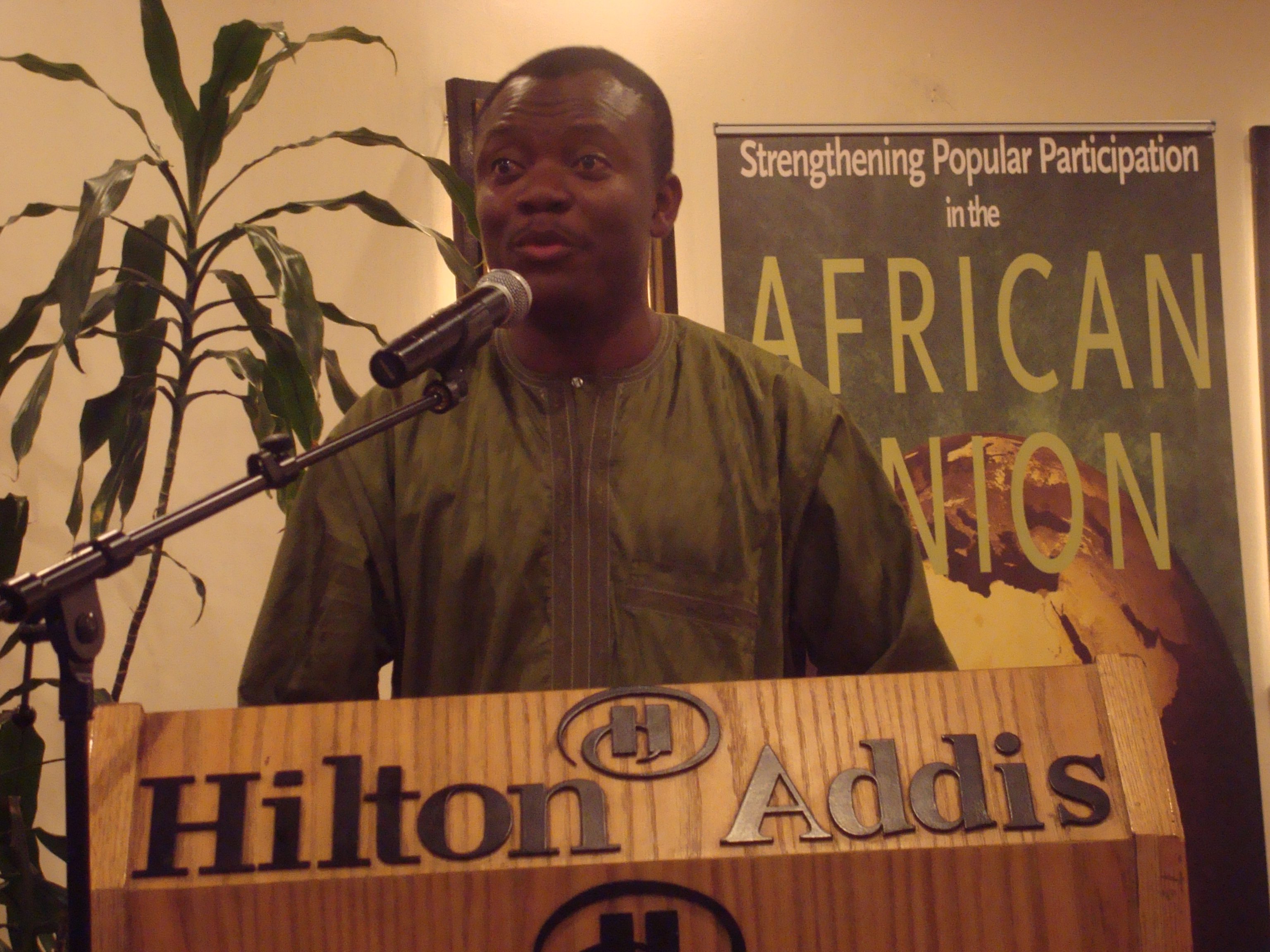
WESTERN SAHARA: “40 FACES, 40 YEARS – A LIFETIME IN EXILE” – African Union Headquarters, 25th April 2016: My Opening Remarks

WS1

Your Excellency Dr. Aisha Laraba Abdullahi, Commissioner for Political Affairs of the African Union

Your Excellency Amb. Yilma Tadesse, Senior Representative of the AU to MINURSO
Ambassadors, Directors and representatives of International Organizations,

Ms. Umetha Hamdi, and Mr. Mahmud Mohamed, from the Western Sahara Refugee Camp

Colleagues & Friends, Ladies and Gentlemen, All protocol observed…. Good Morning and Thank you for joining us !

Oxfam Liaison Office to the African Union is delighted to co-host this event on the Sahrawi refugee crisis with the African Union Commission.
I would like to explicitly thank the Bureau of the Chairperson, the Department of Political Affairs and the Peace and Security Department for this fruitful cooperation and support.
This photo exhibition, and the seminar with the participation of Sahrawi from the refugee’s camps – comes at a crucial time.
60 million people in the world are displaced today from their home. Many of them are forced to flee because of conflict or despair. Among them are the Sahrawi refugees, who have been displaced for forty years.
Ladies and Gentlemen;
As a humanitarian and development organisation present in 90 countries around the world including 38 in Africa, Oxfam works together with local partners, to fight poverty and related injustice.
When doing so, we base ourselves on the international legal framework and we are mindful to bring out the voices and wishes of the concerned communities — The Sahrawi refugees are no exception.
The Sahrawi refugee crisis is old, complex and it reminds the international community, and particularly Africa, of a painful colonial history. But, the Sahrawi situation is virtually unknown in the world, or, worse — ignored. This must change.
Oxfam has been working with partners to deliver humanitarian assistance to Sahrawi refugees since 1975. We are committed to sharing more information and we are working to make this humanitarian crisis more visible, showing the dire conditions in which refugees have been living for 40 years. We work to ensure that more diplomats, analysts and journalists can visit the refugee camps to see first-hand, the situation and, most importantly, hear from refugees themselves—as we all will do today.
This photo exhibition is part of our attempt to shed light on people that have never experienced anything other than life as a refugee. These 40 men and women live in the heart of the Sahara desert, in a remote and harsh environment. The Sahrawi refugees remain heavily dependent on humanitarian aid and still, there is no prospect that this will change any time soon.
We are planning to bring this exhibition to many cities on different continents in order to address the absence of knowledge on this crisis.

Chers Amis,
Deux choses sont importantes pour Oxfam:
D’abord, nous devons subvenir pleinement aux besoins des réfugiés sahraouis. Les besoins de base sont encore loin d’être couverts, en partie, à cause de l’environnement particulièrement sévère, et à cause d’un manque de sources de financement pour la crise.
Après 40 ans, les donateurs devraient également tenir compte des aspirations des réfugiés, en particulier les jeunes. Se limiter à expédier de l’aide est inacceptable. Nous devrions aider la population à se prendre en charge, a être capables de renforcer leur communauté et, construire leur vie d’une manière définitive et en dehors des camps de réfugiés.
Ceci me conduit à mon deuxième point: les causes profondes de la crise doivent être embrassées et traitées par la communauté internationale. Les réfugiés sahraouis doivent avoir la possibilité de vivre avec dignité et de construire leur vie en dehors des camps.
Ce conflit doit être réglé par voie de négociations pacifiques en vue de trouver une solution politique juste, durable et mutuellement acceptable, qui permette l’autodétermination du peuple du Sahara Occidental.
Ce mois d’avril est un moment important dans le contexte du Sahara occidental, en particulier au niveau de l’ONU. Les principaux acteurs doivent être conscients du cadre juridique international et se rappeler des promesses faites au peuple du Sahara Occidental.
Mesdames et Messieurs,
L’Organisation de l’Unité Africaine, le prédécesseur de l’Union Africaine, a joué un rôle important dans le cadre des accords qui ont été conclus au début des années 90, y compris l’accord de cessez-le feu et un référendum.
Les événements récents qui menacent l’espoir d’une résolution négociée, risquent non seulement de régénérer la violence et des souffrances humaines inutiles, mais aussi de compliquer davantage la recherche d’une solution durable, mutuellement acceptable, conformément au droit international.
Nous sommes à la croisée des chemins en ce qui concerne la crise des réfugiés sahraouis. La communauté internationale doit se mettre ensemble et travailler à trouver des compromis.
Laisser un problème de côté ne va jamais le résoudre —, bien au contraire, il s’aggravera avec toutes les conséquences imaginables.
Oxfam espère continuer à travailler avec l’Union Africaine et d’autres acteurs dans la recherche d’une solution à cette crise.
Que ces 40 visages de 40 personnes vivant dans une situation humanitaire catastrophique, et qui luttent pour prendre le contrôle de leur vie —- soient une source de motivation pour nous tous, pour les décideurs et les détenteurs du pouvoir partout…
La pauvreté à laquelle ce peuple est confrontée, et l’impact humain plus large de cette crise est une injustice qui n’a que trop duré.`
Je vous remercie pour votre attention.

Access to Rights and Governance in the Context of Fragile States

By Désiré Assogbavi

It is universally accepted that human rights are indivisible and interdependent. It is not enough that rights are recognized in national law or policy rhetoric: there should be mechanisms for their full exercise by citizens with no discrimination. But how shall we deal with access to rights in fragile states?

A fragile state has a government is not able to deliver core functions to the majority of its populations. This is true for a wide range of situations, but usually involves a combination of weak administrative capacity and territorial reach, lack of state control over the use of violence, and the lack of accountability to populations, particularly poor and marginalized people. A state is fragile when it is unable to provide for the security and development of a majority of its citizens. A decade ago, most countries in fragile situations were low-income; today, a good number of them are middle-income countries.

The majority of citizens in highly fragile states are known to be poor, experience repeated violence, and suffer economic exclusion and inequality. Is fragility ever an excuse for a lack of respect for human rights, then?

Despite all principles supporting human rights, the reality is that in conflict and post-conflict situations, or other contexts of fragility, there is a breach of individual rights and personal security. In most cases, this includes the violation of a number of other rights due to weak state institutions and state’s inability (but also lack of political will) to meet the basic needs of the population.

Which rights must be met and which should be met, and when and by whom?

The very first step should be the observance of the core principles of human rights: equality, non-discrimination, participation, empowerment, and accountability. Inclusivity and non-discrimination, as well as transparency, are particularly helpful in reducing the tensions and frustration of rights holders, even when state institutions are not able to provide all the rights they are due. This is particularly true when various constituencies including civil society are given the chance to participate in the realization of rights and to promote the inclusive design and organization of democratic institutions such as electoral processes, so as to ensure and facilitate the involvement and participation of socially and economically marginalized and vulnerable groups. Such reform should include measures to support the ability of such groups to exercise their freedoms of association, assembly, and expression.

Prioritization and sequencing?

The International Bill of Human Rights – including the Universal Declaration of Human Rights, the International Covenant on Economic, Social and Cultural Rights, and the International Covenant on Civil and Political Rights – indicates a series of rights. But there is no guidance as to which comes first, especially today, when we are strongly convinced of the interdependency of those rights.

Some rights cannot be derogated

Some rights cannot be derogated: Article 4 (2) of the International Covenant on Civil and Political Rights sets out those groups of rights which can never be restricted or derogated. These include the rights to be free from arbitrary deprivation of life; torture and other ill-treatment; slavery, retroactive penalty, and the violation of freedom of thought, conscience, and religion. Article 4 provides for the derogation of other rights during periods of national emergency, under strictly limited circumstances.

In certain situations of the state’s incapacity or even total failure, it may not be possible to restore all services and meet all needs immediately. We are then forced to prioritize and determine which rights must be met first and which are to be realized over a certain timeframe. This is the concept of the progressive realization of rights.

The Covenant on Economic, Social and Cultural Rights allows for the progressive realisation of those rights over time, subject to some limitations (mentioned above). Some economic rights must be met at all times, however, including basic requirements for food and shelter.

Whose responsibility?

Unless we get to a situation of the total inexistence of a government, the state has the responsibility to respect the fundamental rights of citizens regardless of the situation. Fundamental rights are not favors given by the state or the government; they are duty, and those in power must account for this duty.

Fragile states may not have the institutional means to meet all of their rights obligations in a particular period, but it has become common to see other actors taking over some of the duties of the state in terms of meeting basic rights. This seems to be the only way to deal with the situation, and there is still room for improvement.

Different UN bodies have the duty to ensure the protection of rights, depending on the situation. These include the Security Council, with or without the consent of national authorities, the General Assembly, ECOSOC, etc. This protection is normally provided through various forms of intervention within the framework of “peace missions”: Human Rights Rapporteurs, ad hoc Commissions of Inquiry, etc. The UN can also send a mission to assume administrative authority in the state (Côte d’Ivoire, Kosovo, East Timor). But political and ideological interests should have a diminishing influence on any of the solutions, and only a better configuration of the UN Security Council can allow this to happen.

Responsibility of other actors?

Civil Society/NGOs: Because of their flexibility and ability to rapidly respond to crises (less bureaucratic, less driven by politics and interests, ability to mobilize resources) coupled with their experience as well as professional staff, NGOs are playing a growing role in the realization of rights in all situations, especially in fragile contexts. They must be encouraged and empowered to continue playing that role in the post-2015 era. The current shrinking of their space, especially in Africa, must be strongly combatted by all means national, regional and international.

The watchdog role of CSOs in monitoring public and private actors should be of great interest, as it can catalyze accountability for the respect or implementation of human rights, particularly in the context of fragility. It must be strongly supported by all stakeholders.

What about business? The UN Guiding Principles require business, as specialized organs of society performing specialized functions, to comply with all applicable laws, including international laws, and to respect human rights. This applies regardless of a state’s ability and/or willingness to fulfill its own human rights obligations. But when businesses have become part of the problem, then something must be done to change their accountability as we enter the post-2015 zone. Multinationals occur in an number of fragile contexts, and have been seen taking advantage of these areas in a variety of ways, mostly in conflict zones, as catalyzers or perpetuators of the fragility of the state. Their actions have included deal making with arms groups and governments in the Democratic Republic of Congo, Central African Republic, South Sudan, and others.

Every year, fifty billion US dollars disappear from Africa through illicit financial flows. At least 70% of these outflows are from extractive industries, some of them in fragile states where national budgets do not meet basic economic rights. Countries like the United States have taken interesting steps to tackle this issue, but we need global coordinated action.

About the Author

Desire Assogbavi is a Lawyer from Togo and currently the Resident Representative of Oxfam International to the African Union in Addis Ababa, Ethiopia. He was formally a Commissioner at the National Human Rights Commission and the National Inter-Ministerial Commission on International Humanitarian Law of Togo

The views expressed in the article are entirely those of the author and are not necessarily the views of his organization.
Citizens’ Participation in African Union Decision Making Process: Some Reflections

Recent developments at the African Union especially the launch of Agenda 2063 – The Africa We Want –  is a landmark step towards the realisation of “an integrated, prosperous and peaceful Africa, driven by its own citizens and representing a dynamic force in the global arena.” The Agenda itself recognises that people’s ownership and mobilisation is needed as one of the critical enablers to concretise the seven aspirations of what we can call the business plan of Africa. This must be true both at country, regional and continental level. Civic space is being terribly challenged in a growing number of countries on our continent. At the African Union level, CSOs/Citizens’ institutional space is clearly recognised in the founding documents of the AU (constitutive Act) as well as in other policies and instruments of the Union has been growing significantly in recent years but it is still not properly structured. Engagement is still informal in most cases.

Citizens/CSOs influencing space at the African Union must include two main set of targets: 1/AU Member States and 2/ African Union organs including the AU Commission (AUC) but also other organs based outside of Addis Ababa.  In addition, influencing and participation must be built on the decision making process of the African Union starting from policy proposals, the Permanent Representatives deliberations, Experts meetings, Ministerial meetings until the final adoption by the Summit or other organs of the Union. An efficient influencing strategy must include issue-based power analysis, countries’ geopolitical positions, and engaging specific departments of the AUC etc. without forgetting external actors’ influence.  Efficient influencing strategy must also take in consideration the annual calendar of events of the AUC normally adopted in January every year (now discussed in the June/July Summit). We should not also forget the fact that the African Union is looking for expertise and alternative analysis on particular issues. CSOs aiming to contribute must seek specialization and grassroots based perspectives that only CSOs have in most cases.

Decisions of the African Union Executive Council and Assembly are normally the result of work done months before each summit by the Commission and other organs, and in decision-making processes within individual member states. The majority of proposals presented to the Assembly at the Summit have already been largely agreed before they are tabled. Some of the reports on the Summit agenda are even adopted without any further discussions.

Documents adopted by the Assembly usually start life as a policy proposal from one of the AU Commission’s departments, from another AU organ or from a Member State. These proposals are debated in an experts’ meeting, whose members are nominated by Member States, and then in a meeting called for the relevant Ministers from Member States to approve or amend the experts’ proposals. With the exception of decisions with implications for the budget which are then considered by the PRC, the final documents from the ministerial meeting will go directly to the Executive Council and the Assembly for adoption.

desire2

Engaging with Experts and Ministerial Policy debate: Over the last 5 years or so, non-state actors’ engagement of the various steps of the AU Decision making process has been easier than ever, even though it remained informal and unstructured. Most of the departments of the AUC have been systematically inviting non-state actors to policy debates including experts and ministerial meetings. NGOs are even allowed to take the floor during those meetings and share their reports. Organizations that have shown interest in particular issues have normally had a chance to be part of policy discussions at experts and ministerial level as long as they keep contact with policy/desk officers at the AUC or other organs. In 2014/15 for example, my organization Oxfam and a number of its partners, African CSOs and other actors  have had numerous direct engagements with Experts and Minsters in charge of health, peace and security, humanitarian, rural economy and agriculture, economic affairs, trade and industries, human rights, gender etc. In many cases such engagement include participation in formal meetings, side meetings hosted by NGOs and well attended by policy makers including Ministers, Ambassadors, Commissioners and desk officer of the AUC. It is important to insist on the fact that, with very few exceptions, policy influence can only happen at ambassador, expert and ministerial meetings level. At the AU summit, most positions would have already been cooked and a good number of ministerial reports are no more open for discussion before adoption.

AU Summit, a networking opportunity: Normally, there is very little room to catalyze deep policy changes at the Summit level only. Engagement must start from the birth of the process described above. However influence on burning current or on-going issues are best done during the AU Summit. Also, issues on which countries have failed to reach strong consensus during the normal policy process come back to the Summit. The AU Summit equally presents an important opportunity for networking for further engagements and for media work to raise and draw policy makers’ attention on important and current issues. It is also an unique opportunity for organizations, donors and other personalities operating on a wide range of issues from the whole continent and elsewhere to be at the same place at the same time. Non-State actors can hold policy influencing side events during the AU Summit and have delegations to attend. A number of pre-summit consultations are held by CSOs including women groups. ECOSOCC and CIDO are also supposed to hold CSOs pre-summit events but this has not been consistent in recent years.

Observers (CSOs) Accreditation to the AU Summit: Non-state actors’ access to AU Summit has not been properly structured so far and it is difficult to know the actual criteria used by the AUC to identify CSOs to be invited. Organizations working with specific departments at the AUC can forward their applications to those departments. The Citizens and Diaspora Directorate normally post a call for application on the AU website 3 months before the Summit. I am not sure this has been systematic though.

Due to space constraint, the AU Commission makes choices likely based on the timing of application, role envisaged in the Summit, activities related to the themes of the Summit, history of the organization requesting accreditation and institutional relation with the African Union organs etc. CSOs intending to participate in the Summit must first of all apply formally and this needs to be done at least 3 months before the Summit. NGOs having a MoU with the African Union are normally systematically invited to the Summit even though it is not always the case. It is always advisable to make a request ahead of every summit if you wish to be invited.

The current trend since January 2013 is that January Summits seem to be more open to observers (CSOs & Non-African Countries, Int. Gov. Organizations etc.) while access to the mid-year summits are more and more restricted. Speculations indicate that Ambassadors complain about the disturbances at Summit meetings by partners (donors) who host multiple bi-lateral meetings with member state delegations while formal summit policy meetings are running. I have personally witnessed situations where Heads of State and their Ministers of foreign affairs and at times the Ambassadors leave Summit meetings in order to meet with partners. A formal decision is likely to be taken on this issue during the 25th Summit in South Africa in June 2015.

CSOs must not be restricted because of the disturbance caused by partners during the Summits. The AU Summit is an unique strategic and symbolic space where citizens and their formations have a chance to interact with high level policy makers in the corridors, during official opening and closing ceremonies and social events. CSOs also use it for media work including press briefings interview and other media programme.

It is well understood that CSOs do not attend close debates of policy makers during the Summit however the AU Commission itself recognises that Observers including CSOs “are entitled to attend the working sessions of the Executive Council dealing with agenda item of which the AU Commission considers that they are concerned I am not aware of any case where CSOs have used this provision always included in the AU invitation letters to Summits.

As a way forwards: while African CSOs must stand against any closure  or shrinking of the AU Summit space (an unique and legitimate continental policy and networking space for African citizens) we should effectively organize ourselves to engage on a consistent and continued basis, the most influential policy spaces of the African Union which are the experts and ministerial meetings as well as engagement of the Addis Ababa based Permanent Representatives, various AU organs/ desks etc. Access to those spaces is more and more open.

To read more on this issue, get our AU Compendium here: https://www.oxfam.org/en/research/african-union-compendium

Note: Views in this blog are absolutely personal.


How should Africa’s development be financed?

Colleagues & Friends: You are all invited tomorrow to join us physically of virtually on twitter. Please share this advisory widely!

*** Media advisory for Tuesday, May 19 2015***

How should Africa’s development be financed?

Grand Debate will build consensus on African priorities before FfD3

WHAT: Oxfam and the African Union, as part of the Fridays of the AU Commission regular meeting schedule, invite media to a public discussion on what should be African priorities at the UN Third Conference on Financing for Development (FfD3) scheduled less than eight weeks from now in Addis Ababa.

Discussants will include diplomatic representatives from AU member states and other continents, AUC, Pan-African institutions such as UNECA, African Development Bank (AfDB), Pan-African Parliament and Regional Economic Communities (RECs), multi-lateral and donor agencies, African civil society organizations (CSOs), international non-governmental organizations (INGOs), academia, and community-based organizations.

The July FfD3 negotiations by member states must define innovative ways of mobilizing resources to drive development while addressing extreme poverty, inequality and underdevelopment – the framework to finance the post-2015 sustainable development goals (SDGs). Proposals may include domestic resource mobilization and tax reform, new commitments to Official Development Assistance (ODA), global changes for debt and macroeconomic policies, climate change financing, the role of private sector finance in development, and monitoring mechanisms to ensure commitments are met.

Oxfam is organizing this event to encourage the mobilization of all constituencies towards FfD3.

WHO: Speakers who will be available to meet with and answer questions from the media are:

  • Mr. Charles Akelyira: Chief Executive Officer, the Savannah Accelerated Development Authority & Commissioner: Ghana National Development Planning CommissionFormer Director of the United Nations Millennium Campaign for Africa
  • AUC Representative, presenting the results from the FFD African Regional Consultation 2015
  • Dr. Vanessa Inko-Dokubo, Oxfam Pan Africa Policy Advisor on Extractive Industries
  • Dr. Réné Kouassi, Director of Economic Affairs, African Union Commission
  • Mr. Desire Assogbavi, Head of Office, Oxfam International Liaison Office to the African Union (Moderator)

These speakers may be available at other times for interviews. Please contact us to arrange

WHEN: Tuesday, May 19, 2015 14:00 – 18:00 pm

WHERE: AU Commission Headquarters, New Builing, Addis Ababa http://ea.au.int/en/sites/default/files/announcement%20EN%20final_rev1.pdf

Please ask questions during the Debate online using #FFDdebate and follow @assodesire, @Oxfam_AU, @palabanapalms, @Octavio_diogo

Media Contact: Sue Rooks sue.rooks@oxfaminternational.org +1 917 224 0834

Burundi: The African Union Must Catch Up Quickly!

La version en Français ici: wp.me/p4ywYV-4J

The situation in Burundi is becoming more and more serious. Police is firing live ammunitions at protesters; armed militias are terrorizing citizens. 24,000 people have already fled the country, including mayors of some areas … At least 12 people have died dozens were seriously injured and over 600 arrested and detained in inhumane conditions…

Yesterday, the Vice President of the Constitutional Court of Burundi Sylvère Nimpagaritse denounced pressures and death threats on his person during the assessment of the constitutionality of 3rd term of the incumbent president. He then fled the country. During deliberations of the Court, while 4 out of 7 members thought the 3rd mandate is unconstitutional, the court deferred its decision. Thus, the death threats started by the government … It is now clear that this court is no more credible and none shall consider its decisions.

The African Union Must Catch up

In its communiqué of 28 April 2015, The Peace and Security Council (PSC) of the African Union has merely ” took note that the Burundian Senate has seized the Constitutional Court on the interpretation of the Constitution regarding the eligibility of President Pierre Nkurunziza’s candidature for re-election and urged all Burundian stakeholders to respect the decision of the Constitution”. The Chairperson of the AU Commission took the same position on her Twitter account a few days before… I had already found this position as weak and ineffective in view of the gravity of the situation on the ground, being aware of the strong influence of the political authorities on the State institutions. Limiting the solution of the Burundian problem to the decision of the current Constitutional Court is simply paving the way for a constitutional coup by the current authorities.  Everyone knows about this practice in many countries in our continent.

Given the gravity of the situation in Burundi, it is no longer enough to just ask the “stakeholders to respect the constitution and the Arusha Agreements.” The African Union must be clear and state that a 3rd term is purely against the constitution and the spirit of the Arusha Agreement.

I believe that the African Union has a certain influence on Burundi. In the past, the AU has led with success a peacekeeping operation in Burundi. The AU has invested its troops and resources in Burundi. Today, the African Union must avoid hesitation and be categorical. We can no more allow a new civil war in Burundi. Our continent has no mean to handle it. We already have too many problems to solve; too many challenges to face. The last civil war in Burundi killed 250,000 people.

Now that the Constitutional Court has no more credibility, the African Union and the PSC must seek advice of their legal bodies on the constitutionality of the 3rd term in Burundi in order to fix this issue once and for good. It is a historic responsibility. Yesterday our continental body missed similar opportunity in Burkina Faso until citizens ousted their dictator. Today a new opportunity shows up for the African Union to join the rest of the world and isolate President Nkurunziza.

The risk of a military coup in Burundi is very high right now. We should not get there. Africa must stop projecting the image of a continent with brutal methods. Political isolation of President Nkurunziza by the African Union will certainly force him to pull back…

The Peace and Security Council must meet urgently to denounce the interference of the Burundian authorities in the functioning of the Constitutional Court, dissociate itself from any decision of a court being ordered by the political power and declare the 3rd term unconstitutional and against the Arusha Agreements.

Note: My opinions are absolutely personal and do not commit my organization

L’Union Africaine doit Sauver le Burundi en Urgence !

English version here: wp.me/p4ywYV-4S

La situation au Burundi devient de plus en plus grave. La police tire à balle réelle sur les manifestants, les milices armées par le pouvoir en place terrorisent les populations. 24,000 personnes ont déjà fui le pays y compris des maires des localités… Au moins 12 personnes ont déjà trouvé la mort des dizaines sont gravement blessées et plus de 600 personnes arrêtées et détenues dans des conditions inhumaines…

Hier, le vice-président de la Cour Constitutionnelle du Burundi Sylvère Nimpagaritse a dénoncé des pressions et menaces de mort sur sa personne dans le cadre de l’évaluation de constitutionalité de la 3eme candidature du président sortant, et a fui le pays.  Lors des délibérations de la Cour, alors que 4 membres sur 7 pensaient que le 3eme mandat est inconstitutionnel, la cour a reporté sa décision. Dès lors, les menaces de mort ont commencé de la part du pouvoir en place… Il est désormais claire que cette cour n’est plus crédible et personne ne dois plus prendre en compte sa décision.

L’Union Africaine doit vite se rattraper !  

Dans son communique du 28 Avril 2015, le Conseil de Paix et de Sécurité de l’Union Africaine s’est borné à « prendre note de la saisine de la Cour Constitutionnelle par le Sénat burundais pour l’interprétation de la Constitution du Burundi en ce qui concerne la recevabilité de la candidature du Président Nkurunziza pour réélection », en demandant aux parties prenantes burundaises de respecter la décision que prendra la Cour Constitutionnelle. La Présidente de la Commission de l’Union Africaine a pris la même position sur son compte Twitter quelques jours au paravent… J’avais déjà jugé cette position de faible et inefficace eu égard à la gravité de la situation sur le terrain étant conscient de la mainmise des autorités politiques  sur les institutions de l’Etat.  Ramener la solution Burundaise à la décision de la « Cour constitutionnelle c’est tout simplement paver la voie au coup d’état constitutionnel du Président Nkurunziza ; tout le monde connait cette pratique de certains pouvoirs africains.

Face à la gravité de la situation au Burundi, il ne suffit plus de demander  aux «parties prenantes de respecter la constitution et les accords d’Arusha». L’Union Africaine doit être claire en déclarant que le 3eme mandat est inconstitutionnel et contre les accords d’Arusha.

Je crois que L’Union Africaine a une influence certaine sur le Burundi, l’Union y a mené dans le passé, avec un certain succès des opérations de maintien de la   paix, l’Union y a investi ses hommes et ses ressources. Aujourd’hui,  l’Union Africaine doit éviter la tergiversation et être catégorique. Il n’est pas question de laisser une nouvelle guerre civile se déclencher au Burundi. Notre continent n’a pas de moyen pour la gérer. Nous avons déjà trop de problèmes à régler ; trop de défis à relever. La dernière guerre civile au Burundi avait fait 250,000 morts.

L’Union Africaine et le CPS devraient avoir demandé l’avis de leurs organes juridiques sur la constitutionalité du 3eme mandat au Burundi et en découdre une fois pour de bon. C’est une responsabilité historique. Hier, notre institution continentale a raté l’occasion de s’imposer au Burkina Faso jusqu’à ce que les citoyens Burkinabè aient chassé eux-mêmes leur dictateur. Aujourd’hui une nouvelle chance s’offre à l’Union Africaine  de se joindre au reste du monde pour isoler le Président  Nkurunziza.

Le risque d’un coup d’état au Burundi est très grand en ce moment. Il ne faut absolument pas en arriver. L’Afrique doit cesser de projeter l’image d’un continent aux méthodes brutales. Une isolation politique  et catégorique du Président Nkurunziza par l’Union Africaine pourra certainement le faire fléchir….

Le Conseil de Paix et de sécurité doit se réunir d’urgence  pour dénoncer l’entrave des autorités burundaise au fonctionnement de la Cour Constitutionnelle, se désolidariser de toute décision d’une Cour aux ordres du pouvoir politique et  déclarer le 3eme mandat inconstitutionnel et contre les accords d’Arusha.    

NB : Mes opinons sont absolument personnelles et n’engagent en rien mon organisation.  

Burundi is burning – Act NOW!

We cannot afford another conflict in Africa at this time. Burundi came from very far and it took a lot of resources, energy and human life to get to the Arusha Peace Agreement. The whole Africa, the African Union and other International actors must standup and be clear on this: No possibility for 3rd term! Please, no more diplomatic or ambiguous language! Citizens are being killed in Bujumbura now; the risk for another human made disaster is very high. Our continent already has enough challenges to face.

The Peace and Security Council must clearly say NO to a 3rd mandate. We have no resources for an additional peace enforcement mission. African cannot continue wasting its resources to make peace while it is easier to abide to democratic principles and our shared values. We need our resources to boost development and take care of our populations, provide free universal health care, promote education, science and technology etc. in order to reach our 2063 targets.

Me must not keep silence and let innocent populations being killed over and over again because of the selfishness of a few leaders. A strong position of the African Union against Nkurunziza’s move for a 3rd term can have an influence. Burkina Faso was a missed opportunity; our Continental Body must seize this one…

Burundi may not be like Burkina Faso because a lot fire arms are circulating there. We may not be able to stop it once it gets worst and the whole region will be affected… So, no time to waste – Act now !