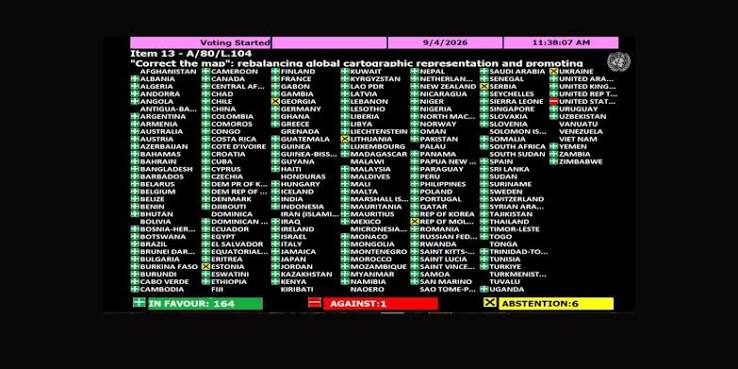
On 4 September, the UN General Assembly adopted a text that some years ago most people outside that room would have dismissed as decoration. Resolution A/80/L.104, “Correct the map: rebalancing global cartographic representation and promoting equitable representation of the world’s regions, particularly Africa,” passed by 164 votes to one, with six abstentions. Togo introduced it on behalf of the African Group. The United States voted against, calling it ideological. Estonia, Georgia, Lithuania, Moldova, Serbia and Ukraine abstained. Everybody else said yes.
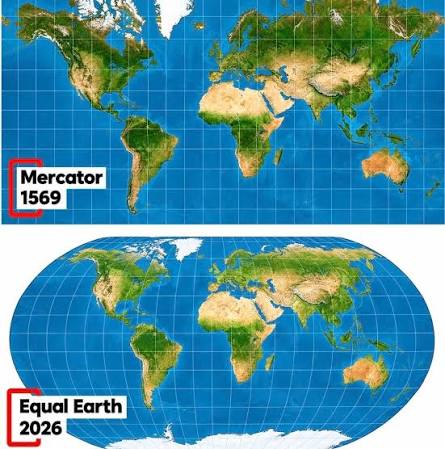
The resolution encourages governments, schools, publishers, international organizations and technology companies to move away from the Mercator projection and toward equal-area projections such as Equal Earth wherever the comparative size of continents actually matters. It is not binding. It redraws no borders, alters no maritime zone, and takes nothing away from anybody. Within hours, France announced it would drop Mercator from its official representations.
Predictably, some online arguments started before the applause finished. Cosmetic. A distraction. Africa has real problems and this isn’t one of them. I understand the impatience, but I think the critics have the wrong end of it.
Gerardus Mercator drew his projection in 1569 to help sailors hold a constant bearing across an ocean. For that, it remains excellent. The problem is what happened afterwards: a navigation tool became the default picture of the world, hung on classroom walls, printed in textbooks, embedded in news graphics and, later, coded into the mapping applications most of us carry in our pockets. And because it stretches landmasses the further you move from the equator, it does something quietly consequential. It shrinks the tropics. Africa covers about 30 million square kilometres, enough to hold the United States, China, India and most of Europe inside its outline with room to spare. On a Mercator map it looks roughly the size of Greenland, which is about fourteen times smaller.
I learned geography from that map. So did the people who now run our ministries, and the people who write about us from other capitals. Not one of us questioned it at the time. That is the whole argument. A distortion you are taught before you are old enough to interrogate it doesn’t register as a distortion at all. It registers as the world. Perception hardens into assumption, assumption into expectation, and expectation into how a continent gets treated in a boardroom, an editorial meeting or a donor conference. Fixing that is not decoration. It is a correction to the mental furniture of several billion people, and it cost nothing but organization.
Which brings me to the part of this story I find more interesting than the map.
Twice in 6 months
This was not a one-off. On 25 March, in the same hall, the General Assembly adopted resolution A/80/L.48, declaring the transatlantic trafficking of enslaved Africans and racialized chattel enslavement the gravest crime against humanity, and opening the door to a conversation about reparatory justice. Ghana carried that one, on behalf of the African Group, with the African Union and CARICOM behind it. President Mahama had given notice of the intention from the same rostrum six months earlier and then spent the interval building the coalition. It passed 123 to 3, with 52 abstentions.
Look at those two vote counts side by side, because they teach something.
The map resolution asked the world to change how it sees. It cost nothing, and it got 164 votes. The slavery resolution asked the world to accept a legal and moral characterisation with financial consequences attached. It got 123, and the entire European Union, plus Canada, Australia and Japan, sat on its hands. The lesson is not that one succeeded and the other didn’t. Both passed. The lesson is that the harder the ask, the more the outcome depends on how tightly Africa holds together, and the less anyone else’s goodwill will carry us.
What both votes had in common was method. One member state carried a mandate that belonged to all 54. The African Union Commission worked the ground beforehand. There was a single clear ask rather than a wish list. There were months of quiet consultation with jurists, scholars and other regional groups before anything reached the floor. And in the room, nobody broke ranks. That is not luck. That is craft, and we now have two demonstrations of it inside one year.
So the question I keep coming back to is not whether the map matters. It’s this: why do we only assemble that machine when the adversary is external?
The same technique, should be turned inward
Consider what we are carrying while we celebrate.
Africa now accounts for around 43 per cent of the world’s forcibly displaced people, roughly 45.7 million, and 96 per cent of them come from countries at war. In 2025 alone, conflict displaced 9.7 million people in the DRC, the highest figure that country has ever recorded and close to a third of the global total. Sudan remained the world’s largest internal displacement crisis for a third consecutive year with 9.1 million people uprooted, 62% of them in Darfur. Sub-Saharan Africa absorbed 14.5 million conflict displacements, about 45 per cent of the world’s total. The African Union’s “Silencing the Guns” Campaign was supposed to be done by 2020. It was rolled over to 2030. On present evidence it will be rolled over again unless something changes in how we approach it.
Now consider the resource question. The continent holds roughly 30 per cent of global reserves of the minerals the energy transition runs on. We produce more than 77% of the world’s cobalt, 83% of platinum group metals, 65% of manganese, and by 2030 we are projected to supply about 60% of global lithium and 40% of graphite. Africa’s share of participation in the global value chains built on those minerals sits at about 2%. Zimbabwe holds the continent’s largest lithium reserves and exports concentrate at around $10,000 a ton into a market where the refined material sells for roughly $40,000. Fifty-four different mining codes, fifty-four tax regimes, fifty-four investment frameworks, negotiating one at a time against buyers who are perfectly coordinated. We are not being outmaneuvered because we are weak. We are being outmaneuvered because we arrive separately.
And trade. 5 years into the AfCFTA, intra-African trade sits at only about 16% of the continent’s total, somewhere between $214 and $220 billion. In Asia the equivalent figure is around 59 per cent, in Europe around 68. UNECA estimates full implementation is worth $450 billion in cumulative GDP by 2035. The infrastructure financing gap standing between us and that number runs at $68 to $108 billion a year.
Every one of these is a problem that a coordinated African position could move, and that no African country will solve on its own. A continental floor for mineral beneficiation. A single negotiating mandate on critical minerals, the way we ran a single negotiating mandate on cartography. A peace and security architecture with the authority and the money to act in Sudan and eastern DRC without waiting for a Security Council that has told us for two decades what it thinks of the Ezulwini Consensus.
Africa Needs to Pay for it
There is one number that undercuts all of this, and we should stop being polite about it. In 2027, more than 79% of the African Union’s program budget is projected to be funded by international partners. Member States, African Institutions and internal sources’ financing of that program budget will be only 20.4%. The 0.2% cent import levy agreed at Kigali in 2016 to finance the African Union remains badly implemented a decade on.
We cannot ask the AU Commission to drive Agenda 2063 while three-quarters of its programs depend on money raised outside the continent. An institution funded by others will, eventually and however good its people are, take its priorities from others. If the map vote proved that the Commission could convene, sequence and land a continental campaign in a hostile diplomatic environment, then the honest response is to give it the means to do that on the things that cost us lives and money, not only on the things that cost the world nothing to concede.
What I hope our leaders take from this: A Stronger African Union
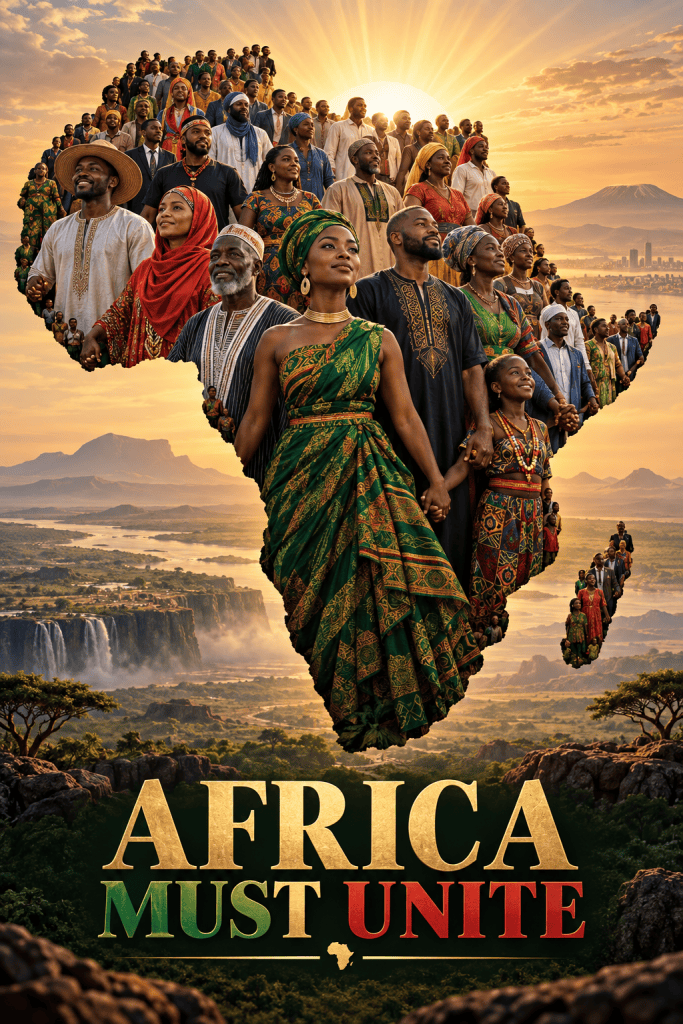
Twice this year, in the same hall, with the same method, Africa asked for something and got it. Not because the world grew generous, but because 54 states decided in advance what they wanted, chose one of their own to carry it, and refused to be split.
That is the lesson, and it has a very short shelf life. Symbolic wins are seductive precisely because they are cheap. The temptation now is to bank the applause, put the Equal Earth map on the wall at the next summit, and go back to negotiating our minerals one country at a time while Sudan burns.
The map was the easy correction. It was still worth making, and I would defend it against anyone who calls it trivial, because how you are seen shapes what you are offered. But the distortions that cost us most are not on any projection. They are in a continent that trades only 16% with itself, captures only 2% of the value of its own minerals, hosts nearly half the world’s displaced people, and funds only 20% of its own union’s programs.
We have just shown, twice, that we know exactly how to fix things when we decide to act as one. There is no longer any mystery about the method. What remains is whether we are willing to use it on ourselves, back home.
If you’d like to receive my articles automatically as soon as they’re published, simply follow this blog using the “Follow” button at the bottom left of this page or send me an email at Desire.Assogbavi@Assodesire.com

